Indian equities are likely to trade on a cautiously positive note today with GIFT Nifty trading around 22,620 levels. Nifty might show some soft signs of recovery, however elevated Treasury yields, persistent foreign selling and renewed geopolitical risks could limit the upside.
On the upside, 22,800 is likely to act as the key resistance zone. On the downside, 22,200 stays the major support level to watch. Nifty bounced back form this levels in the last session but a breakdown below this level would likely accelerate selling and open the door toward 22,000 zone.
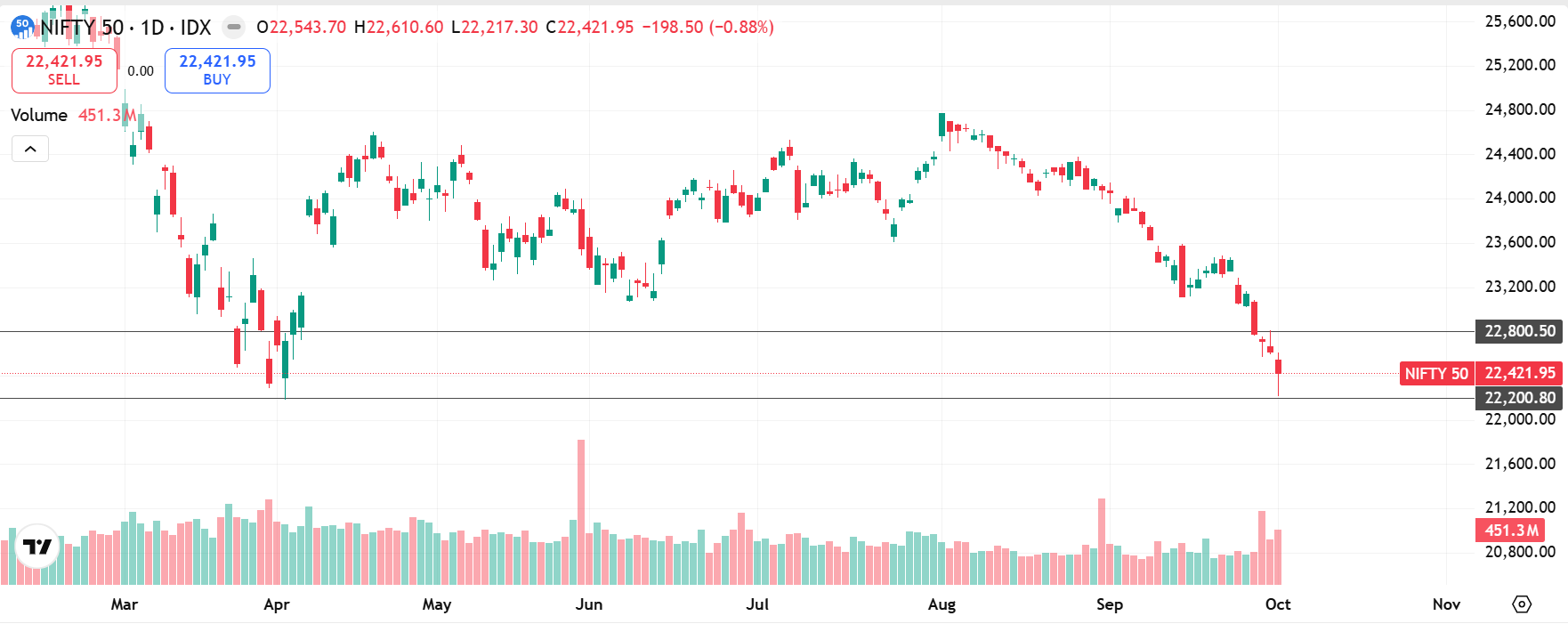
Nifty: 22,421, -0.88%
Sensex: 71,910, -0.79%
Bank Nifty: 54,451, -0.33%
Global Market Movements
GIFT Nifty: GIFT Nifty futures is trading live at 22,603, signaling a flat start for the domestic market today.
US Markets: U.S. stock indexes closed higher on Friday, October 2nd, with Nasdaq closing +1% up, S&P 500 closing +0.70% up.
Asian Markets: Asian markets are trading with mixed to cautious moves today.
Commodities
Brent crude: $101.4/barrel
Brent crude Oil price trades in the range of around $100-101/barrel amid uncertain conditions.
FII & DII Activity
FII: -9,484 crores
DII: +10,041 crores
Net Flow: +557 crores
The Investors Lens
How Do Stocks Get Added or Removed From an Index?
Ever wondered why a company can suddenly become part of the Nifty 50 while another company gets removed? Who actually decides this?
An index is not a fixed basket of stocks. It is regularly reviewed to ensure it continues to represent the market it is designed to track. For the Nifty 50, this review happens twice a year on the last working day of March and September, using predefined eligibility criteria.
So what determines whether a stock gets in?
Factors such as market capitalisation, liquidity, trading frequency, free-float and other index-specific requirements are considered. If an existing constituent no longer meets the criteria and another eligible company qualifies, the index can replace it.
The change doesn’t happen randomly. NSE Indices announces the changes in advance, and Nifty 50 replacements are generally implemented on the last trading day of March and September, with prior notice to market participants.
There is another important point: being added to an index can create additional demand for a stock. Index funds and ETFs that track the index may need to buy the newly added stock, while funds tracking the index may need to sell a stock that is removed.
And it’s not only about additions and removals. Corporate actions such as stock splits, bonuses or rights issues can also require adjustments so that the index value remains continuous and doesn’t artificially jump or fall.
The takeaway:
An index evolves with the market. Companies don’t enter because they are simply “popular”, they enter because they meet the rules. And when a stock enters or exits a major index, the change can create real buying or selling flows beyond the company itself.