
What could happen today?
Indian equity markets are poised for a strong opening today, with sentiment receiving a boost from a sharp retreat in international crude oil prices. GIFT Nifty is trading around 24,305, up 355 points, or 1.48%, signalling the possibility of a substantial gap-up opening for the domestic benchmarks.
Nifty continues to maintain improving bullish momentum, supported by sustained buying interest.The 24,000 psychological level remains an important technical reference. A sustained move above 24,200 could extend the recovery towards 24,400, while a breakout above 24,400 may open the way for further upside.
On the downside, 24,000–23,950 could emerge as an immediate support zone following the anticipated gap-up opening, while 23,750–23,700 remains an important underlying support area.
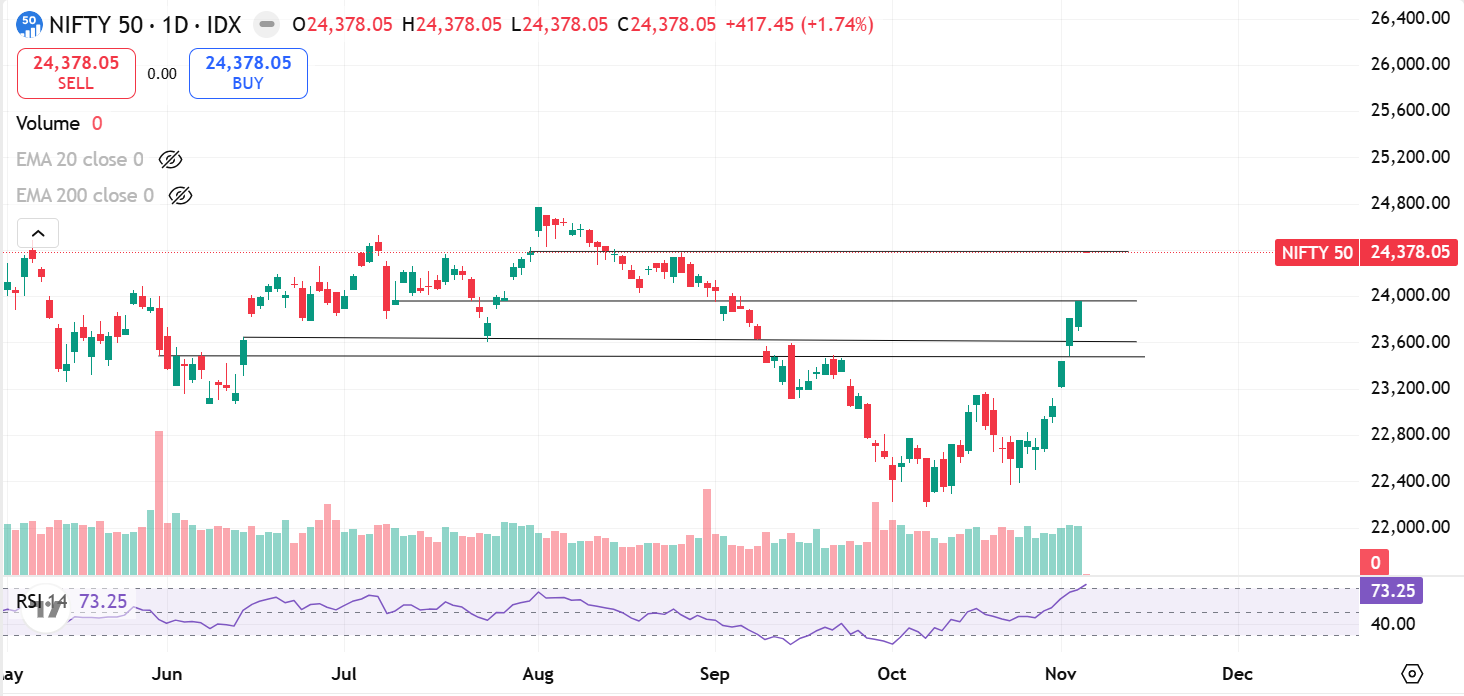
Nifty: 23,960, +1.58%
Sensex: 77,301.40, +0.50%
Bank Nifty: 55,913.60, +0.67%
Global Market Movements
GIFT Nifty: GIFT Nifty futures is currently trading around 24,284, indicating a positive start for Nifty.
US Markets: U.S. stocks surged sharply in yesterday’s (Wednesday, November 4, 2026) session, driven by post-election momentum and a drop in oil prices following the U.S. midterm elections.
Asian Markets: Asian markets trade mixed today as regional indices digest Wall Street’s sharp overnight rally following the U.S. midterm elections with Hang Seng Index (Hong Kong) rising +3.11%, Nikkei 225 (Japan) down -0.38%, KOSPI (South Korea) down -2.95%.
Commodities
Brent Crude: $94.03/barrel
Brent crude falls after US Mid term election and easing peace talks.
FII & DII Acitivity
FII: +7,284 crores
DII: -3,712 crores
Net Flow: +3,572 crores
The Investors Lens
Why Do Markets React to Expectations, Not Just Numbers?
When a stock you own keeps falling, what’s harder: accepting the loss or continuing to hope that it will recover?
Many investors find it difficult to sell a losing stock. They hold on, waiting for the price to return to their buying level so they can exit without a loss. But this mindset can sometimes turn a small loss into a much bigger one.
This is where an important investing principle comes in: knowing when to exit is just as important as knowing when to enter.
Imagine you buy a stock at ₹500, and it falls to ₹400. You’re now sitting on a 20% loss. To recover to ₹500, the stock needs to rise by 25%. If it falls further to ₹300, it would need to gain nearly 67% just to get back to your purchase price.
The deeper the fall, the harder the recovery becomes.
But exiting a stock doesn’t mean selling every investment that declines. A temporary market correction is different from a company whose fundamentals are deteriorating. Before deciding to exit, investors should revisit why they bought the stock in the first place.
Has the business outlook weakened? Are earnings consistently disappointing? Has the original investment thesis changed? Are there better opportunities elsewhere?
If the reasons for owning the stock no longer hold, continuing to wait simply because you don’t want to book a loss may not be the right decision.
The takeaway: Your purchase price is in the past. What matters is whether the stock still deserves your money today. Sometimes, protecting your capital means accepting a loss and moving on.