What could happen today?
Indian equities are likely to stay cautious and under pressure today note with Asian markets seeing the hit and primarily driven by hotter-than-expected US inflation data.
On the downside, 22,500 remains the immediate support level, followed by 22,300 at the broader level. On the upside, 22,800 remains the immediate resistance zone and 23,000 is the broader resistance zone.
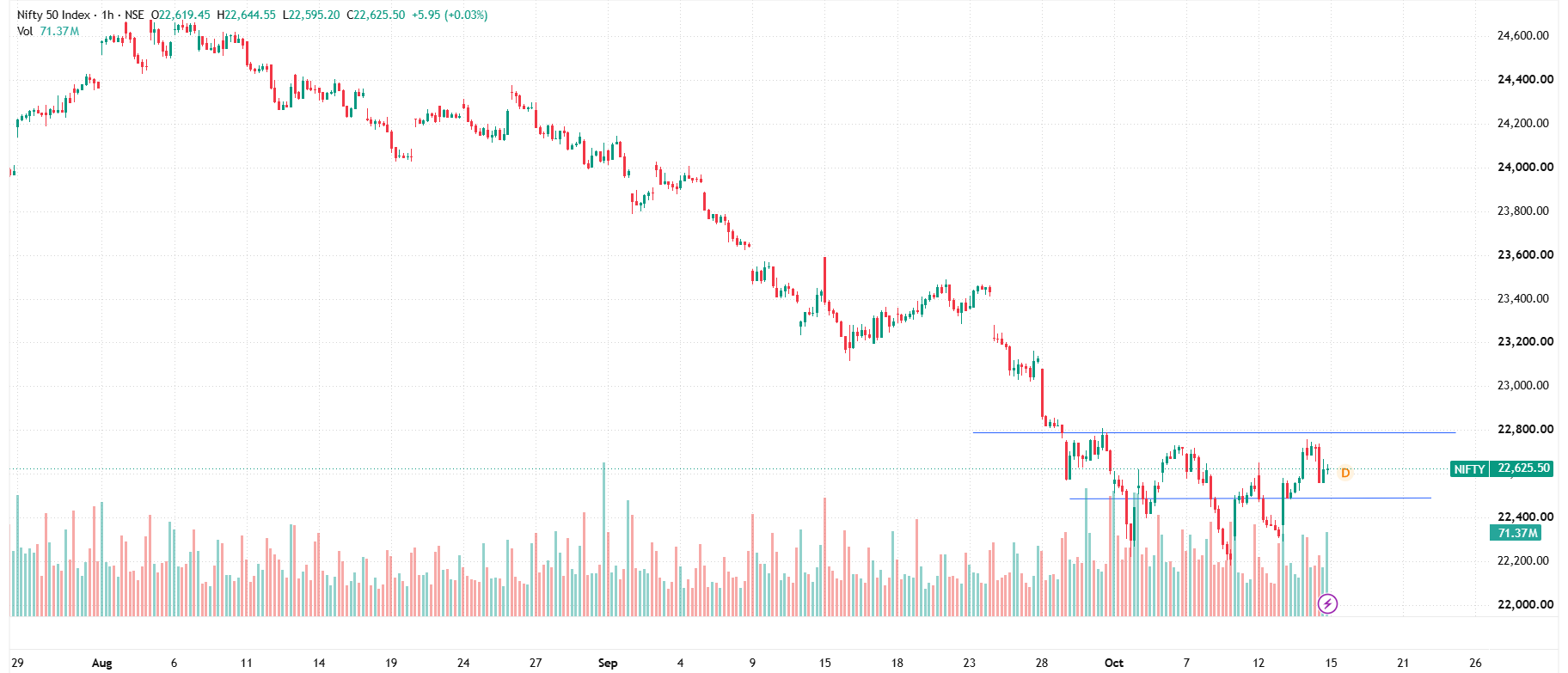
Nifty: 22,622.70, -0.44%
Sensex: 72,781.89, -0.39%
Bank Nifty: 55,316.0, -0.30%
Global Market Movements
GIFT Nifty: GIFT Nifty futures is trading at 22,690, indicating a positive start for the Indian indices.
US Markets: U.S. stock markets closed lower yesterday with Dow Jones down by 0.09%, Nasdaq at -1.88% and S&P 500 down by -1.11%.
Asian Markets: Asian stock markets fell sharply today with Nikkei 225 (Japan) falling by 4.81%, Hang Seng by -0.98% and Kospi (South Korea) fell by 7.87%.
Commodities
Brent crude: $104.3/barrel
Brent crude reclaims the price below $105/barrel despite Middle east concerns.
FII & DII Acitivity
FII: -1,857 crores
DII: +2,670 crores
Net Flow: +813 crores
The Investors Lens
What is Sharpe Ratio?
Sharpe Ratio primarily answers the question, “Are You Getting Enough Return for the Risk You Take?”
Two investments both deliver 15% returns. One experiences wild swings, while the other grows steadily. Which one performed better?
This is where the Sharpe Ratio helps. It measures how much excess return an investment generates for the risk taken, using volatility as a measure of risk.
Sharpe Ratio = (Portfolio Return − Risk-Free Rate) ÷ Standard Deviation of Returns
For example, suppose two investments return 15%, and the risk-free rate is 6%.
- Investment A: Volatility of 10% → Sharpe Ratio = 0.90
- Investment B: Volatility of 15% → Sharpe Ratio = 0.60
Both earned the same return, but Investment A generated more excess return per unit of volatility.
Generally, a higher Sharpe Ratio indicates better risk-adjusted performance over the period measured. However, it should be compared across similar strategies and time periods. It also relies on volatility, which doesn’t capture every kind of risk, such as extreme losses.
The takeaway: Don’t judge an investment only by how much it earns. Ask how much risk it took to earn that return. The goal isn’t just higher returns it’s better returns for the risk you bear.