
What could happen today?
Nifty 50 is poised for a positive, gap-up opening above the 23,100 level, tracking a strong 118-point rally in overnight GIFT Nifty futures.
While yesterday’s 1.66% gain helped Nifty reclaim its short-term 20-day moving average, the overall setup remains a relief rally since the index sits below its 50-day and 200-day moving averages. Sustaining momentum will require broader participation beyond the large-cap stocks that drove yesterday’s bounce.
On the upside, 23,090-23,100 remains the immediate resistance zone and any sustained move beyond it makes 23,300 the broader resistance zone.
On the downside, 22,900 is the immediate support level followed by 23,750 as the next broader support zone.
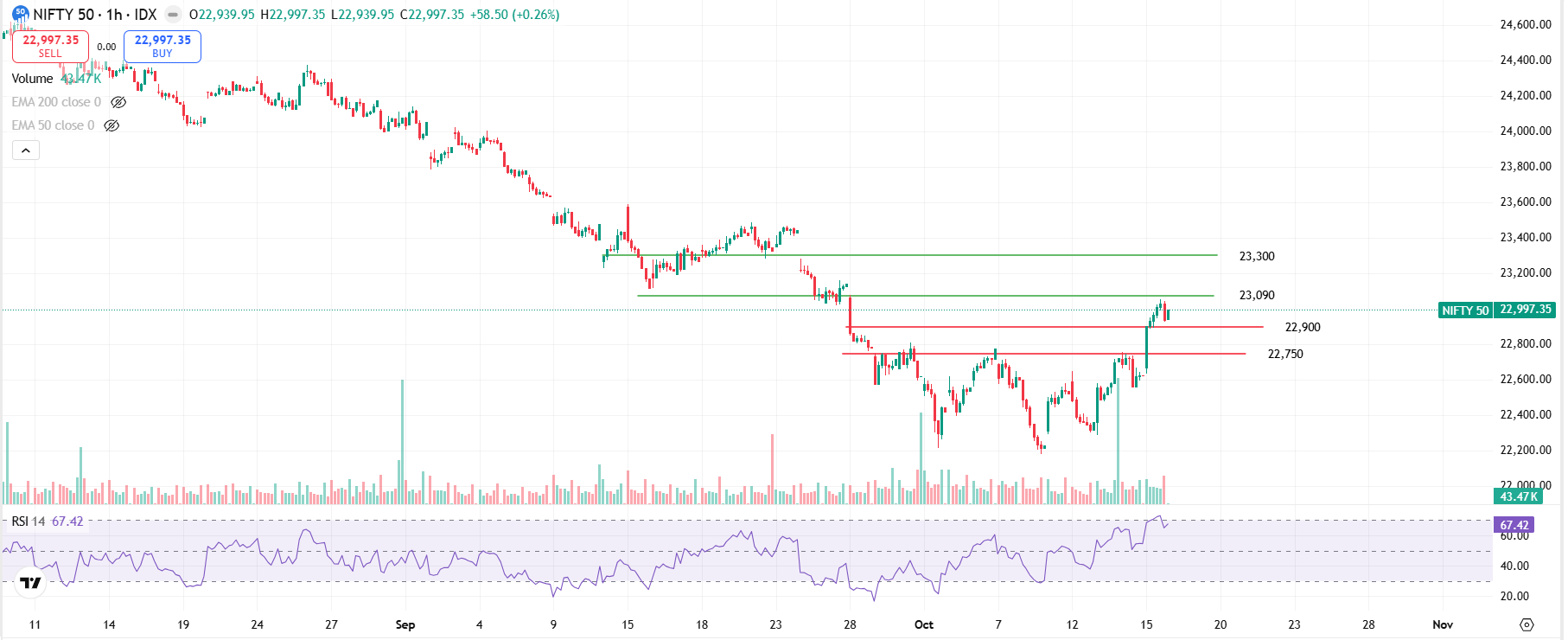
Nifty: 22,997.35, +1.66%
Sensex: 74,315.61, +2.11%
Bank Nifty: 55,810.50, +0.89%
Global Market Movements
GIFT Nifty: The GIFT Nifty is currently trading at 23,106.00, up 118 points or 0.51%, pointing toward a positive opening for the domestic market.
US Markets: US markets finished mixed to higher on Thursday as they rebounded from early tech-driven losses.
Asian Markets: Asian indices broadly rebounded during early Friday trade as chip sector sell-off pressures began to ease.
Commodities
Brent crude: $105.50/barrel
Brent crude oil is currently trading at around $105, down 0.45% in early Asian trade.
FII & DII Acitivity
FII: -5,285 crores
DII: +3,319 crores
Net Flow: -1966 crores
The Investors Lens
FII vs DII, Why does their activity matter?
The market falls even when Indian investors are buying. How? Because not all market participants move in the same direction.
FIIs (Foreign Institutional Investors) are overseas institutions that invest in Indian markets, while DIIs (Domestic Institutional Investors) are Indian institutions such as mutual funds, insurance companies and banks.
When FIIs buy more than they sell, they record net inflows. When they sell more than they buy, they record net outflows. The same logic applies to DIIs.
Why does this matter? Large institutional trades can influence market demand, liquidity and sentiment. For example, heavy FII selling can put pressure on share prices, while DII buying may help absorb some of that selling.
But flows don’t tell the whole story. FIIs may sell because of global interest rates, currency movements or opportunities elsewhere, while DIIs may invest steadily through domestic savings and mutual fund inflows.
The takeaway: Don’t just track who is buying or selling. Track whether FII and DII flows are reinforcing each other or pulling in opposite directions. Their activity offers a useful market signal, but prices still depend on earnings, valuations, global cues and investor expectations.