
What could happen today?
Indian equity markets are likely to remain cautious amid weak following the overnight signals from the U.S. and the Asian markets, that had a technology driven sell-off.
GIFT Nifty futures point to a positive opening for Indian equities, which could be difficult to sustain amid fragile global sentiment and persistent external risks. Participants are likely to remain cautious, with the rising crude prices.
The key levels for Nifty on the upside are 22,850 as the immediate resistance zone followed by the 23,000 zone. On the downside, 22,600 becomes the immediate support zone and 22,500 becomes the next important support level.
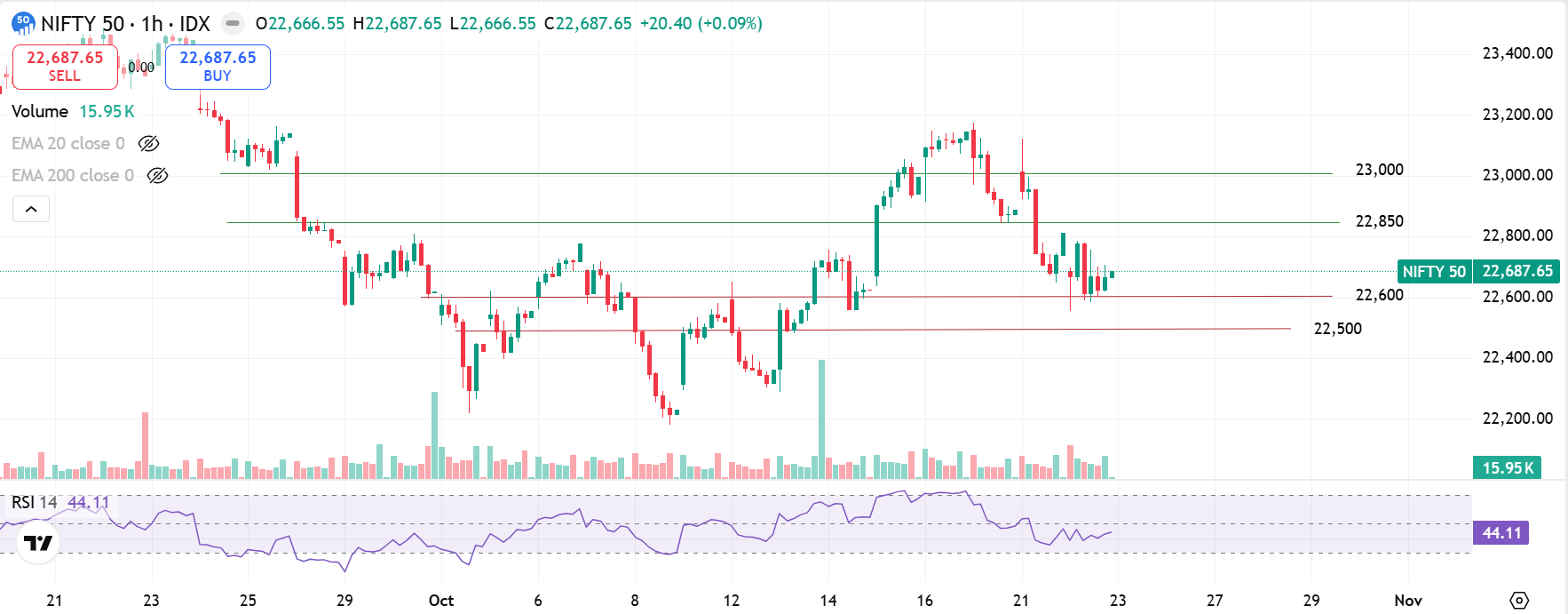
Nifty: 22,687.65, -0.54%
Sensex: 73,249.39, -0.62%
Bank Nifty: 54,925.75 -0.09%
Global Market Movements
GIFT Nifty: GIFT Nifty is currently trading at 22,833, up ~150 points from Nifty’s previous close, pointing towards a positive start for the domestic market.
US Markets: U.S. stock markets closed on a mixed note on Thursday, October 22, with DJI closing +0.02% up and S&P 500 and Nasdaq closing -1.21% and -2.60% down.
Asian Markets: Asian markets declined sharply today, where Kospi (South Korea) fell between 2.5-3.5%, Nikkei 225 (Japan) fell by 0.49%.
Commodities
Brent crude: $113.6/barrel
Brent Crude price climbs above $113 after latest attacks on Saudi Arabia.
FII & DII Acitivity
FII: -3,459 crores
DII: +2,891 crores
Net Flow: -568 crores
The Investors Lens
Why Does Festive Season Matter for Indian Companies?
A festival can mean more than celebrations for a business. It can be one of the most important periods for its annual sales. But which companies benefit, and why?
Festive periods such as Diwali often bring higher consumer spending as households buy vehicles, electronics, clothes, jewellery, homes and everyday products.
But the impact varies by sector:
FMCG: Festive shopping and gifting can lift demand for packaged foods, personal care and household products.
Automobiles: Discounts, new launches and auspicious purchase dates can boost vehicle sales.
Jewellery: Gold purchases often rise around Dhanteras and Diwali.
Consumer durables: TVs, refrigerators and other appliances can see stronger sales.
E-commerce and retail: Festive offers can drive higher order volumes, although heavy discounts may squeeze margins.
Hotels, travel and restaurants: Holidays and family gatherings can support bookings and spending.
For investors, the key is not simply whether sales rise. They need to check whether higher sales translate into better profits. Discounts, advertising costs, inventory buildup and supply-chain expenses can eat into the festive boost.
The takeaway: Festive demand can create a seasonal tailwind, but it doesn’t benefit every company equally. Look beyond the sales headline: the real question is whether festive spending drives profitable growth and whether that growth lasts after the celebrations end.