After spending more than three decades in the markets, ICICI’s Chief Investment Officer, Sankaran Naren has seen bull markets, crashes, bubbles, euphoric rallies and painful corrections.
And what makes his investing philosophy interesting isn’t just what he invests in.
It’s how he thinks about making decisions.
Here are a few lessons from his experience that would genuinely help you.
1. You are going to make mistakes. Build a process that helps you learn from them.
Naren makes a very important point: investing is not a zero-mistake game.
Even the best investors make mistakes.
The real question is what you do after one.
Most investors lose money on a stock and immediately ask: “Should I hold or sell?”
A better question is: “Why was I wrong?”
Was the business worse than you expected?
Did you overpay?
Did you ignore a risk?
Did the investment thesis change?
Or did nothing fundamentally change and the price simply move against you?
Those are very different situations.
The lesson: Don’t just track your returns. Track your decisions.
After a bad investment, write down:
-
Why did I buy?
-
What did I expect to happen?
-
What actually happened?
-
What did I miss?
-
Would I make the same decision today?
That’s how a mistake becomes useful.
Naren’s point isn’t that you should never be wrong.
It’s that you should avoid making the same mistake repeatedly.
2. Buying is easy. Your exit plan is where the real thinking begins.
This is one of Naren’s most interesting observations: buying is actually the easiest part of investing.
And if you think about it, he’s right.
A stock looks attractive.
You research it.
You like the business.
You buy it.
Done.
But what happens six months later?
The stock is up 40%.
Do you sell?
Hold?
Buy more?
The market crashes 20%.
Do you still believe in the business?
The company’s earnings disappoint.
Has your thesis changed?
These are the decisions that actually determine whether your original idea works.
The lesson:
Don’t buy an investment without defining what would make you change your mind.
Before you buy, answer:
What would make me sell this?
If you can’t answer that, you may have a reason to buy — but you don’t yet have an investment process.
3. Asset allocation is not about predicting the future. It’s about not becoming overconfident in the present.
This is where Naren’s experience with market cycles becomes particularly useful.
His observation is simple:
When something performs extremely well, investors want more of it.
When something performs badly, investors want less of it.
That’s how you end up with what he calls reverse asset allocation — increasing exposure to what has already become popular and expensive, while moving away from what has become unpopular.
Think about what happens after a spectacular bull run.
Your equity allocation grows.
You feel richer.
Everyone around you is talking about stocks.
And suddenly, reducing equity feels like a stupid decision.
But that’s precisely when you need to ask:
“Has my portfolio become riskier simply because the things I own have gone up?”
The lesson:
Don’t let your portfolio allocation be decided by whatever performed best recently.
Set an allocation.
Review it periodically.
Rebalance when it moves too far away from what you originally intended.
You don’t need to predict which asset will perform best next.
You just need to avoid becoming excessively dependent on the one that performed best yesterday.
4. Markets move in cycles. Your strategy should account for that.
Naren’s investment philosophy places a lot of importance on cycles.
And you don’t need to be a fund manager to use that idea.
When a sector is euphoric, ask:
What would have to go right for today’s valuation to make sense?
When a sector is deeply unpopular, ask:
What would have to go right for today’s valuation to look cheap in hindsight?
You won’t always get the answer right.
Naren himself describes determining where you are in a cycle as an art, not an exact science.
But simply asking the question changes how you invest.
The lesson:
Don’t ask only, “Is this a good company?”
Also ask:
“What part of the market cycle am I buying it in?”
A great company bought at the wrong price can still be a poor investment.
5. You don’t need to act every day. In fact, some of the best opportunities require patience.
This might be one of the most counterintuitive lessons.
Naren argues that extreme opportunities don’t come around every week.
They can be years apart.
He points to periods such as 2002, 2008 and March 2020 as examples of extreme market opportunities.
The mistake investors make is trying to behave as though every day is an opportunity.
They buy.
Sell.
Switch.
Rebalance.
Chase.
Exit.
Re-enter.
And eventually, activity starts replacing strategy.
The lesson:
Don’t confuse activity with progress.
Ask yourself:
“Has something fundamentally changed, or do I just feel like I should do something?”
Sometimes the correct investment decision is to act.
Sometimes it’s to wait.
And sometimes it’s to do absolutely nothing.
And this is where systematic investing becomes interesting.
Look at the common thread across all these lessons.
The difficult part of investing isn’t knowing what you should do.
It’s doing it consistently.
You know you shouldn’t chase something just because it has gone up.
You know you shouldn’t panic because the market has fallen.
You know you should diversify.
You know you should review your decisions.
You know you shouldn’t constantly change your strategy.
But knowing something and consistently doing it are two very different things.
That’s where a systematic approach has an advantage.
Not because it can predict the market.
Not because it eliminates mistakes.
And certainly not because it guarantees higher returns.
But because it can turn good intentions into rules.
Instead of asking yourself every time:
“Should I buy?”
“Should I sell?”
“Should I rebalance?”
“Should I change my allocation?”
You define the conditions beforehand.
If X happens → do Y.
That removes one of the biggest problems in investing:
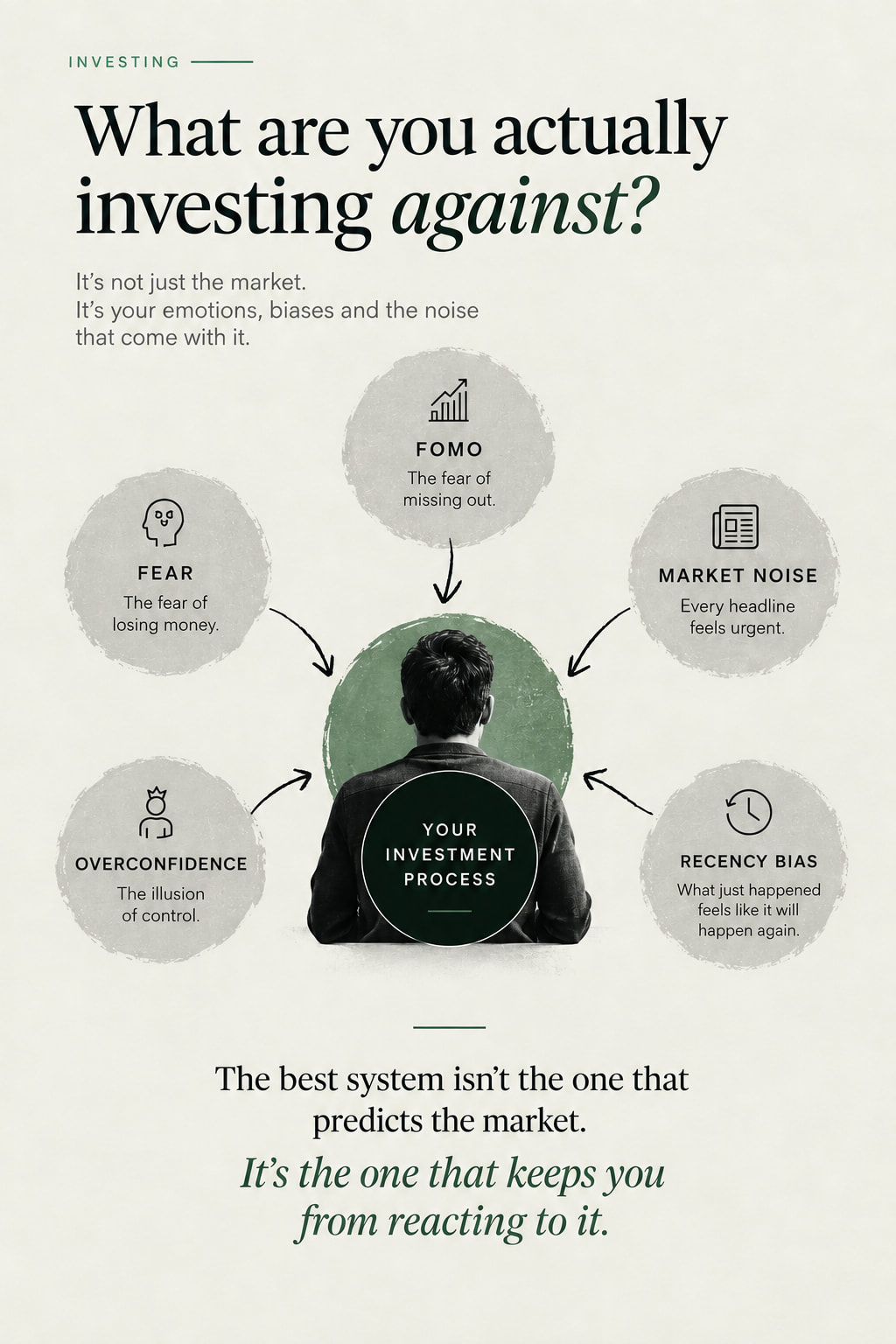
having to make an emotional decision at the exact moment when emotions are strongest.
And that’s why I think the biggest long-term advantage of systematic investing isn’t really better prediction.
It’s better consistency.
Because over 10, 20 or 30 years, you aren’t going to make one investment decision.
You’re going to make hundreds.
And the investor who can make reasonably good decisions consistently may have a much bigger advantage than the investor who occasionally makes a brilliant one.
You don’t need to predict every market cycle.
You need a process that can survive them.
That’s perhaps the most useful takeaway from decades in the market:
Don’t build an investment strategy that depends on you being rational every single day.
**Build one that still works when you’re not.
**