ALGO SPOTLIGHT #18 | Value Guard
NSE | Equity Investing | Value + Quality with Trailing Stops
This is an investing algo. No daily trades, no options, no expiry stress. It holds a focused portfolio of fundamentally sound companies and protects each one with its own safety net.

What is it?
Cheap stocks aren’t always good investments. Some are cheap because the business is in trouble, and some keep getting cheaper. Great businesses, on the other hand, are often too expensive to buy with a margin of safety.
Value Guard looks for, financially sound companies that are still attractively valued.
It starts with a safety screen:
- Companies must be above a minimum size
- They must pass a debt-quality test based on the past year
- Their reserves must be comfortably above their capital
- Only actively tradable NSE equity stocks make the list
Only companies that clear the screen get considered. The algo then asks which of them offer the best value.
How are stocks picked?
The companies that pass the screen are ranked in a fixed order of priority:
-
Value: the more attractively valued a company is, the higher it ranks
-
Quality: used as the next differentiator, so between companies with similar value, the higher-quality one ranks higher
So, the algo prefers inexpensive companies first and uses quality to separate them. Because the safety screen comes first, “inexpensive” is only considered among companies that already look financially sound.
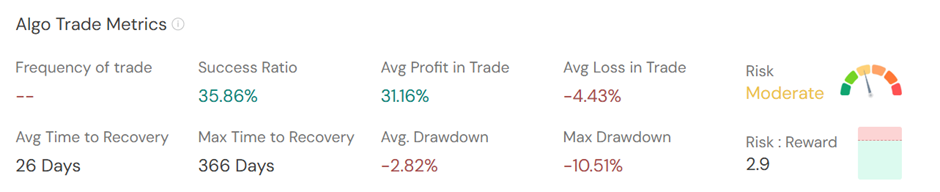
What does the portfolio look like?
- A focused portfolio of roughly 12 stocks, equal weighted (a little over 8% each)
- Fewer holdings than a typical diversified basket, so each stock matters more
- If your capital is too small to buy even one share of a stock, that portion isn’t forced in. It is parked in LIQUIDBEES (a liquid ETF)
- Minimum capital: ₹1 lakh
How does rebalancing work?
Fundamentals are refreshed and the portfolio is reviewed once every quarter, in January, April, July and October. Only one rebalance happens in a review month.
To avoid churning stocks that have only slipped slightly, there is a buffer. A stock already in your portfolio gets some extra room to stay even if it drops a few places in the ranking, while new stocks have to rank near the top to get in.
Because of this buffer, you may sometimes see slightly more than 12 stocks in your portfolio after a rebalance. That’s by design, not an error. All holdings are equal weighted again after each review.
The “Guard”: how each stock is protected
This is what makes Value Guard different from a plain value strategy. Value investing can mean owning stocks that look cheap and keep falling, and Value Guard doesn’t leave that unchecked between reviews.
Every day, the algo checks each holding against a trailing stop, based on the highest weekly high the stock has reached.
- The stop sits a fixed percentage below that peak
- As the stock rises, the stop rises with it
- The stop never moves down
- The check uses the opening price of the latest session, not intraday dips, so a brief spike down during the day doesn’t trigger a sale
The money from a stopped-out stock moves to LIQUIDBEES and stays there until the next quarterly review, when the portfolio is rebuilt. If every holding gets stopped out, the algo can start a fresh selection instead of sitting empty.
Things to remember
- This is a value strategy, so it behaves slowly in strong momentum-driven or growth-led markets
- Value stocks can stay cheap for long stretches. Give it time to play out
- The stop is checked on the opening price, so after a gap down the actual exit price can differ from the stop level
- Cash sits in LIQUIDBEES between a stop-out and the next review, so part of your capital may not be invested at times
- With ~12 stocks, individual holdings carry more weight than in a broad basket
Who is this for?
- Investors who want value investing with a financial-health filter
- People who like a defined downside plan for each stock instead of “hold and hope”
- Anyone building a long-term equity layer to run alongside their F&O algos. It’s patient, equity-based and independent of your daily trading P&L
Available on Stratzy. Deploy it, let it run, and check your portfolio after each quarterly review or whenever a stop is triggered.
Community Discussion:
Do you prefer buying quality at a fair price, or buying cheap and managing the risk? And how do you handle stop-losses in your own investing: strict rule, or case by case? Share below!