Diversification Isn't Just a Correlation Number, Why Low Correlation Algos Can Still Lose Together

Dear Algo Traders,

Over the last few weeks, three questions have kept coming up in this community, in DMs and with our support team:

  1. If these algos have low correlation, why did they take the same trade?

  2. When the market is clearly falling or rising, why does the algo go the other way?

  3. Why does it feel like everyone is losing at the same time?

These are fair questions, and you deserve a proper answer in one place rather than scattered across threads. We are listening, so here is the full picture.

First, where capital sits today

Out of all the algos live on Stratzy, a lot of people are deploying into the same few, such as Zen Credit Spread Overnight, Ratio-Fluxer Credit Spread Expiry, Curvature Credit Spread Overnight and Damper Credit Spread. All of these are credit spreads.

These are good algos and they are popular for a reason. But it means a very large number of portfolios look alike, and that explains most of what follows.

1. Low correlation, but the same trade. Why?

Correlation tells you how the daily P&L of two algos has moved together over a long period. A correlation of 0.1 means that over time their results were mostly unrelated. It does not mean they take opposite trades every day. Over a long horizon they take mostly different trades, but on any given day they can overlap.

A few things worth keeping in mind:

  • Correlation is an average. In a sharp market move, algos of the same type tend to move together more than their historical average suggests.

  • Same category means same underlying risk. Credit spreads earn when the market does not move far against the position and lose when it does. Different entry logic helps, but the payoff shape is the same.

  • Look beyond the top of the list. In Combine Other Algos, the ones you see first pair a low correlation with a good algo score. Scroll further and you will also find algos with negative correlation, which fewer people choose.
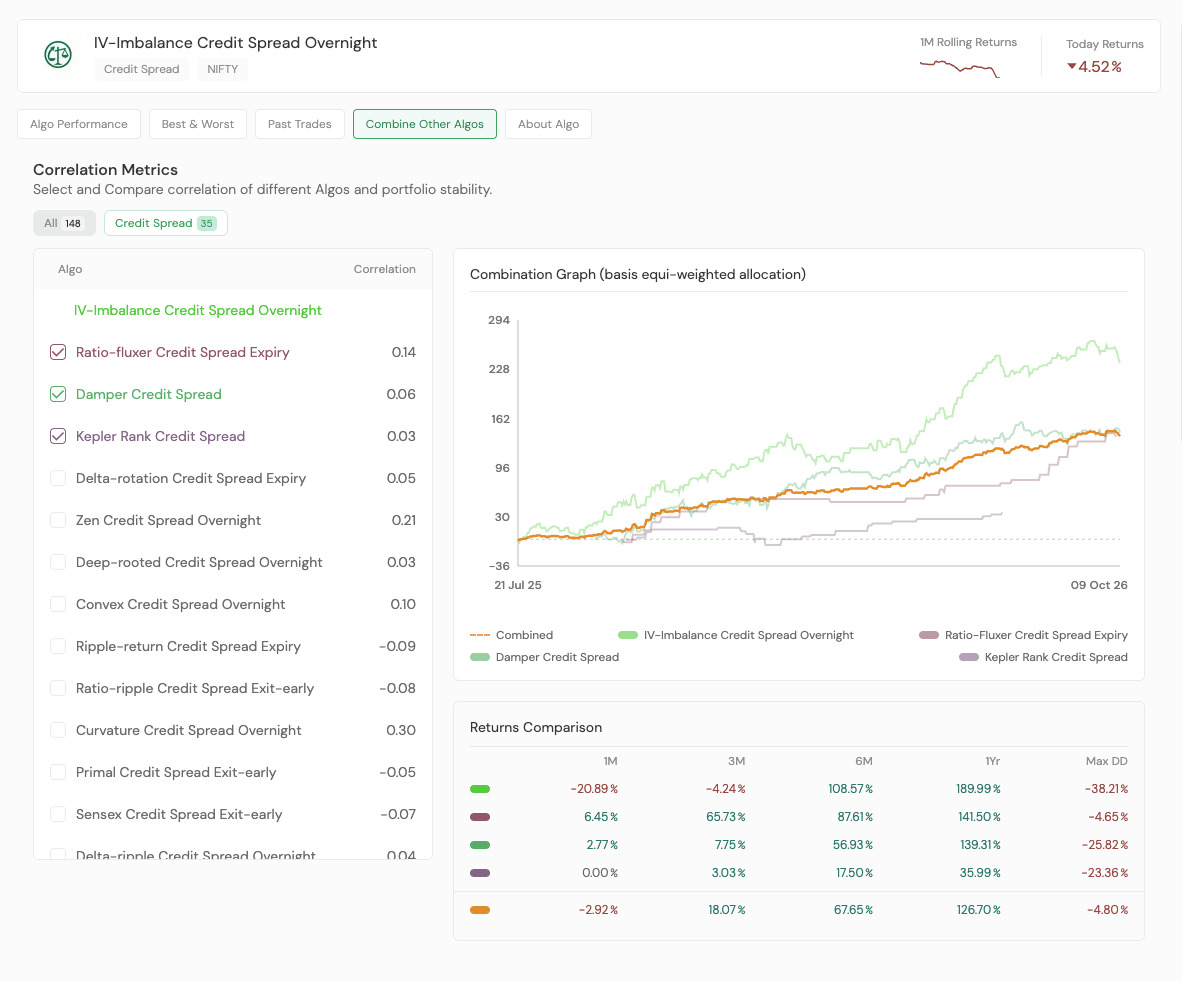
Spreading across low correlation algos still helps a lot. Here is what the Combine Other Algos screen shows for IV-Imbalance Credit Spread Overnight combined equally with three other credit spreads:

Algo 1M return Max drawdown
IV-Imbalance Credit Spread Overnight -20.89% -38.21%
Ratio-Fluxer Credit Spread Expiry 6.45% -4.65%
Damper Credit Spread 2.77% -25.82%
Kepler Rank Credit Spread 0.00% -23.36%
Equal weighted combination -2.92% -4.80%

Same month, very different outcomes for each algo, and a combination that is far smoother than the most volatile one. But all four are still credit spreads, which is why the next layer matters.

The next layer: diversify across categories

Real diversification is not only about uncorrelated credit spreads. It is about owning different kinds of return:

  • Credit spreads: directional exposure that the algo manages for you.

  • Straddles and strangles: non-directional, earning from time decay when markets stay in a range.

  • Options buying: a smaller allocation that can pay off when the market moves sharply, which is usually when the rest of the book struggles.

  • Investing algos: a different source of returns altogether, which we are bringing soon. Join the waitlist.

In our earlier post, Which algo trading strategy should you deploy?, we shared a regime based way of thinking about this for larger capital: most of the book in non-directional, a smaller share in directional credit spreads, and a small allocation to options buying. It is not a fixed formula or personal advice, but it is worth comparing against your own mix. If you are on our annual plan, your dedicated wealth manager can review it with you.

2. The market is obviously falling. Why is the algo going the other way?

Because the chart you are looking at is a chart of the past. After the fall, it looks like a clean line. At 9:45 am the same day, it was one of several possible paths.

An algo is not a view on today’s chart. It is a rule set that was tested across many data variables and market regimes, trending, sideways, calm and volatile, and its edge shows up over many trades, not on a single day. Many structures, credit spreads included, do not need the market to move in their favour. They need it not to move far against them. So a trade that looks wrong to the naked eye can still be exactly within design.

This is also why stepping in manually works against you. When we cut the trades that look wrong today and keep the ones that look right, we are no longer running the tested system, and we quietly change our own risk and reward without any rule behind it. If you want your own limits, Algo Triggers lets you set profit, loss and time based exits with rules, instead of a click in the middle of a stressful day.

3. Why is everyone losing at the same time?

Mostly because most portfolios hold the same few algos. When most people are deploying into a handful of algos (Zen, IV Imbalance) from the same category, a tough stretch for that category is felt by almost every account at once.

It does not mean every algo is struggling. In the table above, Ratio-Fluxer shows 6.45% over 1M while IV-Imbalance shows -20.89%. There are algos in other categories taking profitable trades on the same days. They just are not where most of the capital is.

Everyone losing together is a sign of overlapping portfolios, not proof that algos do not work. The fix is diversification across categories, not moving to the next popular algo.

Think in years, and plan for red months

Algos should be judged over a long horizon, quarters and years, not days or a single month. Plan for the fact that in a typical year, around 4 out of 12 months can be drawdown months. It could be fewer, it could be more, and they can come back to back or hit several of your algos at once. We operate in uncertainty, and nobody, including us, can tell you which months those will be.

What we can do is build the process so that no single algo, category or month decides your year. That only works if you stay with the process through the red months, because the edge sits in the whole run and not in any one month.

We are listening

This post exists because of your questions. If anything in the Combine Other Algos screen made this harder to read, tell us in the comments, it directly shapes what we build next. And if you have questions about your own mix, drop them below and I will go deeper.

2 Likes

Agree with lot of what you said. However that does bring up two things :

  1. Lot of uses have wealth managers allocated and portfolio created is with their recommendation. Incase it has to be more diversified then wealth managers should help it. Lot of people have invested in credit spreads because typically they have had best results in past but seeing the streak of losing days it does bring a doubt in mind if strategy is losing edge

  2. While I respect what historical data shows for algos, it does not mean they are perfect. If lot of them seem to be taking wrong entry and exit then review should be done and it won’t hurt a lot to explain in webinar or something to take example of a day and few algos to explain what prompted it to take trade other way round. I think it will help everyone understand and also will give creators an opportunity to review the algos. Since new algos are coming up , I am not sure if existing algos are being reviewed regularly.

Regards

Shashank

1 Like

While I completely understand and respect that algorithmic models rely on a strict framework of predefined entry and exit rules, there comes a point where rigid technical logic must account for undeniable market realities.

Currently, the algorithm is executing positions that run directly opposite to a powerful, sustained market trend, one that is clearly visible to the naked eye. When a macro trend or strong structural momentum is this obvious, it raises a critical question for the product and investment teams: What underlying metrics or lagging indicators are driving the algo to fight the prevailing market force, rather than capitalizing on it?

Simply justifying these moves by stating that the system is ‘following its rules’ isn’t enough when those very rules are forcing it to trade against obvious momentum. I strongly urge the Stratzy team to proactively reassess the current parameters of this strategy. We need to ensure that the logic is dynamic enough to adapt to clear, real-time market shifts rather than blindly bucking the trend."

1 Like

Hi Shashank, thank you for the thoughtful read. Both points are fair, so let me take them one at a time.

1. Wealth manager allocations and whether the edge is fading

Wealth managers advise based on each person’s portfolio, and there is no common advice that fits everyone. Some investors ask for conservative algos, some for aggressive ones, and the capital they want to deploy deserves equal attention. That is why it is good to revisit your portfolio with your wealth manager at regular intervals, and the category split is worth raising specifically, not only individual algos. Credit spreads were a natural choice for many because of their track record, and that is also why a lot of portfolios ended up looking alike. I will take this feedback back to our wealth manager team.

On whether the strategy is losing its edge, edge decay is real for any strategy, so the useful test is this: is the current drawdown inside the range seen historically, or outside it? A losing streak of days or even a bad month that sits inside the historical range is uncomfortable but expected. Repeatedly going outside that range is the signal that an algo needs a proper review. We monitor all algos and their ranges, and there are systems in place for exactly this.

2. Why an algo took a particular trade

Agreed that historical data does not make an algo perfect, and on any given day an entry can turn out wrong. But explaining why an algo took this long trade or that short trade on a particular day is not how quantitative trading works. The market is uncertain and every day has its own unique circumstances, so an algo is not a story behind each trade. It is a rule set whose edge shows up over many trades, which is why we judge it by how it behaves over a long run and within its historical range, not by single entries.

All the algos on Stratzy are black box algos built by our own internal quant and research team. What we can do is help you understand them better. We will plan group webinars that walk through the different algos, what each is designed to do, and the risks that come with directional algos in particular, so you know what to expect in different market conditions.

Appreciate you pushing on this.

Hi Dinesh, thank you for putting this across so clearly. Your frustration is understandable, especially when a move looks obvious on the chart and your positions are sitting on the other side of it.

Here is how we look at it. Nobody knows how the market will perform from here, not us, not the algos, and not any trader looking at the same chart. A trend that looks undeniable today can pause or reverse sharply tomorrow, and the same trend can also keep running for days. The obvious direction is mostly visible in hindsight. That is why our algos are not built on a call about where the market goes next. They are built on rules tested across many market conditions, including strong trends like this one, and judged over a long run rather than on a single stretch.

It is also why stepping in changes the purpose. The moment an algo is overridden or reshaped around what looks obvious right now, it stops being the tested system, and the results you see in its track record no longer describe your account. We also monitor all algos and their historical ranges, so there are systems in place to catch an algo that behaves outside what is expected.

That said, I do understand that some phases feel uncomfortable to trade through. If you feel the market is not good to trade, or is extremely volatile, the cleanest option is to take a pause on the algos for that period rather than adjusting individual trades. That keeps the decision in your hands without breaking how the algos are designed to work.

Your feedback is noted, and we will keep working on helping everyone understand the algos better, including group webinars on how each algo is designed and the risks that come with directional algos. Appreciate you raising this openly.

1 Like

Thanks, Nikhil for addressing my queries. Look forward to the invites when you have.

1 Like

Dear Mr. Nikhil,

Whatever you have explained is understandable, and we respect the logic behind your algo strategy. We are hoping for the best and looking forward to better days ahead.

However, our concern is that when you advise us to pause the strategy for some time, those very days could turn out to be among the most profitable ones. If the strategy generates good profits or helps recover our previous losses during the paused period, we may end up missing those opportunities, which would naturally be disappointing.

Another concern is regarding the daily and monthly P&L scoreboards. Earlier, you used to share the daily overall P&L as well as the individual subscribers’ performance on a daily and monthly basis. Why has this practice stopped? As subscribers, we would like to understand how the strategy is performing, whether in profit or loss. Seeing transparent and consistent performance updates would help us understand the situation and maintain confidence in the strategy we have chosen.

Also, I would suggest excluding the P&L figures of subscribers who have manually intervened in the strategy, so that the scoreboard reflects the actual performance of those following the algo without manual intervention.

During challenging market conditions like these, we believe open communication is especially important. Regular updates, honest discussions, and perhaps explanatory or live videos from your side would go a long way toward reassuring subscribers and strengthening their confidence.

I hope you understand the genuine concerns of your subscribers. We are not questioning your efforts; we simply expect transparency, communication, and clarity during difficult times.

Hoping for the best and looking forward to better days ahead.

3 Likes

Just a suggestion from my end if it helps. Maybe we could add classification within category (credit spread, option buying, etc). Classification could be trend following, mean reversion, pure execution (VWAP, TWAP), etc. This would help to pause mean reversion algos and switch to trend following if there is a clear trend observed by the user and at his discretion. Allocating capital across non-correlated categories should be the goal as pointed out, but this could potentially also help to select algos with different execution style within same category.

2 Likes