Imagine you’ve been running an algo for six months. It’s been profitable, the returns look good, and you’ve started trusting the strategy.
Then comes a bad month.
The P&L turns red. The drawdown deepens. Suddenly, you’re wondering whether the algo has stopped working, whether you picked the wrong strategy, or whether you should switch to something else.
But here’s the thing: a bad month doesn’t automatically mean a bad algo.
1. Every algo has market conditions it struggles with
An algo is designed to capture a particular market behaviour. And no market behaviour persists indefinitely.
Consider a few examples:
-
Credit spreads: These strategies can benefit from time decay and markets staying within a favourable range. But a sharp directional move or a volatility spike can lead to significant losses.
-
Options buying: These strategies can benefit from strong price movements, but sideways markets and time decay can erode premiums even when the underlying moves slightly in the expected direction.
-
Mean-reversion strategies: These look for prices to return towards their average. But when a strong trend develops, prices can continue moving away from that average for longer than expected.
-
Momentum strategies: These can perform well during sustained trends but struggle when breakouts fail or the market repeatedly changes direction.
Each strategy has a different way of making money. And each has conditions in which that edge becomes less effective.
The same conditions that make an algo profitable in one month can be absent in the next.
2. A losing month is not necessarily a failing strategy
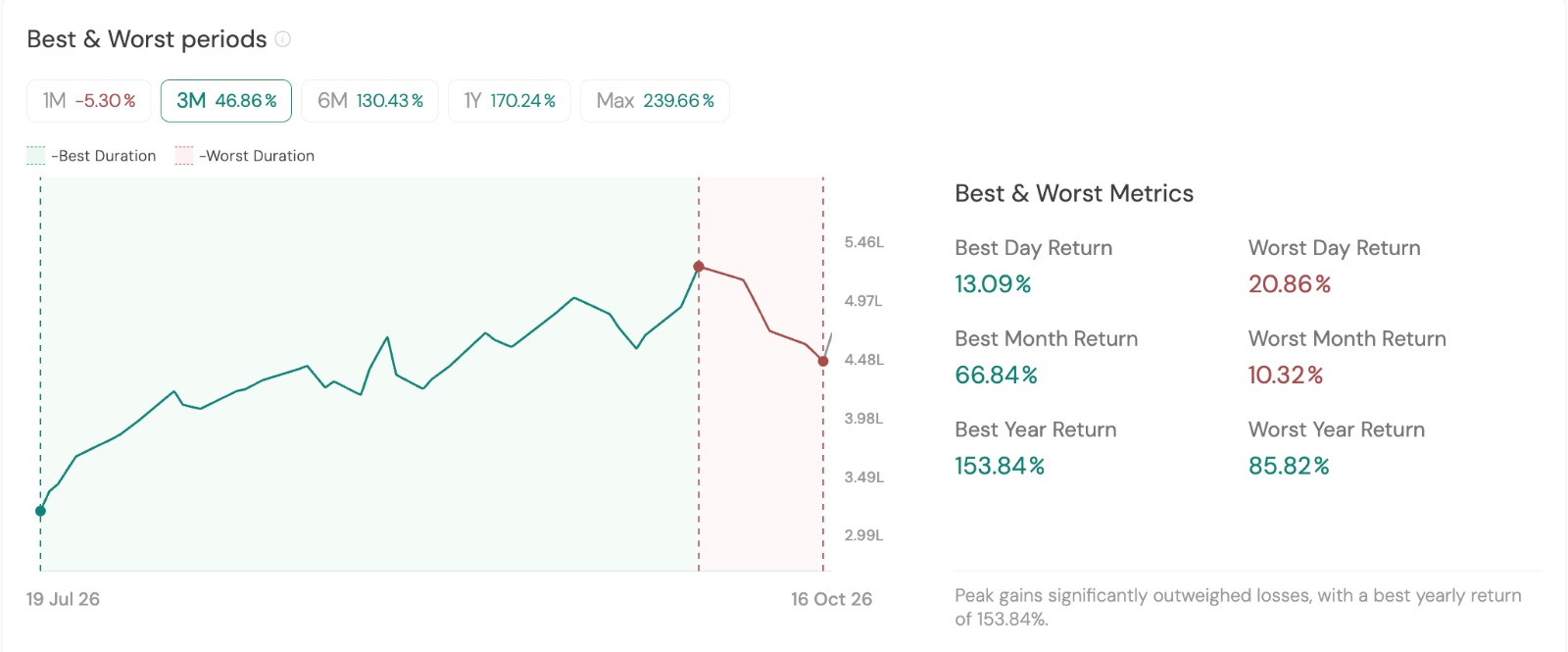
Let’s say an algo has delivered positive returns over several years, but its historical performance includes a few losing months

Can you guess the above strategy on stratzy.in?
Anyway, that alone doesn’t make the strategy unreliable. Losing periods are a natural possibility in any probabilistic trading system.
What matters is the context.
Is the drawdown within the range the strategy has historically experienced? Is its performance consistent with its underlying logic? Are its losses within your risk tolerance? Has its behaviour changed materially, or is it going through a difficult but plausible period?
These are much more useful questions than simply asking whether the algo made money this month.
Of course, a bad month shouldn’t automatically be dismissed either. Drawdowns that exceed historical expectations, persistent deterioration in performance, or changes in market behaviour may warrant a closer review.
The point is not to ignore losses. It’s to evaluate them properly instead of reacting to every red patch.
3. Stop expecting one algo to perform in every market
One of the biggest mistakes traders make is expecting a single strategy to deliver consistent returns month after month.
When it struggles, they abandon it for another algo that has recently performed well. But that new algo has its own weaknesses, and the same cycle can repeat.
Instead of searching for the one perfect algo, think about how different strategies behave across market conditions.
A strategy that struggles during a sharp market move may have different strengths and weaknesses from one that benefits from strong directional movement. Understanding these differences can help you build a more balanced portfolio.
This doesn’t mean every combination will reduce risk. The strategies’ actual return patterns, underlying exposures and allocations matter.
The takeaway
No algo wins every trade. No algo performs equally well in every market regime. And no algo is immune to drawdowns.
The goal is to understand how a strategy works, what conditions it struggles in, and whether its risk and performance remain acceptable over time.
Don’t judge an algo only by its best month or abandon it solely because of its worst one. Understand the strategy, understand its risks, and evaluate the bigger picture.
If you’re running multiple algos, there’s another important question to consider: are your strategies genuinely diversifying your portfolio, or are they exposed to the same risks despite having low historical correlation?
You need to explored this in detail in our community post, Diversification Isn’t Just a Correlation Number: Why Low-Correlation Algos Can Still Lose Together.
Thoughts?