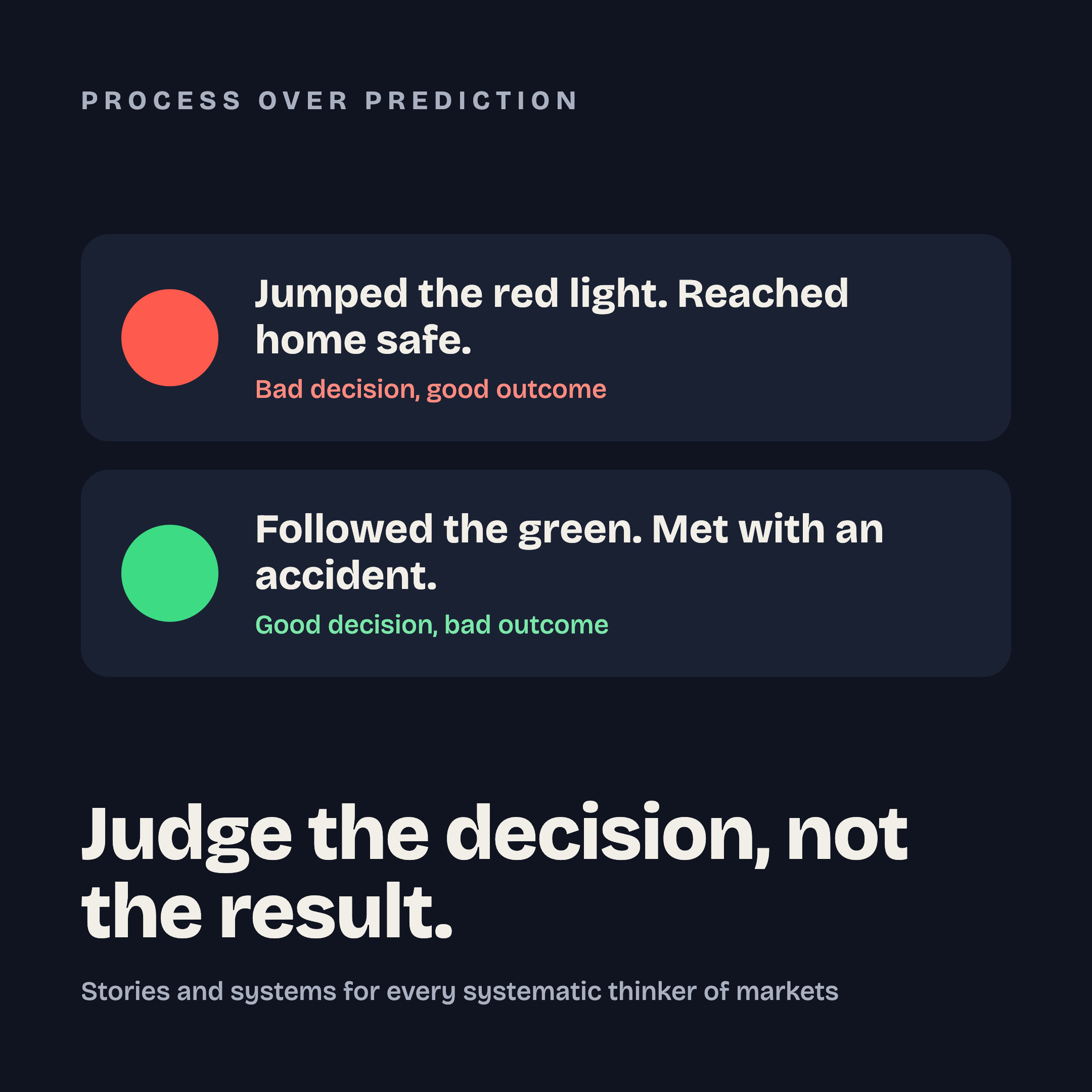
Jumped the red light. Reached home safe. Bad decision, good outcome.
Followed the green. Met with an accident. Good decision, bad outcome.
Nobody would call the first driver smart, and nobody would blame the second one for stopping at the signal. On the road, we understand instinctively that decisions and outcomes are two different things. In markets, we forget this all the time.
We judge trades by their result
A trade makes money, and we call it smart. A trade loses, and we call it a mistake. But a result only tells you what happened. It does not tell you whether the thinking behind it was sound.
Poker players have a name for this mistake. Annie Duke calls it “resulting”, the habit of judging a decision by how it turned out. It is why a good player can make every right decision and still lose a session, and a weak player can get lucky and walk out a winner, convinced they played well.
That second case is the dangerous one. A bad process that happens to win teaches you the wrong lesson, and the market usually collects the bill later.
What you can control
Nobody can predict which trade will go wrong. What you can control is the process: rules decided in advance, followed every time, with the understanding that luck will not always be on your side.
A simple way to judge any decision, separate from its P&L:
-
Was the rule decided in advance, or invented in the moment?
-
Did I follow it?
-
Was the size something I could afford to lose?
-
Is the idea backed by long run evidence, or by what happened this week?
If the answers are yes, a loss is just the cost of doing business. If they are no, a win is just luck you should not repeat.
The trap markets add: recency bias
To the naked eye, the recent past always looks like the future. A few calm weeks and we feel safe. A few falling weeks and it feels like it will never end. Recency bias is natural, and it is expensive. It is also why people reshape their portfolios at exactly the wrong moments, after the damage is done and before the recovery.
In my last post here, Tough Times for Markets, and for Us, I wrote about what rising volatility does to this feeling. A system does not carry that bias. It does not care how last week felt.
Something I want to keep exploring
How to think about markets systematically is a big topic, and I want to keep going deeper into it here. Stories, systems and doubts, all welcome. We all learn faster that way.
Share your story in the comments, including what you would judge differently once you take the outcome out of the picture.