India’s steel sector is gearing up for the future!
The National Steel Policy aims to boost domestic steel consumption, improve steel quality, and make India’s steel industry globally competitive.
A key part of this vision is ensuring a reliable supply of essential raw materials needed to support the sector’s long-term growth.
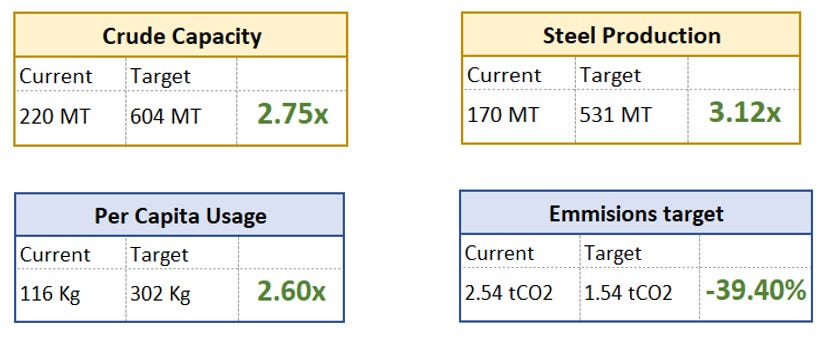
Key Metrics and Projections (Present vs. 2047 Target)
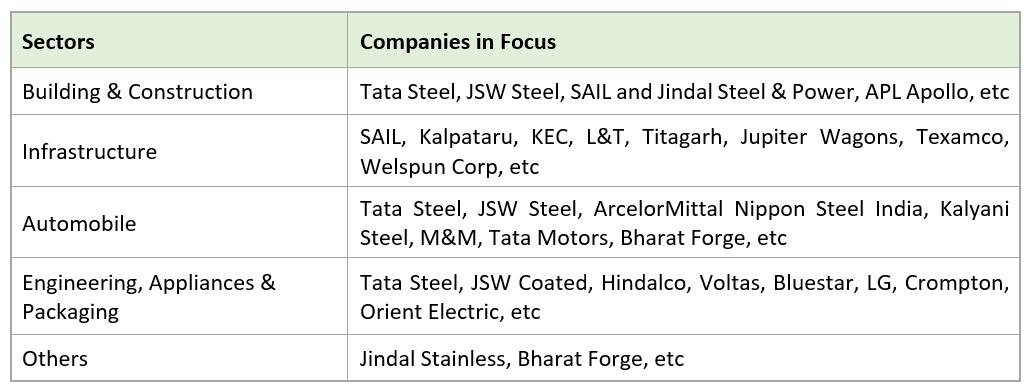
Where is Steel most demanded?
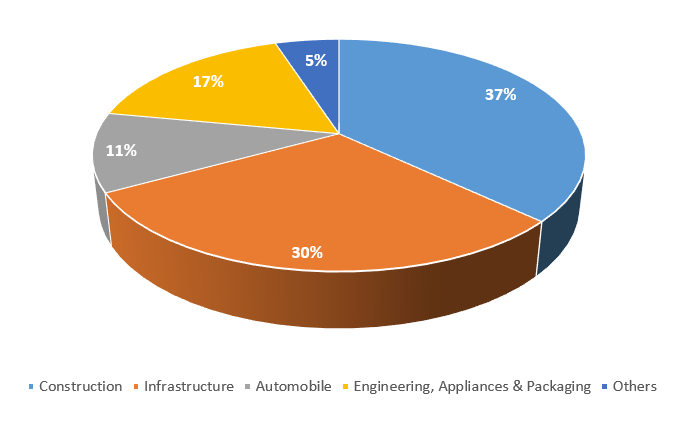
Sector wise Steel consumption
Building and Construction Sector (37%) alone accounts for around 37% of domestic steel consumption, driven by residential housing, commercial buildings, industrial structures and urban development.
Infrastructure (30%) includes roads, railways, metro systems, bridges, ports, airports, pipelines and power projects supported by central capex that has tripled since FY20.
Automobiles (11%) are driven by EVs, specialty grades and import substitution. OEMs and forging companies could face input-cost risk if import curbs lift domestic prices.
Engineering, appliances and packaging (17%) benefit from Make in India and PLI-linked manufacturing. Coated, colour-coated and tinplate producers gain. Appliance makers such as Voltas and Blue Star depend on cost pass-through, and aluminium packaging is a substitute.
Others (5%) include defence, capital goods, wind, transmission, hydrogen, semiconductors and data centres. Foreign OEMs and import-dependent users are the ones affected.
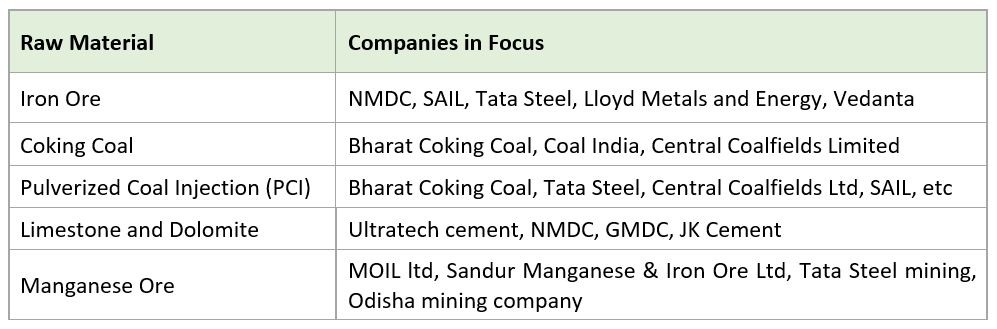
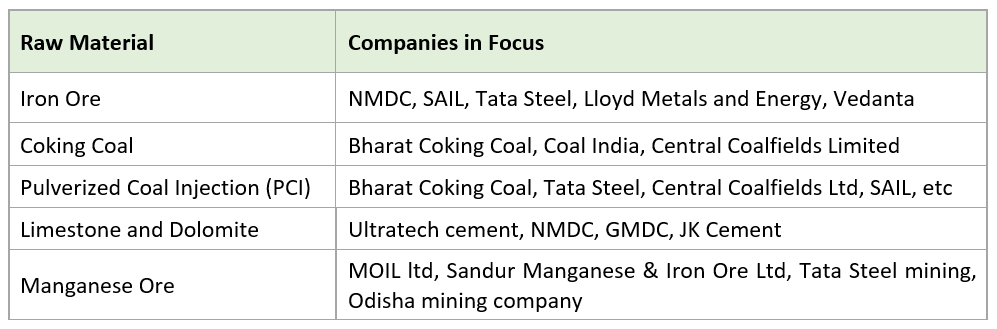
Which raw materials are needed to make Steel?
-
Iron ore: Iron ore is the primary raw material for steel making, which is typically processed into iron using blast furnaces or direct reduced iron methods. India is self-sufficient in iron ore. The iron ore demand is projected as 772 MT by 2047, against the demand of 299 MT in 2025. Ministry of Steel will make efforts towards expansion, exploration of mines, beneficiation/pelletization of low-grade ore, and foreign asset acquisitions.
-
Coking Coal: Coking coal is the primary reducing agent in the BF iron making route. High import dependence (nearly 92% imported). Demand will reach 236 MT by 2047. Policy focuses on expanding domestic coal washeries, AI-based coal blend optimization, and strategic global partnerships.
-
Pulverized Coal Injection (PCI): PCI is used in BF to partially replace coke and improve fuel efficiency. They are mostly imported for PCI (Russia and Australia), with 17 MT of demand rising to 48 MT. NSP Vision 2047 seeks to expand exploration and washing to increase the domestic availability of PCI-grade coal.
-
Limestone and Dolomite: They are import dependent. India consumes 24.3 MT of limestone and produces only 8.1 MT (about 33%). SMS-grade limestone is about 97% imported from the UAE and Oman. Dolomite demand is 9.2 MT, of which 2.7 MT is domestic (about 29%), with imports from Bhutan, the UAE and Oman. Demand is projected at 77 MT and 51 MT by 2047.
-
Manganese Ore: Manganese is a vital alloying agent that enhances the hardness, strength, and durability of steel. India is import dependent for manganese ore. Consumption is 10.8 MT against domestic production of 3.9 MT (about 36%), with imports from South Africa, Gabon, the UAE and Singapore. Demand is projected at 34 MT by 2047.
The Value Adding Segment
Specialty Steel:
It’s important for India to develop indigenous capabilities in specialty steel but Indian producers face 5-10% higher production costs due to inefficiencies in technology, logistics, power and finance. In high-end and strategic applications in sectors such as automotive, defence, space and power some grades unavailable domestically due to technical or capacity constraints and hence, is imported. There is high demand for specialty steel across multiple sectors and addressing these gaps provides a huge opportunity and reduces the dependence on other countries.
Stainless Steel:
Stainless steel is used across a wide range of downstream industries, including kitchenware/utensils, process industries, tubes and pipes, architectural and structural applications, transportation, automotive components and industrial machinery. Per capita stainless-steel consumption in India is around 3.4 kg, compared with the world average of over 6 kg, indicating significant potential for growth in domestic consumption.
Takeaway
Steel is not just about what comes out of a furnace. It’s about what happens when iron ore prices move, when infrastructure spending picks up, when auto companies demand stronger grades of steel, or when a policy pushes the industry towards value-added products.
One small shift in one corner of the value chain can create a domino effect across the entire industry, benefiting some companies while putting pressure on others. And that’s where the real understanding begins: not just knowing what the policy says, but connecting the dots to figure out who benefits, who gets squeezed, and where the next opportunity arises.