# 📊 Stratzy Algo | Watchlist November 2026

A new month. A new market environment. A fresh set of strategies to track.

After a challenging October, November has started with improving market sentiment. Recent sessions have seen a recovery in benchmark indices, supported by better corporate earnings, softer crude oil prices and signs of renewed foreign investor participation.

However, the recovery still needs to establish itself. Global uncertainties, geopolitical developments, crude oil prices and currency movements remain important factors to watch.

This creates an interesting environment where both directional opportunities and premium-selling strategies deserve attention.

For November 2026, our watchlist covers five strategy categories, each designed to capture different market behaviours.

:shield: Credit Spread Watchlist

Our largest allocation of attention remains on structured premium-selling strategies, with a mix of overnight, expiry and exit-early structures.

:small_blue_diamond: Convex Credit Spread Overnight
:small_blue_diamond: Delta-Ripple Credit Spread Overnight
:small_blue_diamond: V-Score Credit Spread Overnight
:small_blue_diamond: Delta-Leverage Credit Spread Overnight
:small_blue_diamond: Delta-Shift Credit Spread Expiry
:small_blue_diamond: Gamma-Fluxer Credit Spread Overnight
:small_blue_diamond: IV-Imbalance Credit Spread Overnight
:small_blue_diamond: Drifting Credit Spread Overnight
:small_blue_diamond: Deep-Rooted Credit Spread Overnight
:small_blue_diamond: Ratio-Return Credit Spread Exit-Early
:small_blue_diamond: Ratio-Ripple Credit Spread Exit-Early

Different structures allow us to observe how premium-selling strategies respond to volatility changes, market direction and expiry-related movements.

:balance_scale: Short Straddle Watchlist

We are tracking selected short-straddle strategies to observe their performance in different volatility and market-range conditions.

:small_blue_diamond: Single Kurtosis Straddle
:small_blue_diamond: Single Tightgrip Straddle
:small_blue_diamond: Blend Rank
:small_blue_diamond: Lattice Short Straddles
:small_blue_diamond: Fusion Gate

The focus is on understanding premium decay, volatility contraction and the impact of sudden market movements on short-premium positions.

:bullseye: Short Strangle Watchlist

Short-strangle strategies remain an important part of our November tracking.

:small_blue_diamond: Theta-zone Strangle
:small_blue_diamond: Holonomy’s Short Strangles
:small_blue_diamond: Bazaar Short Strangle Overnight

We will closely monitor how these strategies respond to changing market ranges, volatility expansion and overnight risk.

:rocket: Option Buying Watchlist

With the possibility of directional moves and volatility expansion, we are also keeping selected option-buying strategies under observation.

:small_blue_diamond: Index Scalper
:small_blue_diamond: Lyapunov Pulse Option Buying
:small_blue_diamond: Index Sniper
:small_blue_diamond: Kalman Pulse Option Buying
:small_blue_diamond: Endure Option FixedRR

These strategies are particularly interesting when markets develop stronger directional momentum or move beyond their expected ranges.

:chart_increasing: Swing Strategy Watchlist

Alongside our options-based strategies, we are also tracking two swing strategies.

:small_blue_diamond: NIFTY Champions
:small_blue_diamond: NIFTY Bellwether

These add another dimension to the watchlist by allowing us to observe opportunities beyond intraday and overnight options trading.


:brain: Wealth Manager’s View

One thing we must understand about the current market environment is that a market recovery does not automatically mean a sustained bullish trend.

Volatility, directional strength, premium behaviour and market breadth can change throughout the month.

That’s why our November watchlist is not built around one market prediction.

Instead, we are monitoring five different strategy categories:

:shield: Credit Spreads → Structured premium capture
:balance_scale: Short Straddles → Range-bound and volatility-related opportunities
:bullseye: Short Strangles → Premium capture across market ranges
:rocket: Option Buying → Directional momentum and volatility expansion
:chart_increasing: Swing Strategies → Broader market trends and directional opportunities

Our objective is not to find one strategy that works in every market.

It is to understand which strategies are behaving well, under what conditions, and with what level of risk.

:pushpin: November 2026 | What Comes Next?

Throughout the month, we will track the shortlisted strategies, observe their behaviour and evaluate their performance.

At the end of November, we will revisit this watchlist and share:

  • What worked and what didn’t.
  • Which strategy categories performed better.
  • How market conditions influenced strategy performance.
  • What we can learn for the next month’s selection.

Because a watchlist is not a prediction.

It’s a process of research, observation, measurement and accountability.

And that’s how we approach systematic wealth management.

#Stratzy #AlgoWatchlist #AlgoTrading #QuantitativeTrading #PortfolioManagement #WealthManagement #AutomateYourWealth

2 Likes

Our objective is apparently not to find one strategy that works in every market, but seems to be generating maximum brokerage through unnecessary trades! :joy:

An open challenge to all algo deployers: Show me even one combination of your so-called top-performing strategies that has delivered consistent profitability over the last 5 months in live markets. All those algorithms that looked like toppers in backtesting and paper trading are now struggling miserably with real money. Instead of intelligent decision-making, adaptive execution and risk management, we’re seeing random entries, excessive slippage, revenge trading and unnecessary trades that generate nothing but brokerage for brokers and taxes for the government! :man_facepalming:

If your algo can’t survive live market conditions, stop selling backtest dreams as trading solutions! :enraged_face::fire:

@Akash_Saha
That’s a fair concern, and we agree that live market performance is what ultimately matters, not just backtested or paper-traded results.

However, our objective is not to find one strategy that works in every market condition. The objective is to generate alpha through systematic trading, strategy diversification, and disciplined risk management.

We would actually encourage you to follow our monthly Algo Watchlist. You can consider deploying a diversified combination of strategies from the list rather than relying on a single algo.

Track the performance every month after accounting for all costs, including brokerage, taxes, slippage, and other charges. Evaluate the actual net P&L over time, ideally across different market conditions.

If the combination consistently delivers positive net returns and demonstrates alpha after all expenses, that’s the real measure of whether the approach is working.

Systematic trading is about following predefined rules, diversifying across strategies, managing risk, and allowing a system to perform over time rather than reacting to every individual trade.

We don’t claim that every algo will perform in every market. Markets change, and strategies can go through difficult phases. What matters is how the overall portfolio performs over a reasonable period.

We would genuinely welcome you to track the monthly watchlists and share your observations and results with the community. Constructive feedback backed by live trading data will help everyone make better decisions.

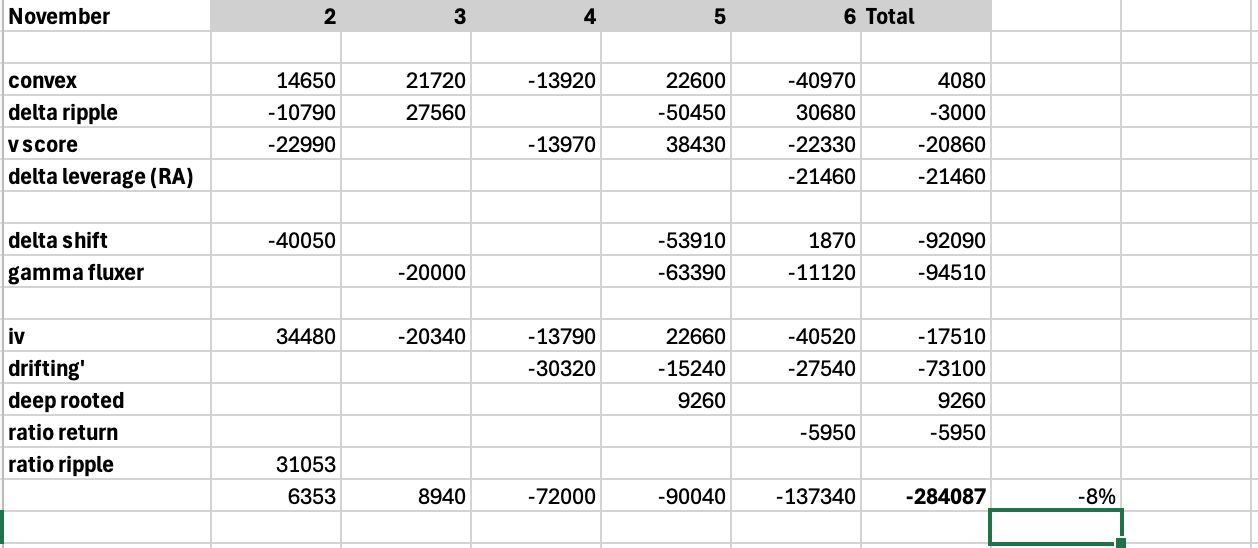
Sir, I was just checking the performance of watch list algos for the November month. Just in 5 days, loss was 8% of the allocated capital. Please see the attached file

I appreciate the detailed response, but honestly, I think this argument shifts the responsibility of proving a strategy’s effectiveness onto the customer rather than addressing the actual concern.

You talk about alpha, diversification, systematic trading and disciplined risk management. These are all good concepts in theory. But where is the independently verifiable evidence that your strategies actually deliver these results in live markets?

A few points need clarification:

1. Diversification is not a guarantee of profitability. Combining multiple strategies does not automatically create alpha. If several strategies are exposed to similar market risks, they can collectively suffer significant drawdowns, especially during unexpected market movements.

2. A watchlist is not proof of performance. Publishing a monthly list of strategies and asking customers to track them is research activity, not evidence of a consistently profitable trading system.

3. Where is the actual live performance data? Instead of asking customers to calculate brokerage, taxes, slippage and other charges themselves, why not publish complete net performance figures based on actual live execution?

4. Show the risk, not just the returns. We need maximum drawdown, capital deployed, risk per trade, consecutive losses, recovery time, monthly net P&L and risk-adjusted returns. A strategy making 20% while exposing capital to a 35% drawdown is a completely different proposition from one generating 12% with controlled risk.

5. Backtesting and paper trading cannot replace live execution. Slippage, liquidity, execution delays and changing market conditions can significantly alter actual results. These differences need to be demonstrated transparently.

And here is my biggest concern:

If customers have to independently select multiple algos, decide allocations, calculate all expenses, monitor drawdowns and eventually determine whether the combination is profitable, then what exactly is Stratzy taking responsibility for beyond publishing strategies and watchlists?

You cannot repeatedly promote systematic wealth management and alpha generation while making customers responsible for validating whether those claims hold true.

I am not asking you to guarantee profits. Nobody can guarantee that in the stock market. I am asking for transparency, measurable accountability and verifiable live trading results.

Please stop presenting diversification and systematic trading as answers to concerns about actual performance. Show the numbers.

Ultimately, customers should not have to become research analysts just to establish whether the strategies they are paying for are genuinely delivering value.