Tough Times for Markets, and for Algos

“You can’t predict. You can prepare.” - Howard Marks

Dear Algo Traders,

We know the last few weeks have not been easy. Many of you have written to us, and we have read every message. Instead of answering one thread at a time, here is what the market data actually shows, and how we think about it.
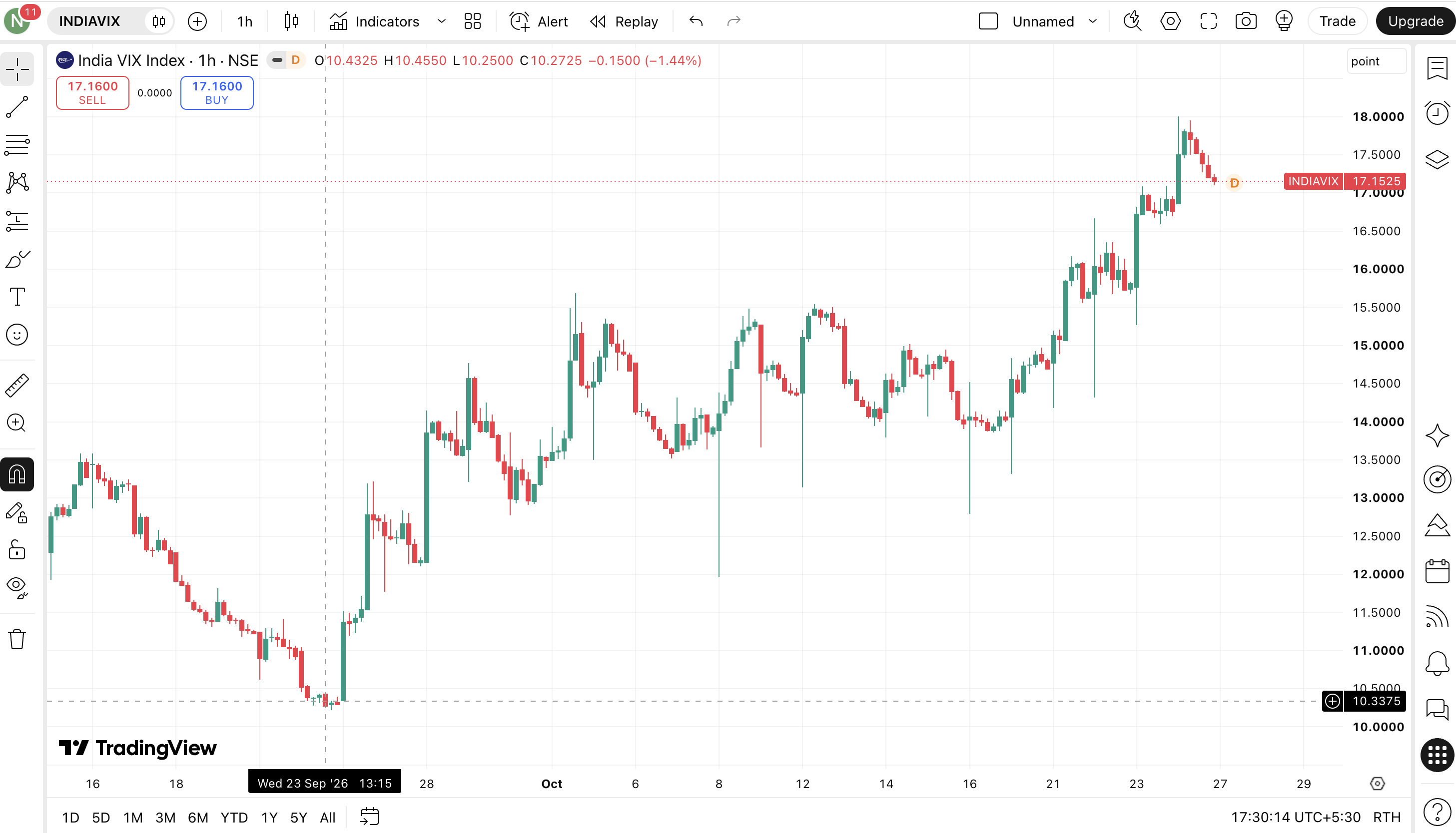
What the VIX chart shows

India VIX is the market’s expectation of how much Nifty will swing over the next 30 days, priced from option premiums. In simple words, it is what the market is paying for protection.

  • On 23 Sep, it was at about 10.3, the calm end of its range through August and September.

  • Within about a week, it had already crossed 14.

  • It has kept stepping higher since, touching close to 18 earlier today, and is sitting around 17.4.

That is a rise of nearly 70% in about a month. Look at the shape too. The dips along the way were brief and shallow, and the lows kept getting higher. There was very little relief at any point.

The chart shows the structure, and the structure is what matters for your algos.

Why it feels so sharp

Let me be upfront: a VIX of around 17 is not an extreme number. Over the long run since 2009, its median has been about 16.7, so today’s level is close to a normal reading. Earlier this year it went far higher, touching the high 20s in March when tensions in West Asia flared.

What stands out is the speed and where it started. Volatility had been easing for months after that March spike, and VIX was sitting near the bottom of its range for the year in late September. Going from there to 17 in about a month is the sharpest sustained rise since March, as far as I can find. In simple words, it is less an unprecedented storm and more a sudden return to normal volatility after a long calm stretch, and the algos feel that jump.

When option prices reprice this fast, premium selling structures feel it the most. Credit spreads, which many of our algos use, cap the loss on each trade by design, but they can still lose in a phase like this, especially when volatility keeps climbing and markets keep moving in a steady direction. That is not a malfunction. It is the cost of how the strategy works, in the same way that the calm months are the reward.

Different categories also behave differently when volatility rises. That is exactly why we keep saying that diversification across categories, not only across algos, matters. If you have not read it yet, this post explains it in detail.

What the market is watching this week

Without taking a view on any of it, here is what market commentary is pointing to:

  • Crude oil and West Asia. Brent has been trading above $115, with Iran related tensions in the headlines.

  • Foreign selling. October has seen heavy foreign investor outflows, partly cushioned by domestic institutional buying.

  • Monthly F&O expiry on 27 Oct.

  • The US Fed decision on 28 Oct. It comes after Indian market hours, so Indian markets react at the next open, which matters for positions held overnight.

  • Q2 earnings and rising bond yields.

None of these tells us which way the market goes. They explain why options are pricing bigger swings than a month ago, including the possibility of gaps.

What nobody can tell you

How long this phase lasts, whether VIX goes higher or falls back, or how the market will perform from here. Not us, not an algo, not a chart. Anyone who claims to know is guessing. What we can do is prepare for it, and that is what the algos, the position limits and the diversification are for.

On stop losses and fresh entries, and the trap of recency bias (Important)

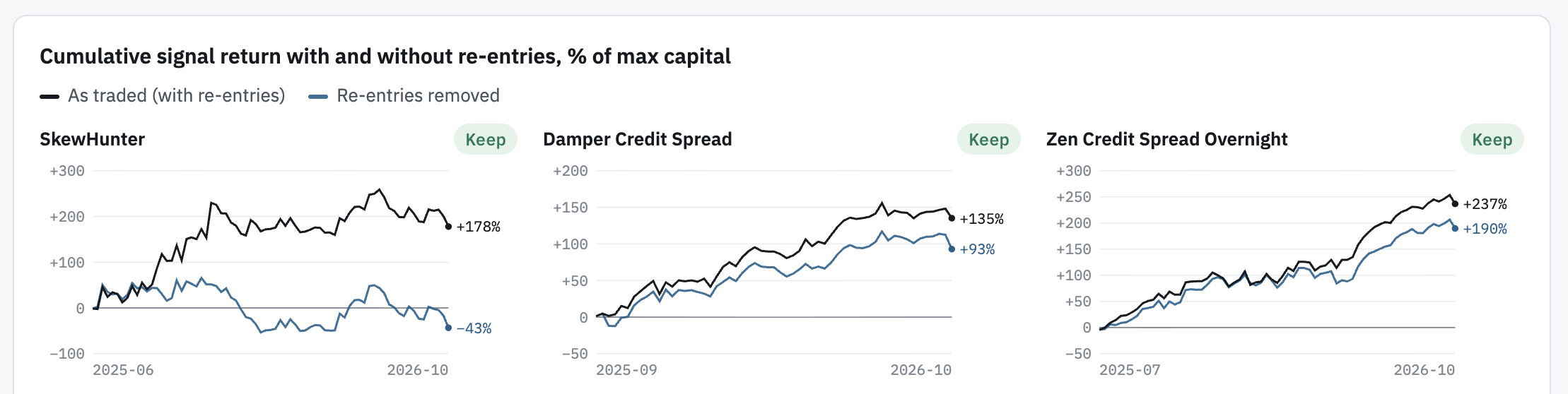
Some of you have noticed that a few algos hit a stop loss and then took another trade soon after, sometimes more than once in a day. I understand why that looks painful. Here is the idea behind it, without going into the internals of how our algos work.

An algo is not trying to win back a loss. When a trade closes, including at its stop loss, the algo is free to take a new trade if its signal appears again. It carries no emotion from the previous trade. The stop loss is the system limiting the damage, and the next trade is judged purely on its own signal. When volatility is climbing, signals tend to come back more often, which is why stop losses and fresh entries bunch up in phases like this one.

The real risk here is recency bias. The last few weeks sit at the front of our minds, and a handful of stop losses in a row start to feel like the new normal. We keep studying this behaviour closely, and when we look at the longer history of some of our larger algos, the version that takes these fresh entries has come out ahead over the long run. The recent stretch is a small slice of that history. It feels bigger than it is because it is recent and it is red.

So when you judge an algo, judge it on the full history and its expected range, not on its last few trades.
What to do, and what not to do

  • Avoid big emotional changes. Closing trades or reshaping an algo mid-storm changes your risk and reward without any rule behind it, and it takes you out of the tested system.

  • A pause is a valid choice. If the market feels too volatile for you, step back for a while. Decide it calmly, and decide in advance how you will come back.

  • Check your sizing. Deploy only what you can comfortably leave through a drawdown.

  • Expect red months. Around 4 out of 12 months can be drawdown months in a typical year. It could be fewer, it could be more, and they can come back to back.

What we are doing

We monitor all algos and their historical ranges, and there are systems in place for exactly this. An algo that goes outside its expected range is a different conversation from one that is going through a normal drawdown, and we treat it that way.

On trust

Trust in algos is not blind faith. It is a process: judge them over a long horizon, within their historical ranges, with a portfolio spread across categories, and with rules instead of reactions when markets get rough. Rough phases like this one are part of that horizon, not a break from it.

If you have questions, drop them below and I will go through them.

4 Likes

Thank you for taking time out and sharing this much-needed support for physiological control and also act as assurance that team monitored every algo and trade to make sure nothing runs out of hand.

1 Like

This is helpful, thanks for sharing.

Could you also cover two areas?

  • Portfolio-level drawdown management: When all strategies are at maximum capacity, how should we rebalance allocations? Should decisions be based on the current market regime or the anticipated regime? In an earlier post, you shared an idea of allocating 50% of the portfolio to non-directional strategies, but most of these strategies have been losing for nearly a year. What could be driving this, and how should we approach allocation in practice?

  • Pausing or retiring strategies: How should we evaluate strategies that have consistently lost money for over a year or breached their maximum drawdown after a previously profitable period? What objective criteria should determine when to pause a strategy, retire it permanently, or reallocate capital to other strategies?

1 Like

Could be useful to everyone on this forum if experienced traders could share their insights on what factors should we keep monitoring that could potentially give us a hint that we are now out of this highly volatile phase from their experience. Sharing this information could improve our own analysis and benefit from others perspective simultaneously. Thank you in advance.

2 Likes

Hi @sv28 , thank you for the thoughtful questions. I’ll try to answer them one by one.

1. Portfolio level drawdown management

Current regime or anticipated regime? My honest answer is neither, if it means predicting. Nobody can reliably call the next regime, so allocating around a forecast just replaces one guess with another. What the current environment should inform is risk, meaning how much you can afford to have at stake right now, not a bet on what comes next.

In poker, you move stakes based on bankroll rules, not on how the last session went. Portfolios work the same way. A few principles that help in practice:

  • Start from the drawdown you can live with. Decide the maximum portfolio drawdown you can sit through without making emotional changes, and size your capital so the combined historical worst cases of your algos fit inside it. Remember that algos in the same category tend to hurt together in a bad phase, so add those worst cases up, don’t average them.

  • Rebalance on rules, not on mood. Pick a schedule or a drift band in advance, and stick to it, instead of reshuffling in the middle of a drawdown.

  • If everything is at full capacity and you need to cut risk, trim where the overlap is highest first, which is usually the most crowded category, rather than simply dumping whatever lost most recently.

The 50% non-directional idea. That was a framework for thinking about balance, not a fixed formula, and it was never meant to be applied without checking it against your own drawdown tolerance. I can’t comment on every algo here, but if non-directional strategies have been under pressure for a long stretch, the usual drivers are worth knowing. This year has had repeated volatility shocks, in March, in July and again now, and sharp or gapping moves and rising volatility are exactly what premium selling, non-directional structures find hardest. A long drawdown in a category does not by itself break the diversification logic, because the point of holding different categories is that they take turns. But it does mean checking two things: whether that category is still within its historical range, and whether the size you hold fits your drawdown budget. If both are fine, abandoning the category after a bad year is the classic way diversification gets undone just before it helps.

2. Pausing or retiring a strategy

The most useful thing is to define the rules before you invest, not after the pain starts. A few objective checks I would use:

  • Your own loss limit. Decide in advance the maximum loss you will accept on the capital allocated to a strategy. When it reaches that limit, you reduce or pause by rule, not by mood.

  • Live versus expected behaviour. Are the trades, slippage and results consistently different from what the strategy was designed to do?

  • Structural change. Has something changed in the market itself that the logic depends on, such as contract structure, margin rules or the way volatility behaves?

  • Fit with your portfolio. Does the strategy still fit your drawdown budget and your category mix, or has it grown into too large a part of your portfolio?

Think in steps rather than a single switch. A bad patch with nothing structurally different means holding, at a size you can live with. Hitting your own limit, or behaviour that differs from the design, means reducing size or pausing while you look for the cause. Retiring is for when the evidence points to a structural change and not just a bad patch, because a year of losses on its own is hard to tell apart from variance, particularly for strategies with fewer trades.

When capital does come out of a strategy, move it by rules too. Direct it toward categories that are underweight in your portfolio, not toward whatever did best last month, since chasing recent winners is how portfolios end up crowded in the same place.

Writing these criteria down now, while you are calm, is the single most useful step.

Appreciate you raising this.

Hi,

Thank you for explaining this.

However, I have a related question regarding the Ratio Fluxer algo.

The drawdown was approximately 5% until recently, but it has now increased to 15%. This appears to be because the algo executed multiple entries throughout the month, while its risk classification automatically shifted from Low to Moderate.

My question is: if the stated trade frequency for this algo is one trade per month, how did it end up executing four trades in a single month?

I understand that this may not have raised concerns when the algo was performing well and generating positive returns. However, now that the performance has turned negative, this is understandably something investors may question.

More fundamentally, I would like to understand how the algo’s parameters, including its risk classification and trading frequency, can change once the SEBI approvals are in place. What controls are in place to ensure that any such changes remain within the approved framework?

I hope my questions are clear. I would appreciate some clarity on these points.

Thanks,
Varun

Vix is single most variable which affects Algo performance. But it seems VIX level is not factored into logic of any Stratzy algos

Hi @varun_khator

We have already addressed this in one of our posts; you can refer to it below: