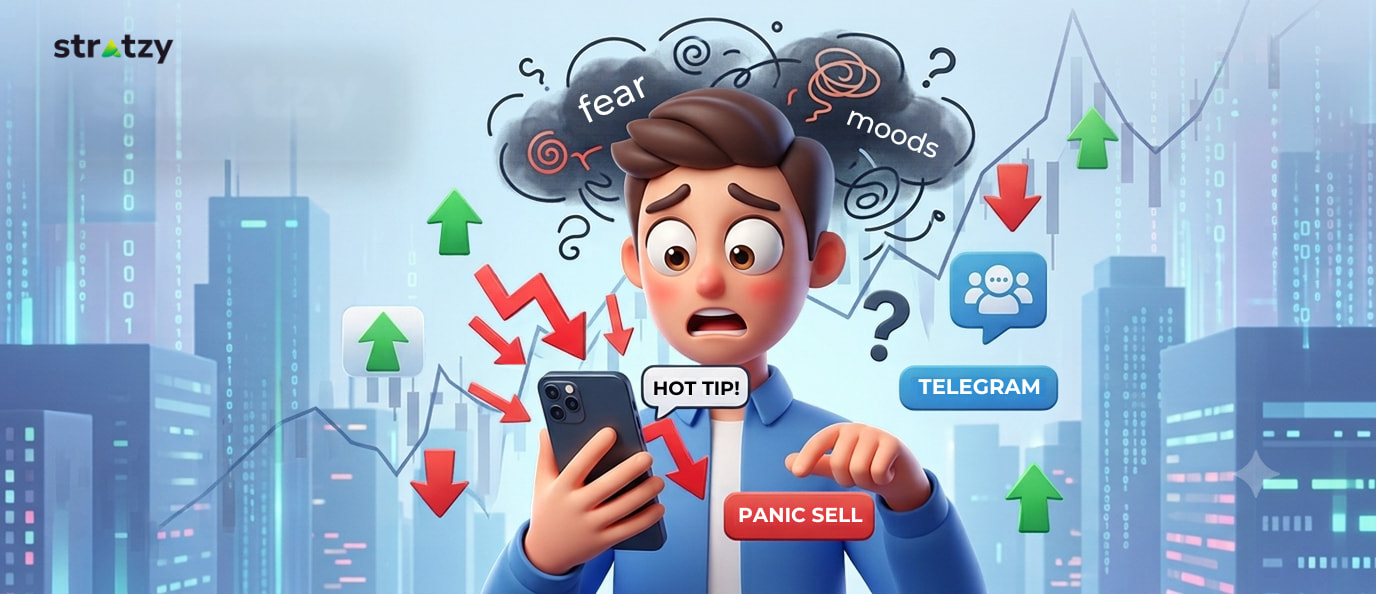
Ever Bought a Stock Because Someone Said “Trust Me”?
Or sold at moments before your returns could have multiplied?
If you’ve nodded twice already, you need to hear me out. Most of us have a story about the hot tip that failed, the panic sell that preceded a rebound, or the “it can only go up” buy that did the exact opposite.
The market didn’t beat you in those moments. Your emotions did.
And What if your investments run on a Plan, not a Mood?
That’s the idea behind Investing Algos.
An Algo is simply a set of rules you decide in advance: when to buy, when to sell, and how much risk is too much. Once it’s set, it follows those rules automatically. No gut feelings. No group-chat tips. No 2 a.m. second-guessing.
Think of it as that one friend who never panics, never gossips about hot stocks, and always sticks to the plan.
Emotions can sometimes be very Expensive
When prices fall, fear takes over and we sell near the bottom, locking in losses that might have recovered. When prices soar, FOMO creeps in and we buy near the top.
Behavioral finance research say that, losing ₹1,000 hurts far more than gaining ₹1,000 feels good. That’s why we hold on to losers hoping they’ll bounce back, rush to cash out winners.
The result is the classic pattern: Buy high, Sell low, repeat. It isn’t a lack of intelligence. It’s just being human.
So how an algo would have reacted in those exact situations?
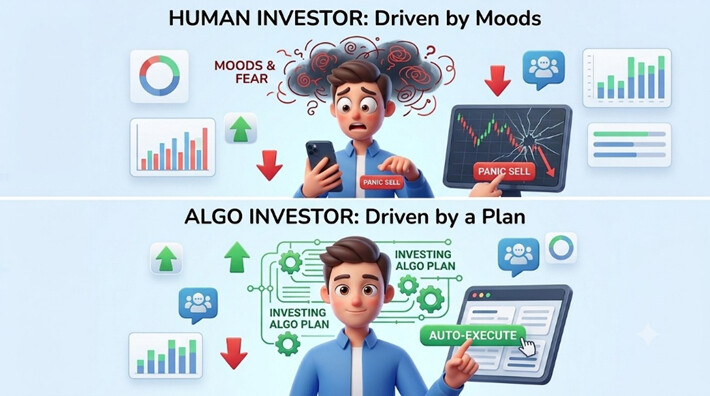
The panic dip: Your rule says “exit if the price falls 5% below entry.” The algo acts on the rule, not on the scary headline.
The hot tip: Your rule says “only buy when these conditions are met.” And not during a friend’s recommendation or a telegram channels message.
The FOMO rally: The algo doesn’t chase. It waits for its signal, or sits it out.
The “just one more day” hope: The algo won’t hope for losses to recover. It follows strategies and it Executes.
Same market, same volatility. The difference is that the decisions were made calmly, in advance, instead of in the heat of the moment.
And while you’re at work, at dinner, or asleep, it keeps watching the market and acting in seconds. You can even test a strategy on past data before real money is involved.
Let’s keep it real
Algos aren’t a money machine. No strategy wins every time, and a bad plan, automated, is still a bad plan. Markets can surprise anyone.
But here’s why it can be a game changer: most investors don’t fail for lack of a good strategy. They fail because they can’t stick to one when it gets uncomfortable. An algo sticks to it every single time and that consistency is the edge.
Your turn
What’s the most emotional investing move you’ve ever made? The panic sell? The tip from a cousin? The buy you made because the ticker sounded cool?
Tell us in the comments. And if you’re curious what it feels like to let a strategy do the heavy lifting, give algo investing a try.
Investments are subject to market risks. This is for information only and is not financial advice.