If an investment hasn’t made money for three months, does something need to change or does it need more time?
Markets give us a reason to act almost every day.
A sharp fall makes us consider exiting. A rally makes us wonder whether we should invest more. A stock we don’t own moves higher, and suddenly the investment we carefully selected feels inadequate.
The urge is understandable. We associate action with progress. When our money is involved, making a change can feel more responsible than waiting.
But the frequency of our decisions says little about their quality.
Sometimes, staying with a well-considered investment is the decision that requires the most discipline.
Investing does not deliver progress every month
Most investors understand that wealth creation takes time. Living through that time is harder.
A few months without gains can make us question an investment we originally intended to hold for years. A drawdown—a decline from a previous peak—can make the discomfort even stronger.
“Should I exit?”
“Has this stopped working?”
“Would my money do better somewhere else?”
These are reasonable questions. But a disappointing period, by itself, does not establish that an investment has failed.
Investment returns do not arrive on a monthly schedule.
A long-term return expectation does not mean an investment will deliver a small, predictable profit every month. Its journey can include periods of limited movement, declines, recoveries, and sharp advances.
A company may be expanding capacity, improving operating margins, and growing earnings while its share price remains subdued. Business progress and market recognition do not always happen together.
That is why patience matters: the investment needs enough time for its underlying case to develop.
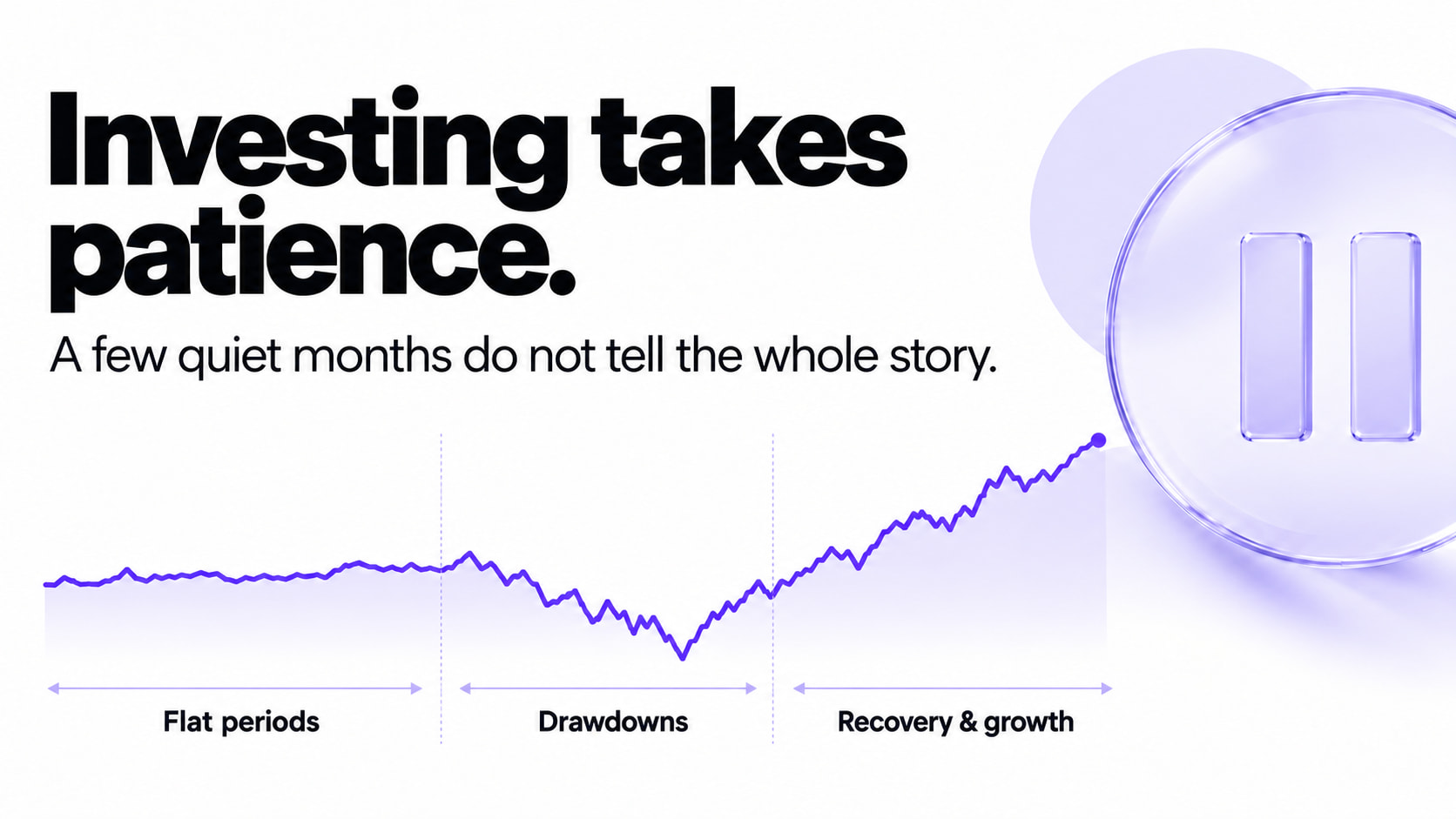
A price movement should prompt a review—not automatically a trade
Imagine investing in a company because you expect its profitability and competitive position to improve over several years.
A month later, the share price falls.
The decline deserves attention. But before selling, ask:
What has changed in the investment case?
Has earnings growth weakened materially? Has debt become a concern? Has the company lost an important competitive advantage? Or has the price declined alongside a broader market correction?
Those situations can require very different responses.
If the original reasons for investing remain valid, a lower price alone may not justify abandoning the position. If the business outlook has deteriorated, the fact that you intended to invest for years should not prevent you from reassessing it.
The purpose of a review is to understand which situation you are facing.
Patience needs a reason
Staying invested does not mean holding every investment indefinitely or assuming every loss will recover.
A drawdown’s size and cause matter. So does its effect on your financial goals. Deteriorating fundamentals, excessive exposure to one company, or a breached risk rule can justify action.
Patience is useful when the investment case remains sound and the risk remains appropriate.
A disciplined investor continues to review the holding. Sometimes that review leads to a change. Sometimes it confirms that the original decision still makes sense.
Both are legitimate outcomes.
The distinction is between waiting with a reason and waiting because you do not want to acknowledge a mistake.
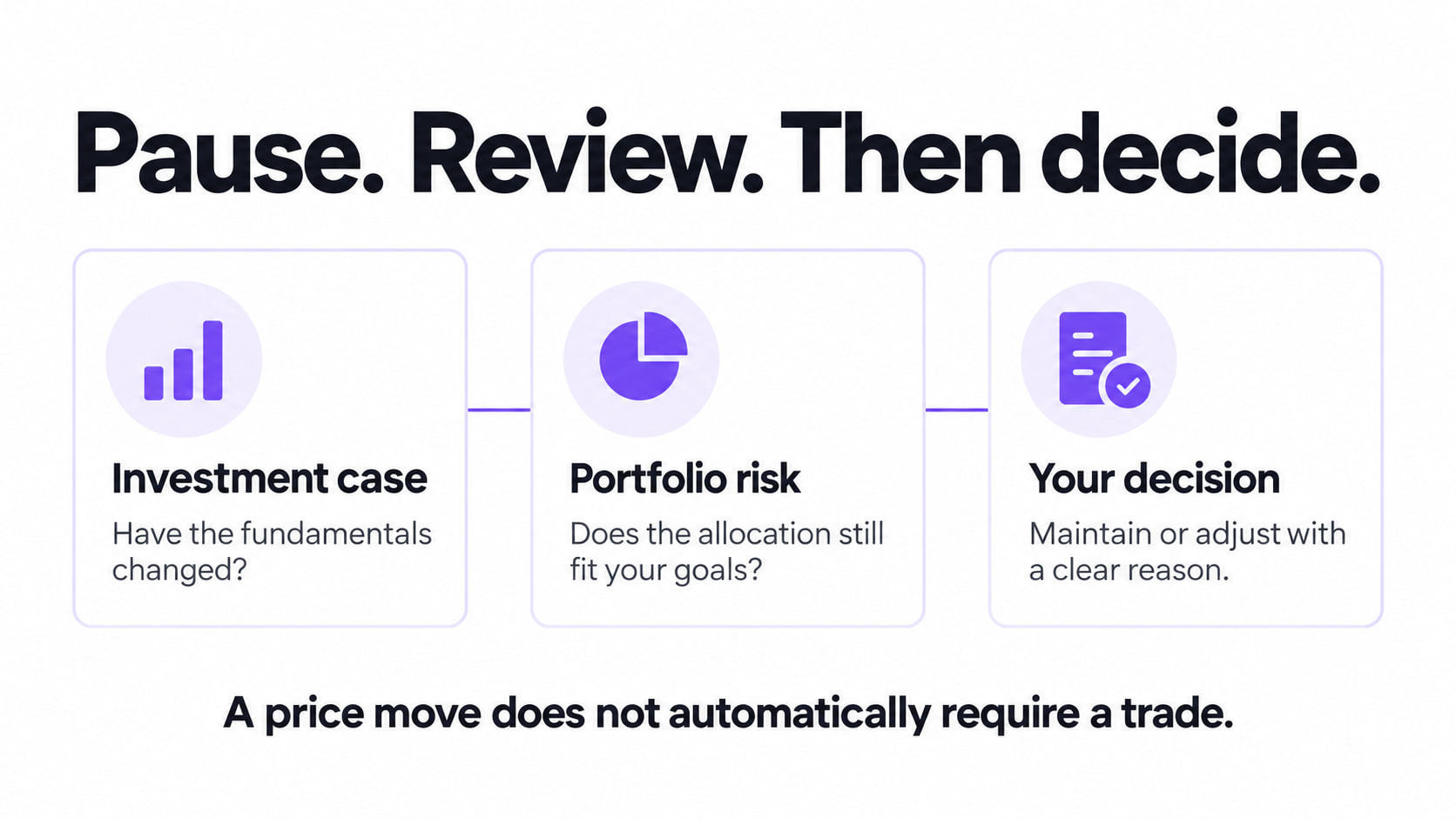
Your allocation should outlast the market’s latest mood
Even a promising investment needs an appropriate place in your portfolio.
Suppose you decided how much capital to allocate to a stock based on your confidence in the business and the loss you could reasonably tolerate.
After a sharp rally, increasing that allocation may feel tempting. After a decline, exiting completely may feel equally convincing.
Yet either response can move you away from the risk you originally intended to take.
Maintaining an allocation means reviewing the position in the context of your overall finances. Has it become too large relative to your other investments? Do you need the money sooner than expected? Has your ability to bear losses changed?
Sometimes, adjusting the position is appropriate. At other times, there is no meaningful reason to change it.
An investment should earn its allocation through a considered decision, rather than the market’s latest mood.
Unnecessary trades create more decisions
Selling because a holding has become uncomfortable creates an immediate follow-up question: what will you do with the money?
You might move into a stock that has recently performed well. But that investment will eventually have its own quiet periods and drawdowns. Without a consistent decision process, the same discomfort can lead to another switch.
If you intend to buy back the original holding, you also need to decide when. A further decline may make you hesitate. A recovery may make it feel too expensive.
What began as an attempt to reduce uncertainty can create more of it.
Switching also creates costs. Depending on the investment and account, these can include transaction charges, spreads, slippage, and taxes.
A trade should have a clear purpose: responding to a changed investment case, managing risk, meeting a financial need, or following an established rule.
The desire to feel productive is a weaker reason.
How this connects to investing algos on Stratzy
The same discipline applies to our investing algos on Stratzy.
Each algo follows its own framework for selecting investments, reviewing holdings, and managing exits. Depending on the strategy, a holding may remain unchanged for an extended period while it continues to meet the relevant criteria.
A period without trades can be a deliberate outcome of the strategy’s rules.
A flat month or a price decline does not automatically require a change. Equally, patience does not override an exit condition. When the strategy’s criteria call for action, its holdings can change.
The purpose is to make those decisions consistently, rather than letting the discomfort of waiting determine when to buy or sell.
For investors, this means understanding an algo’s intended horizon and risks, allowing its process time to operate, and continuing to assess whether it suits their goals.
Give your investment horizon a chance
If you selected an investment for a multi-year goal, a few flat months should be assessed within that context.
That does not make the period irrelevant. It means judging it alongside the investment’s fundamentals, portfolio role, and risks—rather than treating the absence of immediate gains as proof that you must move on.
Before your next trade, ask:
- Has something material changed in the investment or my financial situation?
- Is the position still appropriate for my goals and ability to bear losses?
- Does this change follow my investment process?
- Am I improving my investment decisions, or responding to discomfort?
Sometimes the answers will point towards action. Other times, they will support staying invested.
An investment does not need constant intervention to make progress.
Investing requires the patience to live through periods when progress is uneven or difficult to see. The discipline is to keep reviewing the investment and give it time when the reasons behind it remain valid.