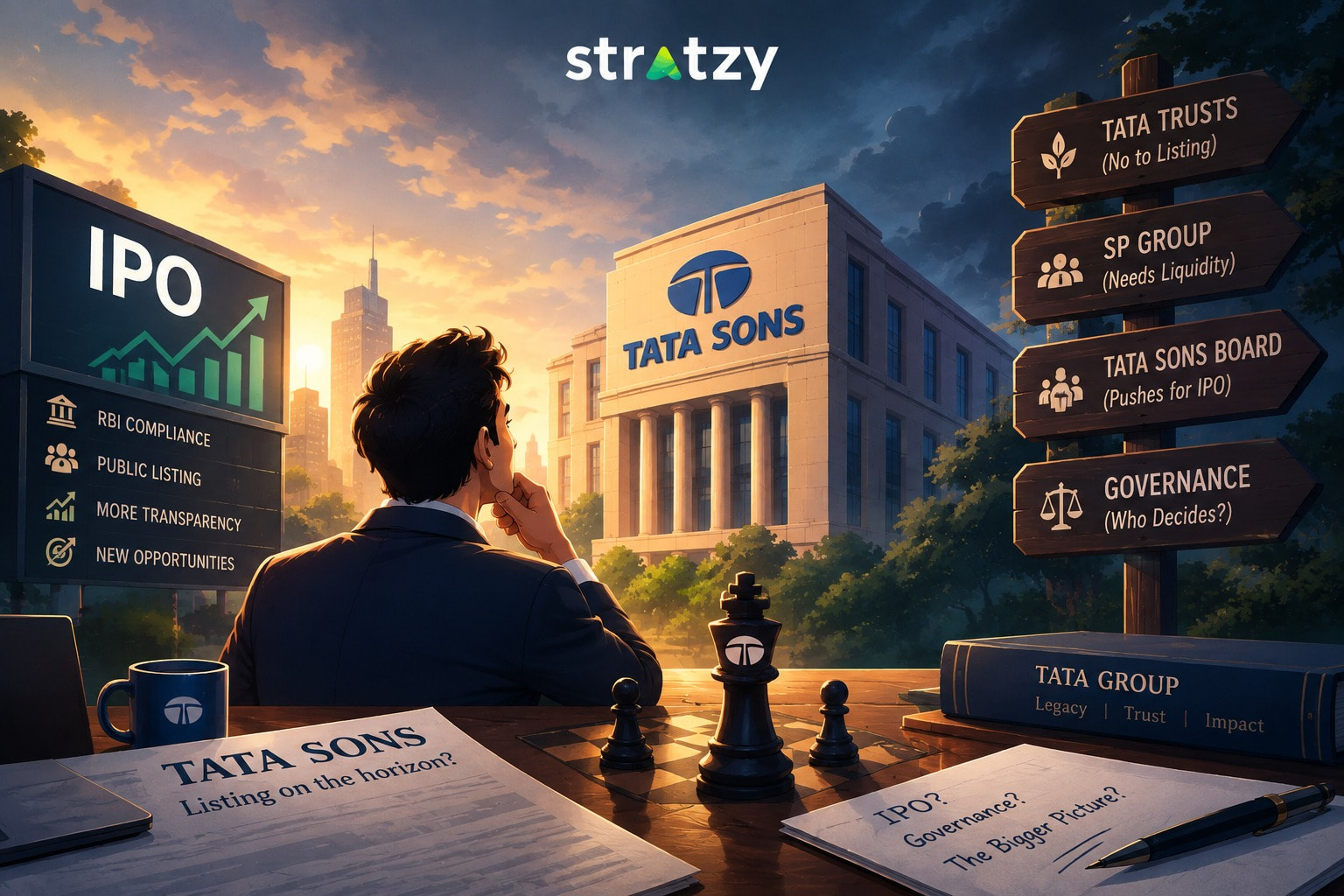
The last two months has seen a strong wave of Mainboard IPOs, with the IPO season clearly in full swing. But alongside this IPO activity, there’s another interesting battle unfolding, and this one involves Tata Group and the much-discussed Tata Sons IPO.
I went through the news, reports, and developments around the case to understand what’s really happening, Why Tata Sons’ IPO has become such a complicated issue, and what could happen next.
Let’s break down the Tata Sons IPO case:
The Tata Sons story is no longer just about an IPO. It is about who has the final say over one
of India’s most influential business groups.
At the centre of the dispute are the Tata Trusts, the Tata Sons board, N. Chandrasekaran, the RBI and the Shapoorji Pallonji (SP) Group.
So Why is Tata Sons being pushed towards an IPO?
Let’s start with the structure:
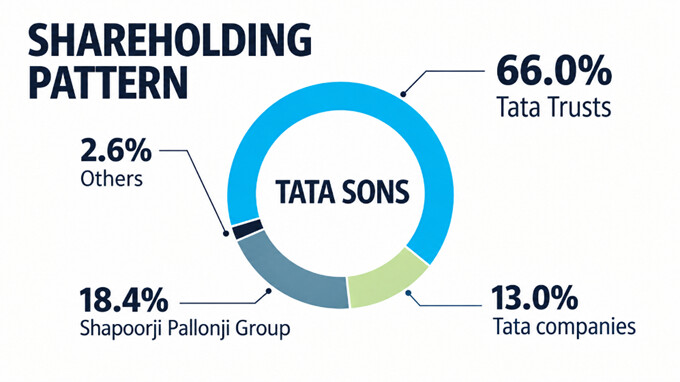
Tata Sons is the holding company of the Tata Group, with Tata Trusts owning around 66% and the Shapoorji Pallonji Group holding about 18.4%.
The story began with RBI. Tata Sons was classified as an “Upper Layer NBFC”, a category subject to enhanced regulatory requirements, including listing. Tata Sons subsequently sought to surrender its Core Investment Company registration, a route that could have taken it outside that framework.
But on September 11, 2026, RBI rejected the application. The Tata Sons board has now said it will initiate steps to comply with the applicable RBI requirements and consider the listing route.
So, the IPO question is no longer theoretical.
But Tata Trusts don’t want to list.
At the September 17 board meeting, Noel Tata reiterated that the Trusts had not agreed to a listing and wanted all alternatives to be explored. His argument goes beyond valuation or dilution.
“A listing will destroy its character and strike at the heart of this principle.” - Noel Tata
The Trusts say Tata Sons’ private ownership structure has helped preserve its long-term, public-purpose orientation for more than a century.
And there is another shareholder with a very different interest; Shapoorji Pallonji (SP) Group. SP Group wants liquidity. The Shapoorji Pallonji Group’s 18.4% stake is largely illiquid while Tata Sons remains private.
The Trusts have tabled a proposal involving monetisation of part of SP Group’s holding, targeting at least ₹25,000 crore through a proposed capital-reduction structure.
And this is where the governance story enters.
At the same September 17 meeting, the board also reconsidered N. Chandrasekaran’s future. Just weeks earlier, on August 12, he had said he would “not seek reappointment” after February 2027.
The board later asked him to reconsider, citing “his contributions and the larger interests of the Tata Group.”
He agreed, and the board voted for another five-year term. Noel Tata voted against it.
Tata Trusts subsequently challenged the validity of the decision, citing the special governance provisions in Tata Sons’ Articles of Association.
Articles of Association (AoA), Article 121 requires “affirmative support from a majority of the Trusts’ nominated directors” for specified major decisions; which means; For certain important decisions, you don’t just need a majority of the entire board. You also need the required support from the Trust-nominated directors.
So, while the Chandrasekaran dispute is a separate issue, it has exposed the same underlying question that now matters for the IPO:
When Tata Trusts and the Tata Sons board disagree, who ultimately gets to decide?
That question could become extremely important as Tata Sons works out how, when and under what structure it could eventually list.
So, three interests are now colliding:
Tata Trusts: Preserve the existing Tata model and governance structure.
Tata Sons Board: Move ahead with leadership continuity and RBI compliance.
SP Group: Find liquidity for its large Tata Sons investment.
And all of this is happening inside the same company.
The bigger picture:
What looks like two separate stories, Chandrasekaran’s reappointment and the Tata Sons IPO are actually connected by one fundamental question:
Who controls the decision-making at Tata Sons when its board and its largest shareholder disagree?
That question is now being tested simultaneously on leadership, ownership, regulation and the future structure of the Tata Group.
And that is what makes the Tata Sons story much bigger than just an IPO.
What do you think is the bigger issue here? Tata Sons’ IPO, Chandrasekaran’s reappointment, or the underlying question of who has the final say?