What could happen today?
Indian equity markets showed signs of recovery in the previous session and might extend their gains today as Iran, Qatari mediators hold third day of talks to end US-Iran war. Crude price also saw signs of relief and eases near $110/barrel.
On a short term basis, momentum has shifted and on the upside, 22,200 becomes the immediate resistance level followed by 23,000-23,350 zone. On the downside, 22,800 followed by 22,650 becomes the crucial support zone.
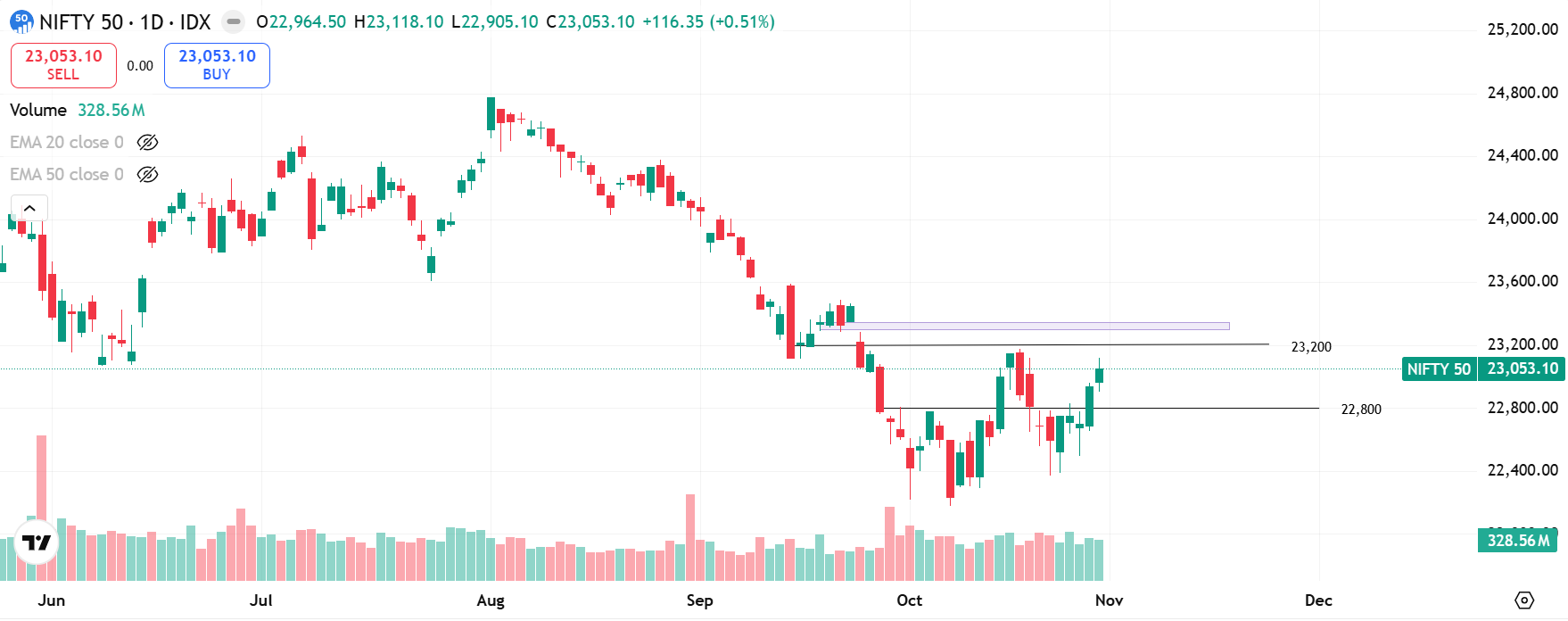
Nifty: 23,053.10, +0.51%
Sensex: 74,459.53, +0.42%
Bank Nifty: 54,686.95, -0.41%
Global Market Movements
GIFT Nifty: GIFT Nifty futures is currently trading around 23,272, indicating a positive start for Nifty.
US Markets: US stock markets finished lower on Friday, October 30, 2026, with DJI closing -1.09% down, Nasdaq closing -2.86% lower and S&P 500 closing -1.82% down from their previous close.
Asian Markets: Asian-Pacific stock markets are trading lower today, driven by the losses on Wall Street.
Commodities
Brent Crude: $110.2/barrel
Brent crude prices eases near $110/barrel after reaching $118/barrel recently.
FII & DII Acitivity
FII: +3,599 crores
DII: -815 crores
Net Flow: +2,784 crores
The Investors Lens
GDP-to-Debt Ratio: How Much Debt Is Too Much for a Country?
Imagine earning ₹10 lakh a year but carrying a loan of ₹15 lakh. Would that make you financially stretched? Countries face a similar question, but on a much larger scale.
The GDP-to-debt ratio measures a country’s total government debt against the value of everything its economy produces in a year.
In simple terms, it tells us how large a country’s debt is compared to the size of its economy.
For example, if a country’s GDP is ₹100 lakh crore and its government debt is ₹80 lakh crore, its debt-to-GDP ratio is 80%.
Why does this matter? Because a country’s ability to manage debt depends partly on the size and strength of its economy. A growing economy can generate more tax revenue, making it easier for the government to service its debt.
But a rising ratio can become a concern. It may mean higher interest payments, less room for government spending and greater dependence on borrowing. If investors begin questioning a country’s ability to manage its debt, borrowing costs can rise too.
However, a high ratio does not automatically mean a country is in trouble. Investors also look at how quickly the economy is growing, the interest rate on government borrowing, the currency in which the debt is issued and the government’s ability to collect revenue.
The takeaway: Debt alone doesn’t tell you how financially strong a country is. What matters is whether its economy can grow enough to manage and repay that debt.