What could happen today?
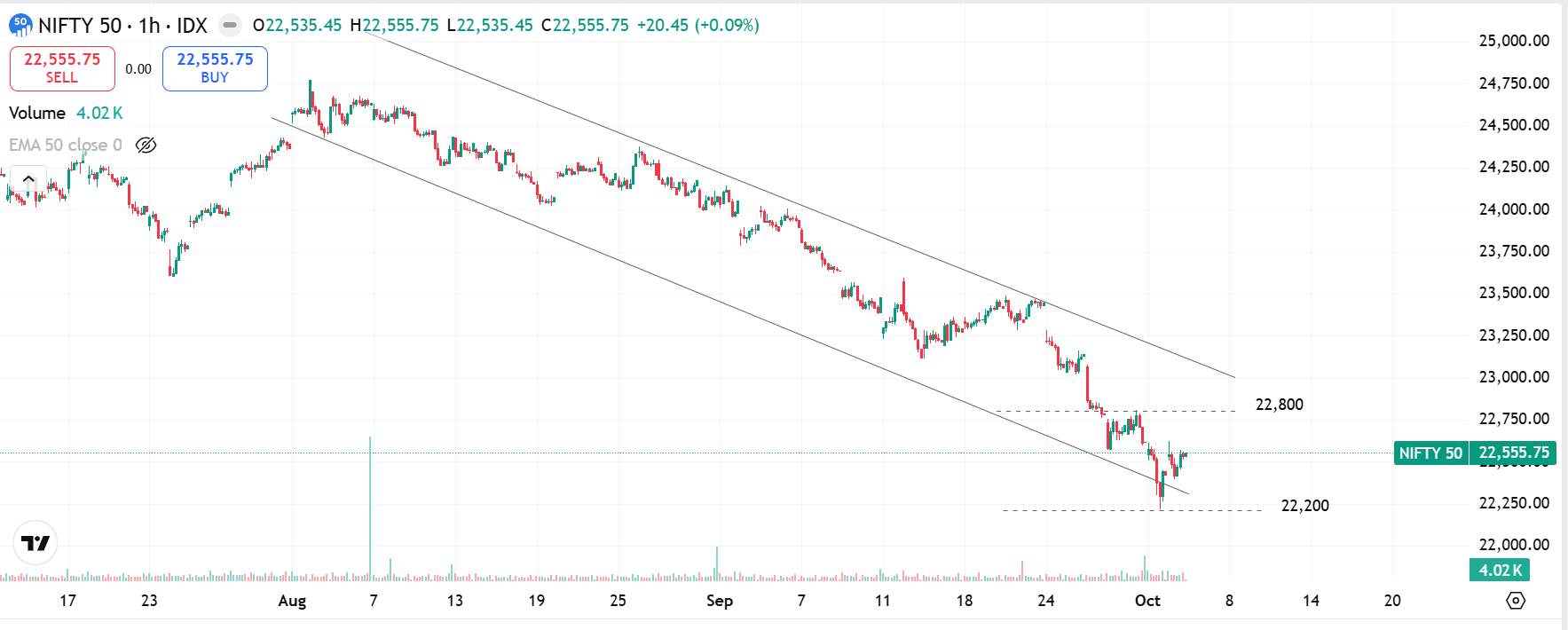
Indian equities are likely to remain steady with easing oil prices improving the sentiment. Nifty showed signs of recovery in the previous session, however the broader structure remains cautious.
On the upside, 22,600 remains the immediate resistance zone. A sustained breakout above 22,600 could strengthen the recovery and pave the way toward 22,800–23,000.
On the downside, 22,400 remains the immediate support, followed by the crucial 22,200 region.
Nifty: 22,555.75, +0.60%
Sensex: 72,382.47, +0.66%
Bank Nifty: 54,741, +0.48%
Global Market Movements
GIFT Nifty: GIFT Nifty futures is trading live at 22,648, a flat move from yesterdays Nifty close.
US Markets: US stock indices closed higher on Monday, October 5th, with Nasdaq gaining +0.9% , S&P 500 gaining+0.70%.
Asian Markets: Asian markets closed higher today with Nikkei 225 (Japan) gaining +0.37% and Hang Seng gaining +0.74%
Commodities
Brent crude: $100.6/barrel
Brent crude oil prices declined amid signs of improving crude shipments from the Middle East.
FII & DII Activity
FII: -4,699 crores
DII: +5,181 crores
Net Flow: +482 crores
The Investors Lens
Why Can an Expensive Stock Keep Rising?
If a stock already looks expensive, shouldn’t it fall? Then why do some of the “most expensive” stocks keep getting more expensive?
Because the market doesn’t price a company based only on what it earns today. It prices what investors believe it can earn in the future.
Imagine a company trading at 50× earnings. It may look expensive compared with a competitor at 20×. But if the first company can grow its earnings much faster, investors may still be willing to pay that premium.
And if those earnings keep growing faster than expected, the stock can continue rising, even at a high P/E.
This is why a stock trading at 50× earnings can sometimes become cheaper without its price falling. If earnings grow from ₹10 to ₹15, the same ₹500 stock now trades at roughly 33× earnings.
The reverse is also true. A stock at 15× earnings can fall sharply if its profits decline or future growth expectations weaken.
The takeaway:
A stock is not expensive simply because its P/E is high. What matters is the price you pay relative to the growth and quality you are getting. In markets, “expensive” stocks can keep rising as long as earnings and expectations keep catching up with the price.