What could happen today?
Indian markets could stay under caution ahead of today’s RBI policy decision. GIFT Nifty indicates a negative start for the indices today.
Nifty 50 showed positive momentum in the last session while reaching near the 22,800 zone which remains a key resistance zone.
On the upside, 23,000-23,070 is likely to act as the next resistance zone after 22,800.
On the downside, 22,600-22,550 acts as the next support level while 22,200 remains the broader support zone.
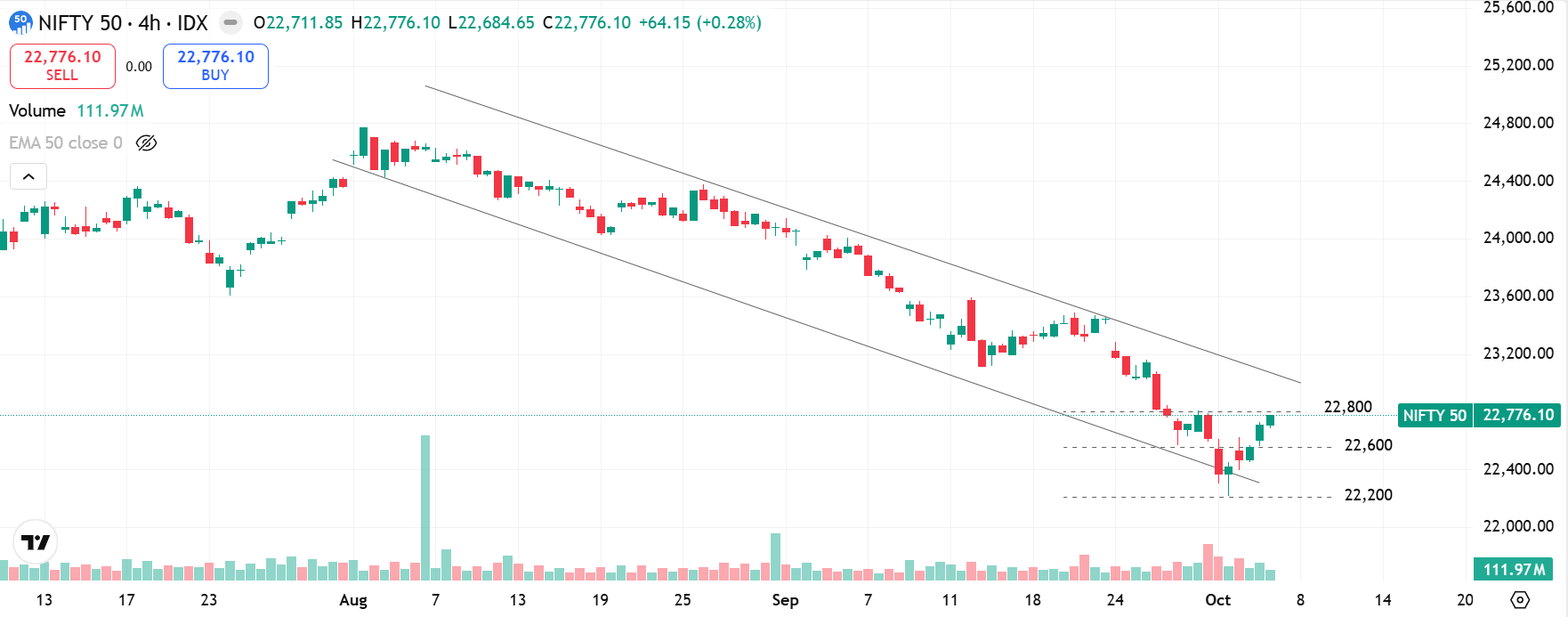
Nifty: 22,776, +0.98%
Sensex: 73,067, +0.95%
Bank Nifty: 55,128, +0.76%
Global Market Movements
GIFT Nifty: GIFT Nifty futures is trading at 22,680, lower than yesterdays Nifty close.
US Markets: US stock indices closed higher on Tuesday, October 6, 2026, led by major gains in tech sector.
Asian Markets: Asian markets traded mixed on Wednesday, October 7, 2026 with Nikkei 225 (Japan) trading flat to slightly lower, Kospi (South Korea) up by around ~0.35%.
Commodities
Brent crude: $101.5/barrel
Brent crude Oil crosses the $101/barrel mark again as persistent risks to Middle East energy flows outweighed signs of improving supply from the region.
FII & DII Acitivity
FII: -2,961 crores
DII: +5,089 crores
Net Flow: +2128 crores
The Investors Lens
How One Rate Change Decision Can Affect the Entire Economy?
A rate hike may look like a banking decision. A rate cut may look like a borrower’s benefit. But the impact goes far beyond both.
When interest rates rise, borrowing becomes more expensive. Companies may delay expansion, consumers may reduce spending, and demand can slow. Higher rates can also make fixed-income investments more attractive, while putting pressure on equity valuations as the cost of capital rises.
When rates fall, the cycle can work in reverse. Cheaper borrowing can encourage companies to invest, consumers to spend, and businesses to expand. Lower rates can also push investors towards equities and other riskier assets in search of better returns.
The impact eventually flows through banks → businesses → consumers → investments → markets → the broader economy.
But the effect is not always immediate. It can take months for a rate change to work its way through loans, spending, investment and corporate earnings.
The takeaway:
Interest rates are not just a number set by the central bank. They are a lever that influences the cost of money and the cost of money influences almost everything else.