What could happen today?
Indian equities are likely to open on a cautious note with improving corporate earnings, strength in IT sector providing some support. On the other hand, the conditions in the middle east and rising crude oil prices keeps the market under pressure.
On a technical basis, Nifty saw a strong recovery on the previous day with Nifty closing above the 22,700 mark. On the downside, 22,600 remains the immediate support level, followed by 22,500. Any move beyond 22,500 could accelerate the selling towards 22,300 mark. On the upside, 22,800 remains the immediate resistance zone and 23,000 is the broader resistance zone.
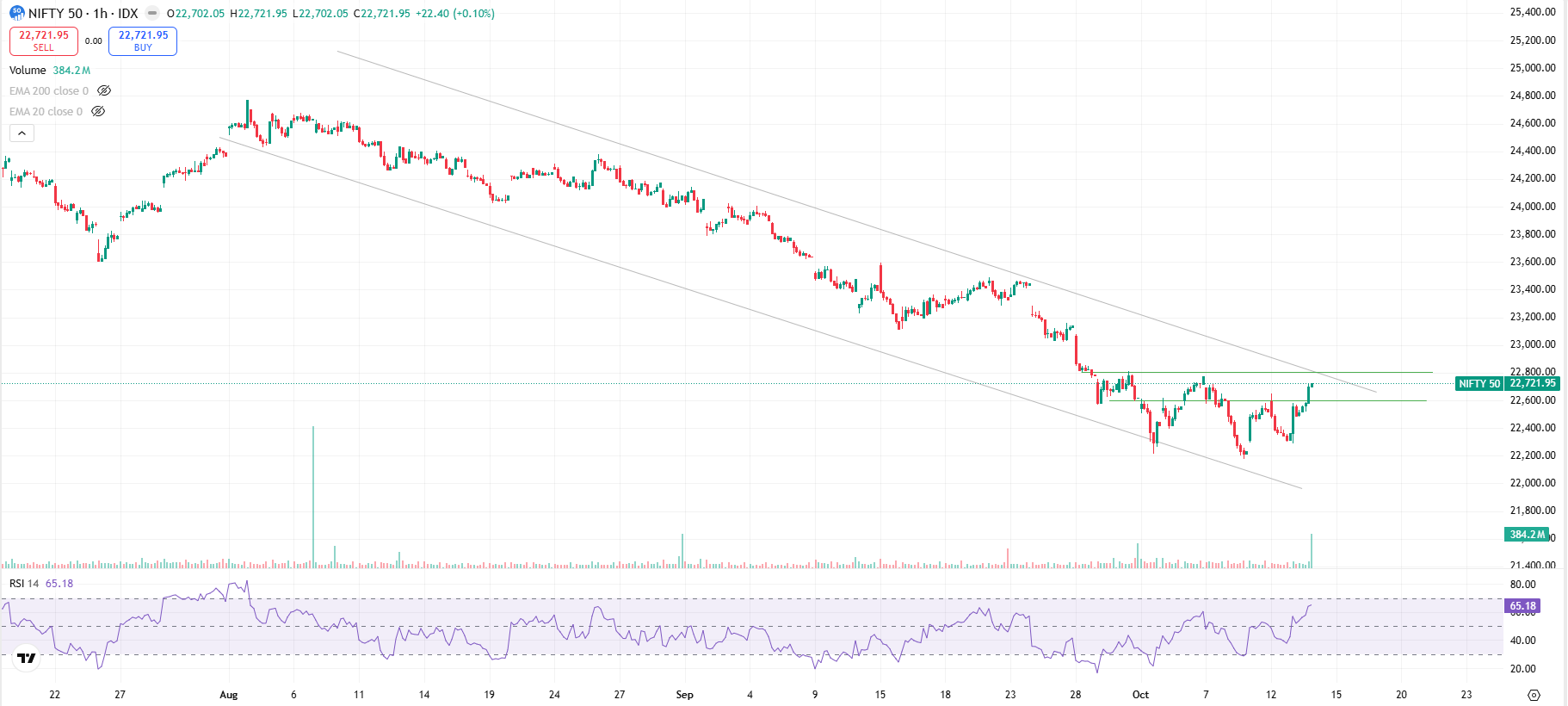
Nifty: 22,721.95, +1.60%
Sensex: 73,033.78, +1.54%
Bank Nifty: 55,481.05, +1.03%
Global Market Movements
GIFT Nifty: GIFT Nifty futures is trading at 22,766, indicating a flat start for the Indian indices.
US Markets: Major U.S. stock market indices closed lower on Tuesday, October 13, 2026, pressured by a sell-off in semiconductor and tech stocks.
Asian Markets: Asian stock markets are are trading mixed to positive today but semiconductor and tech shares face pressure following a pullback in US tech and chip stock.
Commodities
Brent crude: $106.6/barrel
Brent crude gains to $107 as Houthis attack Saudi Aramco building in new attacks.
FII & DII Acitivity
FII: -1,305 crores
DII: +2,439 crores
Net Flow: +1,134 crores
The Investors Lens
What Makes a Business difficult to compete with?
If a competitor can copy a product, cut prices and attract customers, what stops a successful business from losing its edge?
The answer is its competitive advantage, often called an economic moat, something that makes it difficult for competitors to take away its customers or profits.
A few examples make this easier to understand:
-
Brand power: Customers may choose Coca-Cola over a cheaper alternative because they trust the brand and prefer its taste.
-
Switching costs: Businesses may hesitate to leave a software provider because changing systems is expensive and disruptive.
-
Cost advantage: A company that produces goods more cheaply can maintain better margins or compete aggressively on price.
-
Network effects: A platform becomes more valuable as more people use it, making it harder for new competitors to catch up.
-
Distribution advantage: A company with a strong distribution network can reach customers faster and more efficiently than rivals.
But having an advantage today doesn’t guarantee it will last. Technology, changing customer preferences or a stronger competitor can weaken even an established moat.
The takeaway: When analysing a company, don’t just ask how much it earns. Ask why customers choose it, why competitors struggle to replace it, and how long that advantage can last. Sustainable advantages are what can help a business protect its profits and compound growth over time.