What could happen today?
Indian equity markets are likely to remain cautious through the session, with persistently elevated crude oil prices and geopolitical uncertainty. A sustained buying interest could support the recovery which is supported by strong earnings.
On the upside, 23,200 remains the immediate resistance zone and 23,400 is the next resistance which also fills the previous gap area. On the downside, 23,000–22,900 represents the immediate support zone, followed by 22,800. A sustained break below 22,800 could weaken the recovery and expose the index to further downside.
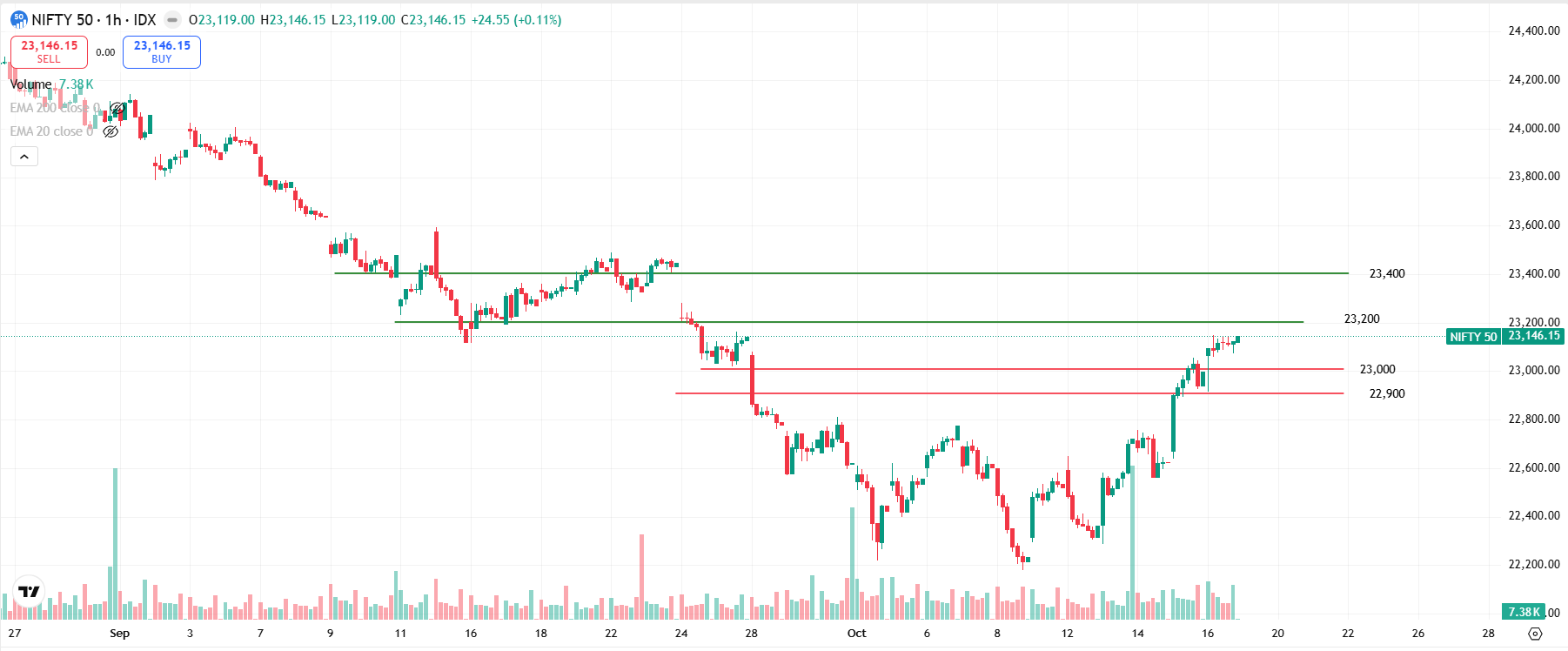
Nifty: 23,146.15, +0.65%
Sensex: 74,729.27, +0.56%
Bank Nifty: 55,844, +0.06%
Global Market Movements
GIFT Nifty: GIFT Nifty is currently trading at 23,118.00, up 53 points or 0.23% from its previous close, pointing toward a flat to positive opening for the domestic market.
US Markets: U.S. stock markets closed lower on Friday, October 16, pressured by a tech and semiconductor sell-off.
Asian Markets: Asian markets are trading lower today, pulled down by a tech and AI-related sell-off following losses on Wall Street
Commodities
Brent crude: $108/barrel
Crude oil prices recently climbed to around $110/barrel driven by escalating supply risks in the Middle East, attacks on critical energy infrastructure, and shrinking petroleum inventories.
FII & DII Acitivity
FII: +1,166 crores
DII: -3,661 crores
Net Flow: - 2,495 crores
The Investors Lens
What Is a Moat, and Why Does It Matter to Investors?
If a competitor offers the same product at a lower price, what stops a company from losing its customers? That’s where a moat comes in.
An economic moat is a lasting competitive advantage that helps a business protect its market share and profitability from competitors.
Think of it as a defence around a business. Some companies build their moat through:
- Brand power: Customers trust the brand and are willing to pay a premium.
- Switching costs: Moving to a competitor is expensive, inconvenient or risky.
- Cost advantage: The company can produce or deliver services more cheaply than rivals.
- Network effects: The product becomes more valuable as more people use it.
- Distribution strength: A wide, efficient network makes it difficult for competitors to reach the same customers.
But not every advantage lasts forever. Technology, new competitors or changing customer preferences can weaken a moat over time.
The takeaway: A good business makes profits. A business with a strong moat has a better chance of protecting those profits from competition. When analysing a company, don’t just ask how much it earns, ask what stops its competitors from taking those earnings away.