What could happen today?
Indian equity markets are likely to remain cautious as rising crude prices and sell-offs in the global markets due to a pressure on technology and AI-driven sectors create a negative environment.
GIFT Nifty futures point to a muted start for Indian equities and the broader corporate earnings season and positive sentiments and developments could lead today’s session which could be weighed by the rising crude prices.c
On a technical basis, the key level on the upside is 22,800 which acts as the immediate resistance zone followed by the 23,000 zone and 23,300 on the broader level. On the downside, 22,400 becomes the immediate crucial support zone followed by 22,200 on the the broader level.
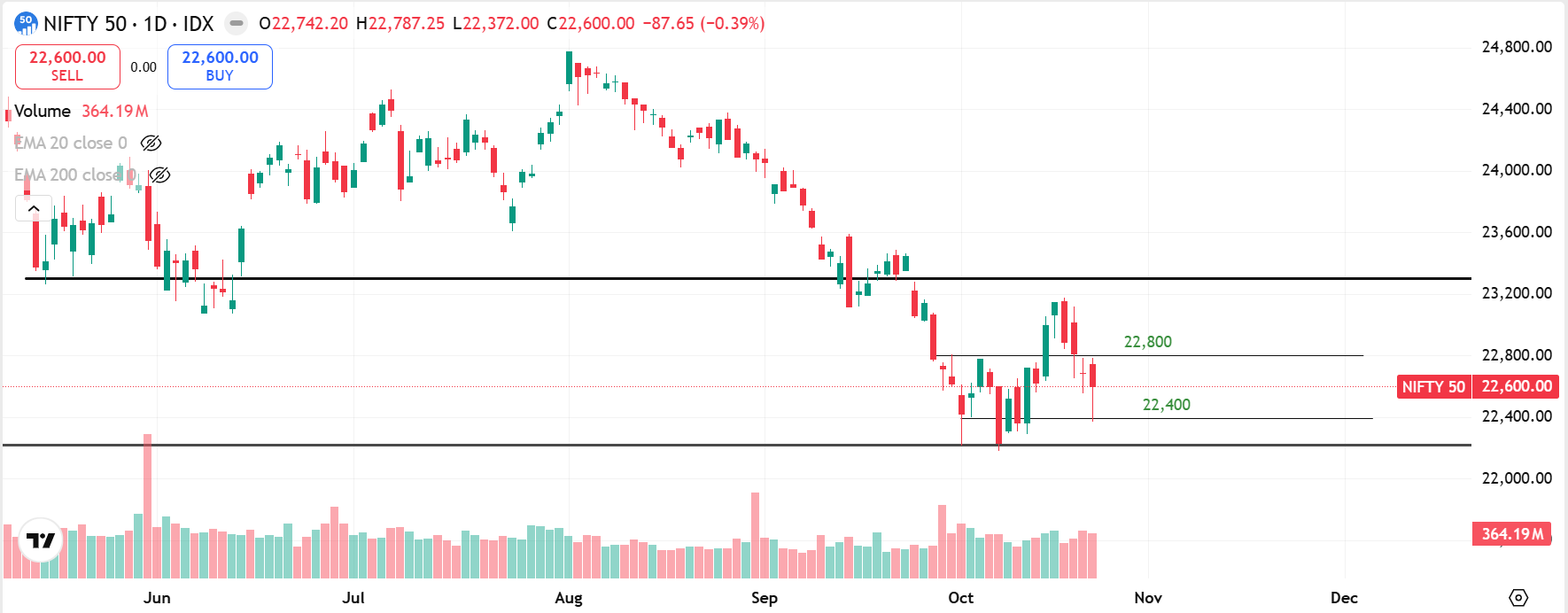
Nifty: 22,600, -0.39%
Sensex: 73,124, -0.17%
Bank Nifty: 54,287, -1.16%
Global Market Movements
GIFT Nifty: GIFT Nifty is currently trading at 22,609, a flat start from Nifty’s previous close, indicating a muted start for the domestic markets.
US Markets: US major stock indices closed lower on Friday, October 23, 2026, pressured by a broader pullback in the artificial intelligence (AI) and tech sectors.
Asian Markets: Asian stock markets are trading mixed to lower today with Nikkei 225 (Japan) down by -0.38%, Hang Seng Index (Hong Kong) down about -0.11%, SSE Composite Index (China) down -0.50%.
Commodities
Brent crude: $114.3/barrel
Brent Crude prices rise despite Middle East Export recovery.
FII & DII Acitivity
FII: +888 crores
DII: +3,235 crores
Net Flow: +4,123 crores
The Investors Lens
What does EBITDA tell us about a Company?
Ever wondered how a company can report strong sales but still struggle to make money? That’s where EBITDA comes in.
EBITDA stands for Earnings Before Interest, Taxes, Depreciation and Amortisation. In simple terms, it measures how much a company earns from its business operations before accounting for borrowing costs, taxes and certain non-cash expenses.
Think of a paint company. It earns revenue by selling paint, but it also spends on raw materials, manufacturing, employee salaries and transportation. After deducting these operating costs, what remains contributes to its EBITDA. A higher EBITDA or improving EBITDA margin can indicate better cost control, stronger pricing power or more efficient operations.
Why does this matter to investors? Because two companies may generate similar sales but have very different operating profitability. EBITDA helps investors compare their core business performance, and the EBITDA margin, EBITDA as a percentage of revenue shows how much operating earnings a company generates from every ₹100 of sales.
But there’s a catch. EBITDA is not the same as cash in the bank. It excludes interest, taxes and capital expenditure, so a company with high EBITDA may still face heavy debt repayments or large spending requirements. Investors should assess it alongside cash flow, debt and capital expenditure before drawing conclusions.
The takeaway? Revenue tells you how much a company sells; EBITDA helps show how efficiently its business operates. Neither alone tells the whole story.