What could happen today?
Indian equity markets are likely to remain cautious as crude prices remain around the $115 mark. Nifty showed good signs of strength yesterday after recovering from its low and closing at the day high with sustained buying in the second-half.
GIFT Nifty futures point to a muted to slightly negative start for Indian equities and the broader corporate earnings season could lead today’s session.
On a technical basis, on the upside, the immediate resistance level is 22,800 followed by the 23,000 zone and 23,300 on the broader level. On the downside, 22,400 becomes the crucial support zone which was tested in yesterday’s session, followed by 22,200 on the the broader level.
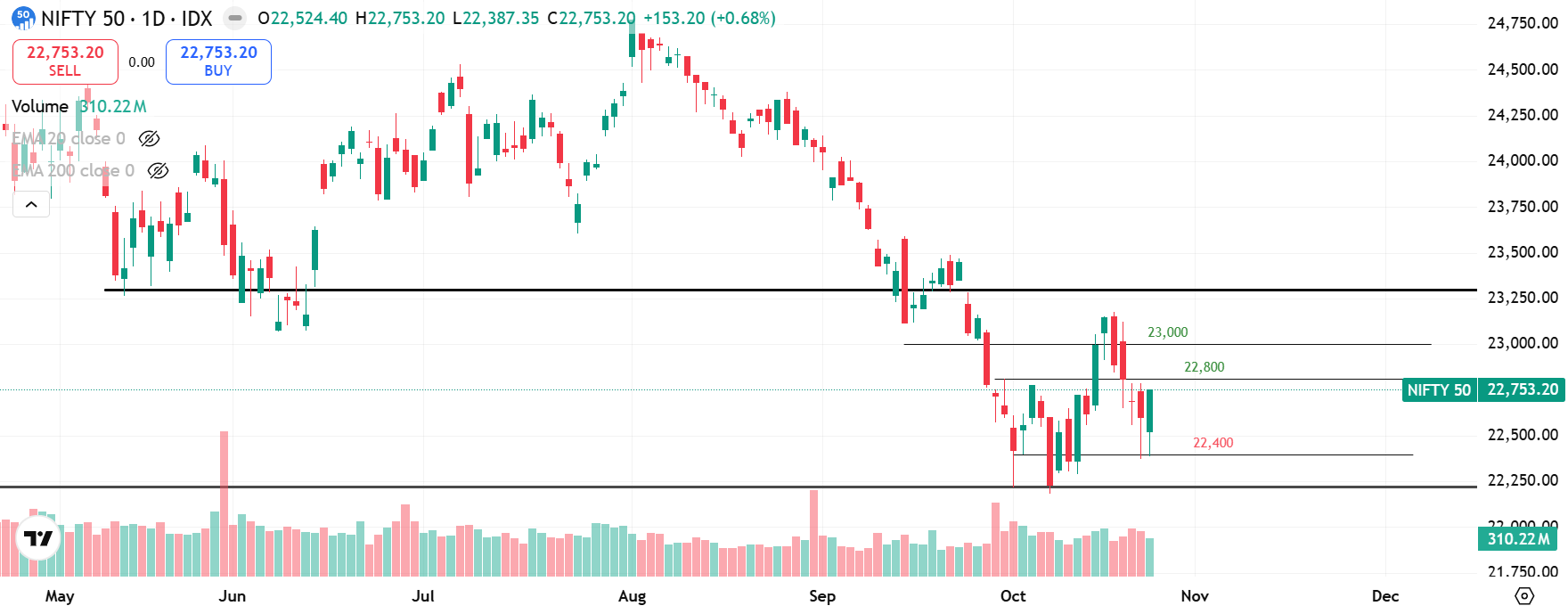
Nifty: 22,753, +0.68%
Sensex: 73,607, +0.66%
Bank Nifty: 54,367, +0.15%
Global Market Movements
GIFT Nifty: GIFT Nifty is currently trading at 22,671, indicating a muted to negative start for Nifty.
US Markets: U.S. stocks closed higher on Monday, October 26, 2026, as a strong rebound in technology and artificial intelligence (AI) related stocks lifted Wall Street.
Asian Markets: Asian stock markets traded mixed to slightly lower today with Nikkei 225 (Japan) down by -0.42%, Hang Seng Index (Hong Kong) trading up by +0.24% and KOSPI Composite (South Korea) down by −1.46%.
Commodities
Gold: ₹1,42,760
Gold price stands at ₹1,42,760 for 24K/10gm.
FII & DII Acitivity
FII: -1,462 crores
DII: +2,608 crores
Net Flow: +1,146 crores
The Investors Lens
Why are Recurring Revenues Valuable?
Imagine two companies earning ₹100 crore in revenue. One has to find new customers every month to maintain its sales, while the other already knows that a large portion of its customers will pay again next month. Which business would you find easier to plan for? That’s the advantage of recurring revenue.
Recurring revenue is income a company expects to receive repeatedly from existing customers. It is common in subscription-based businesses such as software platforms, streaming services, and membership models, but it also appears in annual maintenance contracts, renewals and repeat service agreements.
Why do investors value it? Predictability. When a company has a stable base of recurring revenue, it can estimate future income more confidently, plan expenses, invest in growth and manage cash flows more effectively. It may also spend less on constantly acquiring new customers just to replace lost sales.
Recurring revenue can also make a business more resilient during uncertain periods. Customers may continue paying for services they rely on, even when they cut back on other spending. That can make earnings less volatile than those of a business dependent on one-off sales.
But recurring revenue does not automatically mean a strong business. Customers can cancel subscriptions, demand discounts or switch providers. Investors should therefore look at customer retention, renewal rates, revenue growth, profit margins and cash flow to understand whether that recurring income is sustainable and profitable.
The takeaway?
One-time sales bring revenue today; strong recurring revenue gives a company greater visibility into tomorrow. The real value lies not just in customers paying repeatedly, but in keeping them for the long term while earning a healthy profit.