
What could happen today?
Nifty remained undecisive in the previous trading session and closed flat. Indian Markets could remain cautious today as crude steadies near the $115 mark. GIFT Nifty indicates a muted to negative start for the Indian indices whereas the international markets extended gains in the recent sessions.
On a technical basis, on the upside, 23,000 becomes a crucial resistance zone. On the downside, 22,500 is the immediate support zone followed by 22,200 on the the broader level.
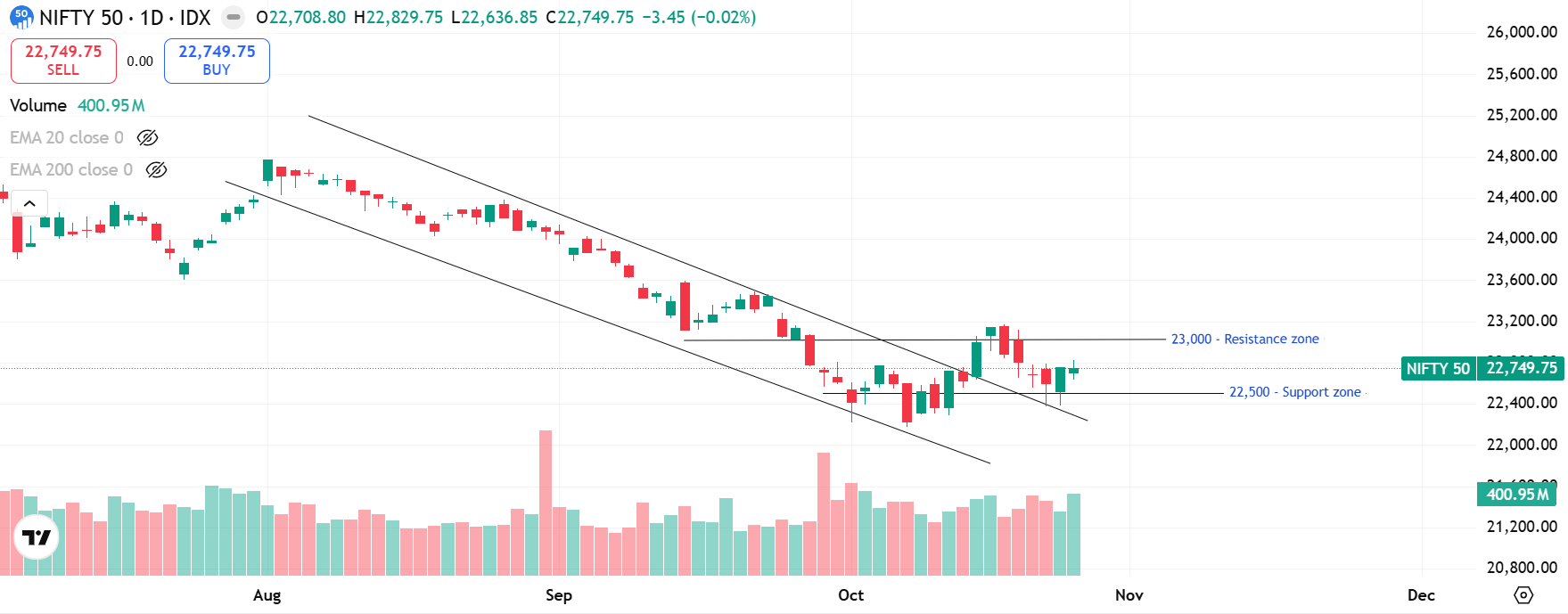
Nifty: 22,749.75, -0.02%
Sensex: 73,598.67, -0.01%
Bank Nifty: 53,974.90, -0.72%
Global Market Movements
GIFT Nifty: GIFT Nifty futures is currently trading at 22,626, indicating a muted to negative start for Nifty.
US Markets: U.S. stock markets extended their gains on Tuesday, Nasdaq closing +1.18%, S&P 500 closing + 0.60% up.
Asian Markets: Asian stock markets are trading higher on Wednesday morning with KOSPI (South Korea) surging +3.99%, Nikkei 225 (Japan) rising +1.31% and Hang Sang Index (Hong Kong) indicating an open of +0.30%.
Commodities
Brent Crude: $115.4/barrel
Brent Crude price hovers and holds around $115 while WTI trades at $100.
FII & DII Acitivity
FII: +4,240 crores
DII: -1,250 crores
Net Flow: +2,990 crores
The Investors Lens
What is a Value Trap?
A stock falls 40%, its P/E ratio looks cheap, and suddenly it seems like a bargain. But what if the stock is cheap for a reason? That’s where investors can fall into a “value trap”
A value trap is a stock that appears undervalued based on metrics such as its P/E ratio, price-to-book value or historical price, but whose business fundamentals continue to deteriorate. Investors buy it expecting the price to recover, only to find that the company’s earnings, growth or competitive position keep getting weaker.
Imagine a company whose share price falls from ₹500 to ₹250. It looks 50% cheaper. But if its profits have also fallen sharply and are expected to decline further, the stock may not be a bargain at all. Its lower price could simply reflect a weaker business.
So, how can investors spot a value trap? Look beyond the share price. Check whether sales and profits are growing, debt is manageable, cash flows are healthy and the company can defend its market position. Persistent market-share losses, falling margins, rising debt and repeated earnings disappointments can be warning signs.
Of course, a falling stock or a low P/E ratio does not automatically mean it is a value trap. A fundamentally strong company can become genuinely undervalued during a market correction. The key is to understand why the stock is cheap and whether its business can recover.
The takeaway: A cheap stock is not necessarily a good investment. True value comes from paying a reasonable price for a business with sustainable earnings not simply buying something because its price has fallen.