
What could happen today?
Nifty continues to take support from 22,500 and 22,800 remains a key hurdle for Nifty to cross. A decisive breakout and sustained move above 22,800 could strengthen Nifty’s position. With the earnings season in focus, Smallcaps and Midcaps extend their gains while elevated crude price and the geopolitical tensions weigh on Nifty.
On a technical basis, on the upside, the immediate resistance level is 22,800 followed by the 23,000 zone and 23,300 on the broader level. On the downside, 22,500 becomes the crucial support zone which has been tested multiple times, followed by 22,200 on the the broader level.
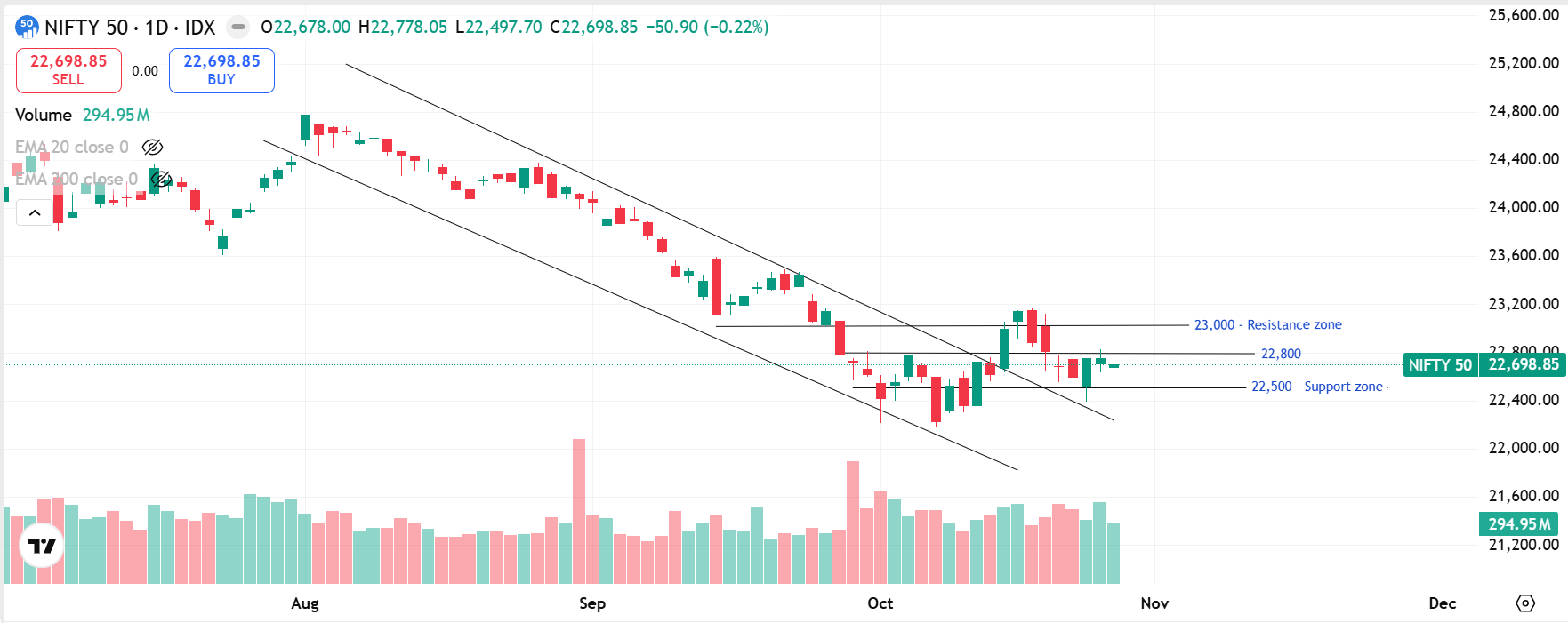
Nifty: 22,698.85, -0.22%
Sensex: 73,246.03, -0.48%
Bank Nifty: 54,267.40, +0.54%
Global Market Movements
GIFT Nifty: GIFT Nifty is currently trading at 22,681, indicating a muted start for Nifty.
US Markets: US stock markets closed positive for the third consecutive day on October 28, 2026, as investors digested the Federal Reserve’s decision to leave interest rates steady.
Asian Markets: Asian equity indices closed higher on Wednesday following Wall Street’s gains.
Commodities
Brent Crude: $114.4/barrel
Oil prices rise as U.S. reportedly tells Gulf countries to prepare for Iran strikes after midterm elections.
FII & DII Acitivity
FII: +872 crores
DII: +643 crores
Net Flow: +1,515 crores
The Investors Lens
Aerospace: More Than Just Building Aircraft
When you think of aerospace, you probably think of planes and rockets. But the real business opportunity stretches much further.
The aerospace industry covers the design, manufacturing, maintenance and servicing of aircraft, spacecraft and their components. It includes everything from engines and avionics to navigation systems, specialised materials and precision-engineered parts.
The industry has two major sides. Civil aerospace serves commercial airlines and private aviation, while defence and space aerospace includes military aircraft, satellites, launch systems and related technologies.
What makes this industry interesting is its supply chain. An aircraft contains thousands of components, and companies don’t necessarily need to build an entire plane to participate. They can supply engines, electronic systems, landing gear, specialised materials or replacement parts. Maintenance and repair also create recurring demand long after an aircraft is delivered.
For investors, the opportunity comes with a catch: aerospace businesses often require heavy investment, strict certifications and years of testing before a product reaches large-scale production. Orders can provide revenue visibility, but execution delays, cost overruns and dependence on a few customers can affect profitability.
The takeaway: Aerospace is not just a bet on more planes in the sky. It is a bet on the entire ecosystem that designs, builds, equips and maintains them.