
What could happen today?
Indian equities might show some signs of relief today as crude price eases, one of the top pullbacks for the market.
On the upside, 23,000 is likely to act as the key psychological resistance zone.
On the downside, 22,500 stays the broader support level to watch. A decisive breakdown below this level would likely accelerate selling and open the door toward 22,000 zone,
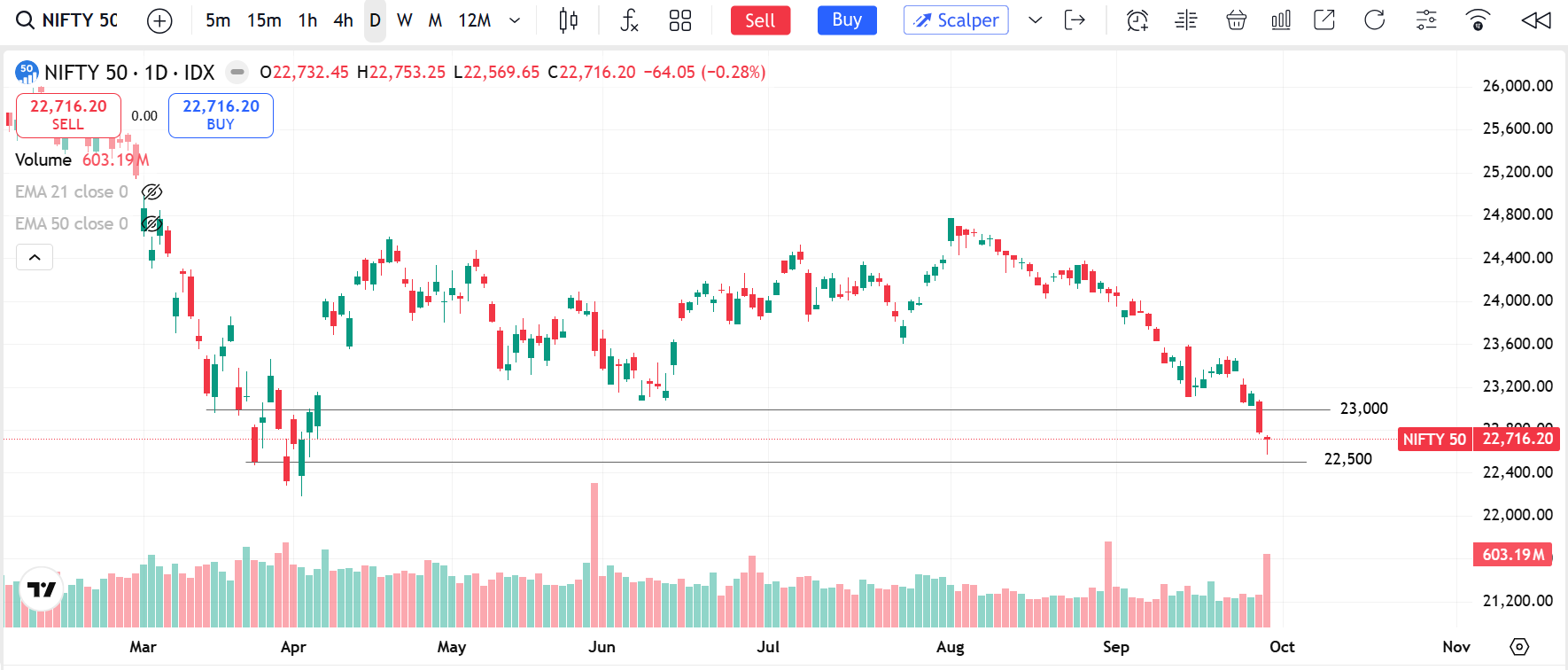
Nifty: 22,716, -0.28%
Sensex: 72,529, -0.33%
Bank Nifty: 54,259, -0.39%
Global Market Movements
GIFT Nifty: GIFT Nifty futures is trading live at 22,814, signaling a flat start for the domestic market today.
US Markets: U.S. stock indexes closed slightly lower on Tuesday, September 29th, with Nasdaq closing -0.09% down, S&P 500 closing -0.17% down.
Asian Markets: Asian stock markets are trading higher today after a three day selloff
Commodities
Brent crude: $103.3/barrel
Brent crude Oil price eases on signs of Middle East exports recovering.
FII & DII Activity
FII: -9,980 crores
DII: +6,952 crores
Net Flow: -3,028 crores
The Investors Lens
What Does P/E Ratio Actually Mean?
You’ve probably heard that a stock is trading at 20x or 50x P/E. But what does that number actually tell you?
P/E, or Price-to-Earnings ratio, compares a company’s share price with the earnings it generates per share. In simple terms: P/E = Share Price ÷ Earnings Per Share (EPS)
For example, if a company earns ₹10 per share and its stock trades at ₹200, its P/E is 20x.
That means investors are currently paying ₹20 for every ₹1 of the company’s annual earnings.
But here’s the important part: a high P/E does not automatically mean a stock is expensive, and a low P/E does not automatically mean it is cheap.
A high P/E can reflect expectations of stronger future growth, while a low P/E may reflect concerns about the company’s growth, profitability or future prospects. That’s why P/E is more useful when compared with the company’s own history and its industry peers, rather than viewed in isolation.
The takeaway: P/E is not just a number telling you how expensive a stock is. It tells you how much the market is willing to pay for the company’s current earnings and the expectations investors have about what those earnings could become.