The IT sector which created the AI, ironically has been the worst hit by AI.
What makes this particularly interesting is that AI has moved beyond being just another tool companies are experimenting with. It’s now challenging the very industry responsible for creating it, and recent developments across the global landscape shows how quickly this transformation is unfolding.
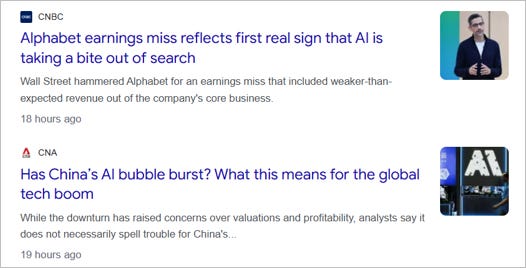
Last week, four big AI stories made headlines around the world, and behind all of them sits one simple question about money.
“What happens when the world spends trillions building something, without knowing how much it will earn?”
Imagine a shopkeeper in your area, taking a loan and opening multiple shops because he is sure that the neighborhood is about to boom. He might be completely right about it but there’s one problem, the loan repayment starts this month and the extra customers have not walked in yet.
Sounds like a risky investment right?
That’s the AI race today. Everyone wants a piece of the opportunity, but the cost of chasing it is becoming enormous.
The technology keeps getting better. The argument now is about money: enormous spending going out, still-small extra earnings coming in.
Billions are being poured into data centers, chips and AI models. But recently, some developments have started raising questions about whether the money being spent will generate enough returns.
And four recent stories explain this shift particularly well.
1. China’s AI Bubble
China was among the biggest beneficiaries of the AI rally, with investors pouring money into semiconductor, robotics and AI-related companies.
But the excitement started cooling.

The STAR 50 index, which tracks major Chinese technology companies was trading at 250x earnings at its peak. It fell approximately 40% from its June peak by October, wiping out around $480 billion in market value. AI makers MiniMax and Zhipu down over -85%.
AI was too big to fall alone. It took the whole market with it.
The problem? Profits never caught up to the prices, and investors started selling. Investors had priced in years of future growth, but actual profitability and business demand weren’t keeping pace with expectations.
The lesson is simple: A technology can have a brilliant future, but that doesn’t mean paying any price for it would make sense.
2. Anthropics Trillion Dollar IPO

Anthropic, which makes the Claude AI, has filed for an IPO. Reports say it wants a valuation of $1.5 to 2 trillion, against $965 billion just five months ago. Its revenue reached $16.8 billion in Q3 2026, compared with $11.6 billion in Q2 and $4.7 billion in Q1.
That’s more than 3.5 times growth in just two quarters!
But there’s a catch. The company reported a net loss of $80.7 billion in the first half of 2026, largely because of non-cash accounting adjustments related to its financing arrangements. That loss is mostly not cash spent. It is an accounting entry: as the company’s value rises, the paper value of some old funding contracts rises too, and the rules count that as a loss.
It has also committed enormous sums towards computing and infrastructure.
So here’s the question: If AI demand is growing so rapidly, why does building and operating these models cost so much?
This is an important IPO to watch out for as if the listing goes well, other AI companies may follow. If it goes badly, the whole sector will feel it. Either way, it is the first big test of what AI is really worth.
3. Microsoft is paying its own people to leave
Microsoft is offering buyouts, reported to cover 60,000 employees, about one in four worldwide. On October 26, Microsoft announced a voluntary exit programme for eligible employees across participating teams in the US, UK, Canada and India.

Why is this interesting? Microsoft is spending billions on AI infrastructure while companies are increasingly using AI to automate coding, research, customer support and other business operations.
It means companies are cutting real jobs today to pay for AI that has not yet paid for itself. It also highlights how companies are rethinking workforce requirements and reallocating resources.
AI isn’t just changing what companies sell. It’s changing how they operate.
4. Google earned 25% more and still its stock crashed
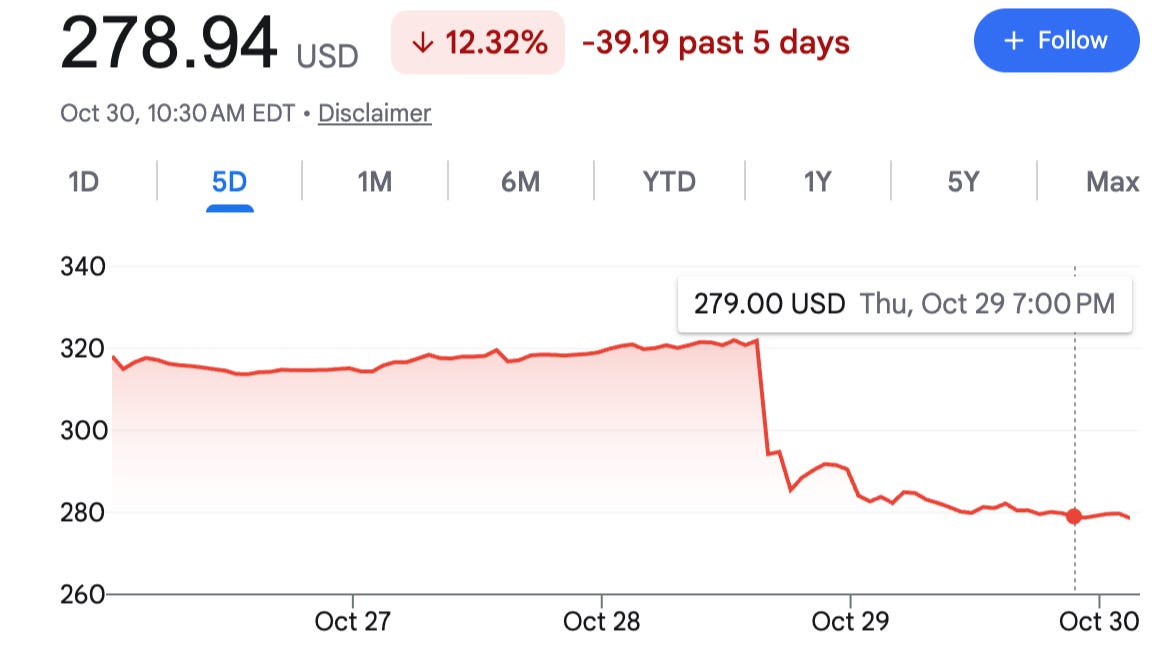
Alphabet’s July to September revenue was $127.6 billion, up 25%. But experts expected $128.2 billion, and in the stock market, missing the guess is what counts. The stock fell more than 10% in a day, its worst fall ever.
The deeper worry is cash. Google spent $51 billion on AI data centers in just three months, pushing its leftover cash about $9 billion into the negative. It is borrowing heavily to keep building; its loans have jumped nearly five times in a year, to $125 billion.
The Bigger Picture

AI could be creating enormous economic value, but the way money is flowing through the ecosystem deserves attention.
A significant portion of the AI boom is being fuelled by an interconnected network of investments, partnerships, debt and long-term commitments. Money invested in one part of the ecosystem often finds its way back into another, creating a cycle where companies are financing the very demand that drives their own growth.
This bears some resemblance to the circular financing seen before the 2008 housing crisis, where interconnected financial arrangements amplified growth and eventually magnified the risks. Of course, AI is a very different industry, with genuine technological progress, real infrastructure being built and rapidly growing customer demand.
And that’s what makes this situation interesting.
AI adoption is increasing, businesses are finding ways to improve productivity, and entirely new revenue opportunities are emerging. The technology could create economic value far beyond what we can currently measure.
But the challenge is ensuring that the money being invested today eventually translates into sustainable revenue, profits and cash flows. As long as spending keeps rising faster than the visibility on future returns, investors need to be careful about how much optimism is already reflected in valuations.
The AI opportunity is too significant to ignore, but too expensive to pursue blindly. The real winners will not necessarily be those spending the most on AI, but those who can turn that spending into lasting economic value.