NIFTY | Credit Spread (Expiry) | Signal-Driven | Directional Strategy
Directional trades are easy to take. The hard part is taking them only when pricing is wrong.
In options, the same directional view can be expressed in dozens of ways. The real edge often comes from identifying moments when the option chain briefly becomes mispriced—and structuring a trade that benefits when pricing normalizes.
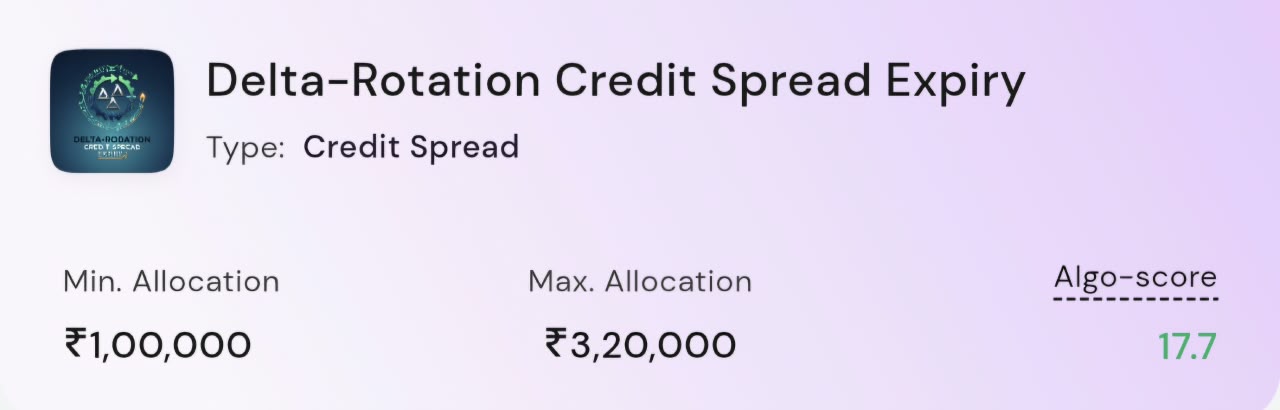
Delta-Rotation Credit Spread Expiry is built around this idea: it continuously reads the option chain for short-term inefficiencies and executes a defined-risk credit spread only when its signals show a clear bullish or bearish bias.
How does the strategy work?
Think of the option chain like a live “market mood board”.
Price alone tells you where the market is. The option chain helps estimate how the market is positioned and what it is pricing in.
Delta-Rotation turns that option-chain information into two core signals:
-
Alpha – a normalized score that blends option-chain features and price action.
-
Alpha2 – a related signal that links spot returns with changes in implied-volatility curvature.
What goes into Alpha?
The strategy combines multiple lenses, including:
-
Implied Volatility (IV)
-
Option Greeks (to infer positioning and sensitivity)
-
Curvature and its changes (shape of the volatility surface)
-
Entropy (how “ordered” vs “disordered” the chain looks)
-
Market energy (Hamiltonian) and related statistical components (eigenvalues)
-
Predicted volatility
The goal is not to forecast perfectly—it’s to identify when the current pricing looks unsustainably stretched and likely to mean-revert.
Trade direction logic (bullish vs bearish)
-
When the alpha conditions indicate a bullish bias, the strategy sets up a Credit Put Spread.
-
When the alpha conditions indicate a bearish bias, the strategy sets up a Credit Call Spread.
In both cases, it’s still the same philosophy: collect premium with a defined-risk structure when the signal quality is high.
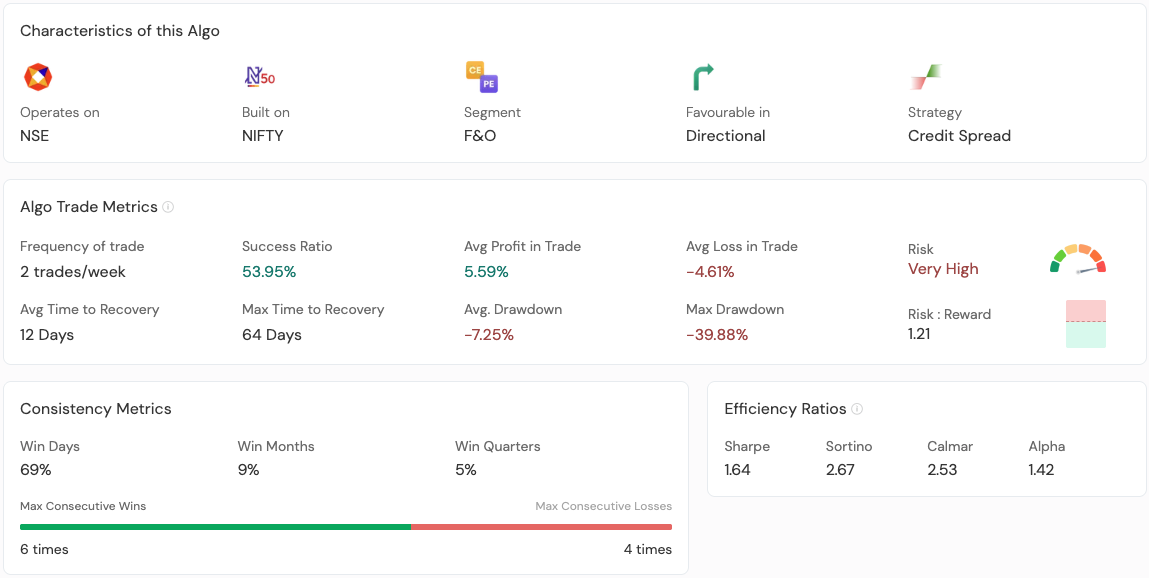
Strategy Snapshot
| Metric | Value |
|---|---|
| Underlying | NIFTY |
| Operates on | NSE |
| Segment | F&O |
| Strategy | Credit Spread (expiry-focused) |
| Favourable in | Directional |
What is the trade structure?
A credit spread means you:
-
Sell an at-the-money (ATM) option, and
-
Buy a protection leg to cap loss.
Delta-Rotation uses expiry-focused spreads:
-
Bullish signal → Sell ATM Put and buy an ITM Put for loss-capping.
-
Bearish signal → Sell ATM Call and buy an OTM Call for loss-capping.
This structure is designed to benefit when:
-
the underlying stays stable or moves moderately in the expected direction, and
-
time decay helps the sold option lose value.

Check the above image to get details on how trades are taken o this algo
Risk & execution discipline (why it doesn’t overtrade)
A key strength of Delta-Rotation is that it avoids stacking trades.
It enforces a strict execution checklist:
-
No overlapping positions: it will not open a new spread if one is already open.
-
Margin-aware risk: stop-loss is set as a percentage of required margin.
-
Defined target: aims for ~50% of max potential profit from the spread.
-
Time validity: trades only within allowed hours; avoids market-closed windows.
-
Expiry gating: checks the current expiry context before trading.
These rules are meant to protect the strategy from “signal noise” and force it to participate only when conditions are valid.
When does it perform best?
Delta-Rotation generally performs best when:
-
The option chain reflects a clear directional bias
-
Volatility surface and positioning metrics show temporary dislocations
-
Price action supports follow-through after a signal triggers
When should investors expect pressure?
It can face headwinds during:
-
Sudden news-driven spikes where spreads reprice instantly
-
Erratic whipsaws that flip signals without follow-through
-
Environments where IV and curvature stay distorted longer than usual
Final Thoughts
Delta-Rotation Credit Spread Expiry combines option-chain microstructure (IV, curvature, entropy, greeks) with price action to build a disciplined alpha signal—and converts that signal into defined-risk spreads.
It’s designed for investors who want a systematic, rules-based directional strategy that seeks to exploit short-lived inefficiencies while keeping execution controlled.