NIFTY | Credit Spread | Overnight | Volatility-Skew Strategy
What is this algo trying to do?
NIFTY options carry two pieces of information most traders don’t look at directly: how puts are priced relative to calls (the skew), and how much the index has actually been moving versus what that skew is pricing in. Gamma-Fluxer Credit Spread Overnight is built around reading these two inputs and positioning for the next session using overnight credit spreads.
It carries a Very High risk rating on the platform. That’s not a footnote - it’s the first filter to apply before reading further, because the rest of this write-up only makes sense for someone who has already accepted that risk level.
How does the strategy work?
Think about how vegetable vendors behave before a festival season - if onion supply is expected to fall short, prices start climbing before the shortage actually shows up, because sellers are pricing in what they expect to happen. Options markets work in a similar way. When traders expect a bigger move in one direction, they bid up the price of the options that protect against that move. This creates a gap — a skew — between what put options and call options cost relative to each other.
Gamma-Fluxer studies this skew (both on the put side and the call side), combines it with realised volatility (how much NIFTY has actually been swinging recently), and turns this into two conviction scores called alpha and alpha2.
-
When both alpha and alpha2 are strongly positive (alpha above 0.75, alpha2 above 0.7), the algorithm reads this as a bullish signal and sells a Credit Put Spread.
-
When both are strongly negative (alpha below 0.25, alpha2 below 0.3), it reads this as a bearish signal and sells a Credit Call Spread.
-
On days when the signals don’t clearly agree, the algorithm simply does nothing. It trades only about 3 times a week - it isn’t designed to be in the market every single day.
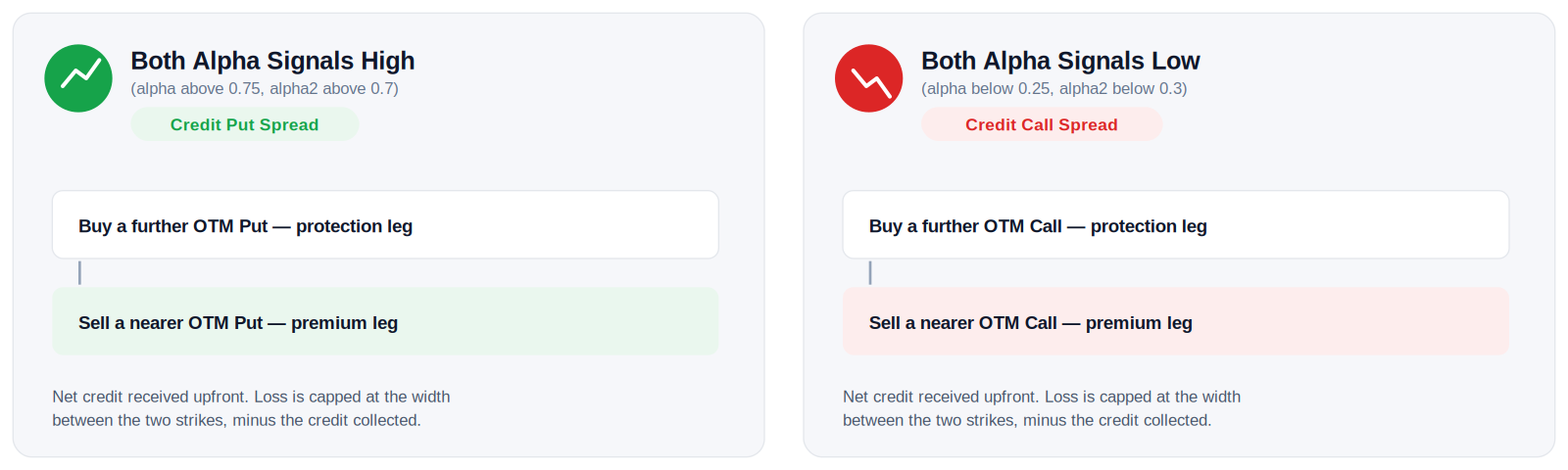
Each trade is built as a credit spread - one option is sold and a second, further-out option is bought against it. This caps the maximum possible loss upfront, unlike selling a naked option where losses are theoretically open-ended.
The algorithm also avoids trading at the edges of the day, right after the opening bell, right before the closing bell, and around monthly expiry, when option prices can move sharply for reasons that have nothing to do with its actual signal.
Beyond Individual Algos: The Power of Combining Strategies
Imagine owning only an umbrella. It’s extremely useful when it rains. But on a cold, windy day, a jacket would serve you far better. Now imagine carrying both — no matter how the weather changes, you’re prepared for it.
Trading strategies behave the same way. Different algos perform differently across changing market environments, and no single strategy — however well designed — is built to lead in every kind of market. Rather than expecting one algo to outperform all the time, combining multiple, uncorrelated strategies can smooth out the overall investment journey.
Seeing it in the data
On Stratzy, you can check this for yourself using the Combine Algo feature — it lets you select any algo and see its correlation with others, along with a combined equity curve based on equal-weighted allocation.
Gamma-Fluxer Credit Spread Overnight currently shows a correlation of just 0.04 with Damper Credit Spread and 0.11 with Zen Credit Spread Overnight — both close to zero, meaning the three tend not to move in lockstep. Looking at a combined allocation across Gamma-Fluxer, Damper, and Zen over the past year:
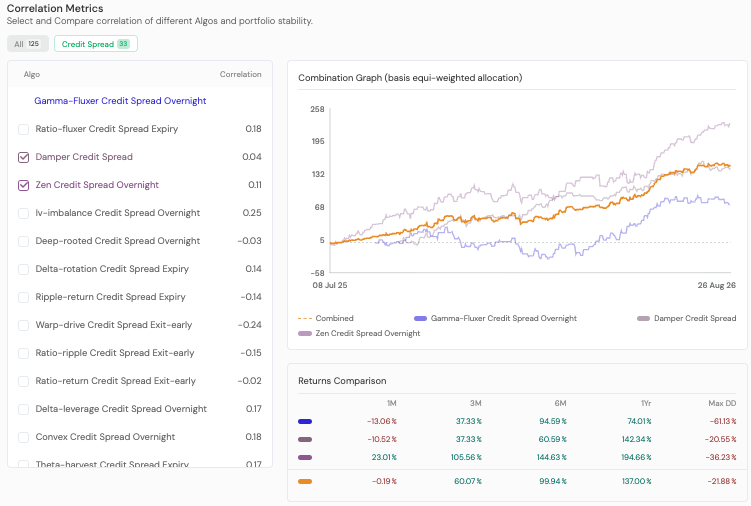
The combined portfolio’s maximum drawdown was meaningfully shallower than Gamma-Fluxer on its own, even while long-term returns held up well. That’s diversification doing what it’s meant to do — not eliminating drawdowns, but softening them.
With Stratzy’s Combine Algo feature, investors can build portfolios of multiple complementary strategies instead of relying on any single algo. It’s a tool worth exploring for anyone thinking about how their overall algo portfolio behaves across different market regimes — not just how one strategy performed last month.
Risk Management
-
If a trade moves against the position, a stop-loss — set as a percentage of the margin blocked for that trade — limits the damage.
-
If a trade moves in its favour, a target profit — set as a percentage of the premium collected — locks in gains instead of holding out for more.
-
The algorithm checks market-open status, trading hours, and expiry dates before entering, to sit out conditions it isn’t built for.
-
Every trade uses a spread structure, not naked option selling, so the worst-case loss on any single trade is known in advance.
-
Fewer than half of all trades are profitable (success ratio below 50%), which is expected for this kind of signal — the strategy is designed so that winning trades are, on average, larger than losing ones, not so that it wins most of the time.
Understanding the risk
This is the part that deserves the most attention before allocating any capital to this algo.
Gamma-Fluxer carries a Very High risk rating on the platform, and its drawdown history reflects that:
-
It has experienced a maximum drawdown of over 60% from a peak.
-
Recovering from a drawdown has, at its longest, taken over six months.
-
Losing streaks of multiple consecutive trades are a normal part of how this strategy behaves, not a sign that something has gone wrong.
Show Image
A drawdown of this size, with a recovery that can stretch past six months, is a structural feature of this strategy — not a rare tail event. Anyone considering an allocation should be financially and mentally prepared to sit through a drawdown of that scale without exiting midway, since stepping out during a drawdown is usually what turns a temporary loss into a permanent one.
Strategy Snapshot
| Metric | Value |
|---|---|
| Underlying | NIFTY |
| Strategy Type | Credit Spread |
| Holding Period | Overnight |
| Favourable In | Directional moves |
| Average Frequency | ~3 trades/week |
| Risk Level | Very High — suitable only for a high risk appetite |
| Risk : Reward | 1.33 |
| Recovery Time (Average / Maximum) | 23 Days / 185 Days |
Detailed return figures, month-by-month performance, and full risk-adjusted ratios are available on the algo’s page within the Stratzy platform.
Who is this strategy suitable for?
Gamma-Fluxer Credit Spread Overnight is best suited for investors who:
-
Have a genuinely high risk appetite and can stay invested through a deep drawdown without needing to exit early.
-
Can financially and mentally handle a recovery period stretching to six months or longer.
-
Understand that winning fewer than half of all trades is normal for this strategy, as long as winning trades stay meaningfully larger than losing ones.
-
Are looking for a defined-risk, data-driven way to take directional views on NIFTY overnight, rather than trading on discretion.
-
Treat this as one part of a diversified portfolio rather than a core, low-volatility holding.
This is not a strategy for anyone who needs stable, predictable outcomes, or who would be tempted to exit during a prolonged drawdown.
Final Thoughts
Gamma-Fluxer Credit Spread Overnight is a Very High risk, signal-driven strategy — it reads volatility skew and recent price behaviour to take defined-risk overnight positions on NIFTY, using credit spreads that cap the worst-case loss on every trade.
Before considering an allocation, weigh the mechanics and the risk profile described here — a Very High risk label, a drawdown history exceeding 60%, and recovery periods that can run past six months — against your own risk appetite and time horizon. For detailed performance data, visit the algo’s page on the Stratzy platform.