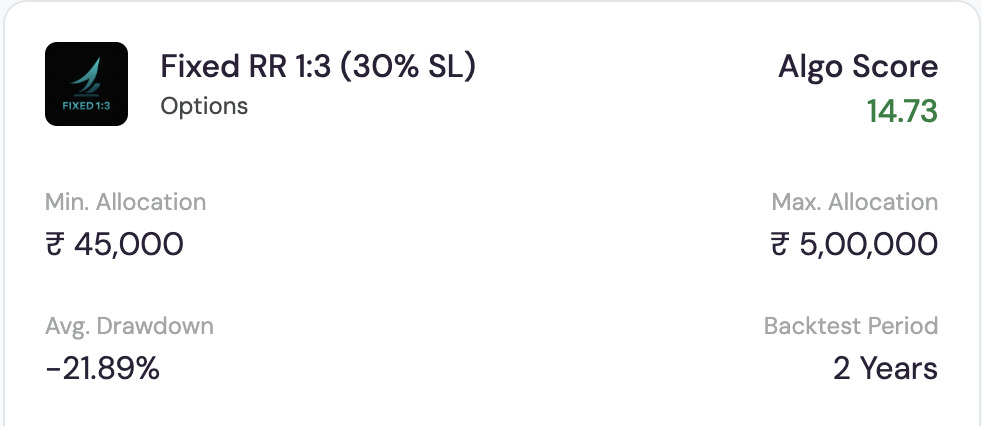
Fixed RR 1:3 (30% SL)
Nifty || Options Buying || Directional || Intraday
What is it?
Most options buyers fail not because they pick the wrong direction — but because they let small losses run and cut winning trades too early. Emotions take over. Fixed RR 1:3 removes that entirely.
It’s a pure rule-based options buying strategy on Nifty with one simple law: risk ₹1 to make ₹3. Every single trade. No exceptions. A 30% stop loss is set the moment the trade is entered, and the target is fixed at 3x that risk. The algo waits for its signal, fires the trade, and lets the math do the work.
The math that makes this work
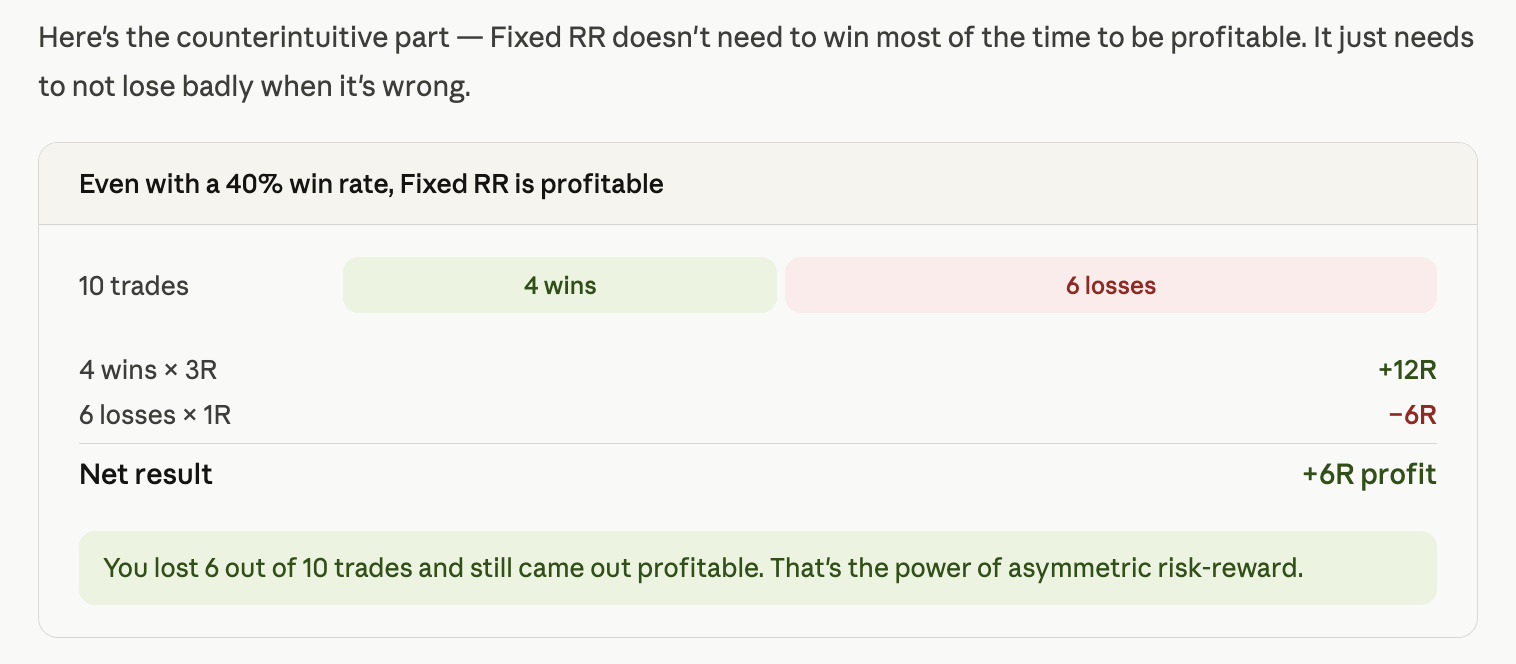
Most retail traders do the opposite — they take small profits quickly (1R) and let losses run (3R, 4R). Fixed RR enforces the discipline that the best professional traders spend years trying to build. The algo does it automatically, every trade, no exceptions.
Why is this different from just buying options yourself?
The problem with manual options buying
You buy a Nifty call. It goes up 20%. You think — let me wait for more. It reverses. Now you’re at break-even. You hold. It drops 30%. You panic and exit at a loss. Sound familiar? The problem wasn’t your view — it was the absence of a rule.
What Fixed RR does instead
The moment the trade is entered, two levels are set in stone — exit at -30% (SL) or exit at +90% (target, which is 3x the risk). There’s no watching, no second-guessing, no “let me wait a little longer.” The algo exits at whichever hits first. Emotion is structurally removed.
When does it work best?
Trending markets with momentum — where Nifty makes decisive intraday moves rather than chopping around
High volatility regimes (VIX above 16–18) — elevated premiums mean the 3x target is more achievable when the market moves
As a portfolio hedge — when your options selling algos are exposed, Fixed RR acts as a natural counterbalance during sharp moves
Sideways, low-volatility markets — when Nifty is going nowhere, options premiums decay fast and hitting a 3x target becomes difficult
Very low VIX environments (below 12) — thin premiums mean the absolute rupee target is smaller, and theta decay is your enemy
How it fits in a portfolio
Fixed RR is not meant to be your only algo. It’s designed to complement options selling strategies like Damper Credit Spread. Here’s why that pairing works:
Market crashes = Your selling algos take a hit. Fixed RR’s options buying position explodes in value — partially or fully offsetting the loss.
Market stays calm = Fixed RR hits its SL (small, defined loss). Your selling algos collect premium and more than make up for it.
This is exactly why the ~10% options buying allocation in the 10L+ regime framework exists — Fixed RR is built for that role.
Who is this for?
Anyone starting at ₹45,000 who wants directional exposure with fully defined risk. It’s also ideal for experienced deployers looking to add a hedge against sharp market moves to their existing options selling portfolio. The lowest minimum capital of any Stratzy algo makes it accessible from day one.
Available on Stratzy. You can backtest it and deploy directly — no manual intervention once it’s live. Check the previous spotlight on Damper Credit Spread to see how these two algos are designed to work together.
Do you currently run Fixed RR as part of your portfolio? And what algo should we cover next in the series? Drop it below 