Nifty || Credit Spread || Overnight || Hedged
Curvature Credit Spread Overnight: The NIFTY Algo That Trades While You Sleep
Understanding Market Imbalances Instead of Chasing Market Direction
Every trader has experienced days when the market appears to be moving decisively in one direction, only to reverse unexpectedly a few hours later.
The difficult part isn’t identifying whether the market is moving—it’s understanding whether the move is sustainable or simply a temporary imbalance.
Curvature Credit Spread Overnight was designed to address this challenge.
Rather than attempting to predict every market move, the system continuously studies how option prices behave across different strike prices and looks for situations where pricing relationships become temporarily distorted. When these distortions begin to move back towards their normal behaviour, the system looks for opportunities with a higher probability of success.
Like every systematic strategy, its objective isn’t to be right every time—it’s to consistently follow a researched process that aims to improve the probability of favourable outcomes while managing risk through predefined rules.
How Does the System Work?
Imagine a traffic police officer managing a busy junction during peak hours.
Most people simply notice whether traffic is moving or stuck. The officer, however, notices something more important—whether vehicles are flowing evenly across all lanes. If one lane becomes unusually congested while another remains empty, experience suggests that the imbalance often corrects itself as vehicles redistribute.
The system observes the options market in a similar way. Instead of focusing only on whether NIFTY is moving up or down, it continuously studies how option prices are behaving across different strike prices. When pricing relationships become unusually stretched compared to their normal behaviour, the system doesn’t react immediately. It waits until predefined conditions improve the probability that the imbalance is temporary rather than structural. Only then does it construct a defined-risk overnight credit spread.
The objective isn’t to predict tomorrow’s market direction.
The objective is to participate only when market behaviour aligns with the statistical characteristics the system was designed to capture.
Every Trade Passes Through Risk Filters
A trading signal alone doesn’t make a robust strategy.
Before a position is taken, every opportunity passes through a series of predefined rules that form the strategy’s Risk Management System (RMS).
These rules determine:
-
Whether current market conditions are suitable for a trade.
-
Whether the statistical edge is sufficiently strong.
-
How much capital should be exposed.
-
When the position should be exited if market behaviour changes.
This disciplined process means the system may deliberately skip many trading opportunities.
Missing a trade is sometimes a better outcome than participating in a low-conviction setup.
The goal is not to maximise the number of trades—it’s to improve the quality of the trades that are taken.
Performance Reflects the Process, Not the Objective
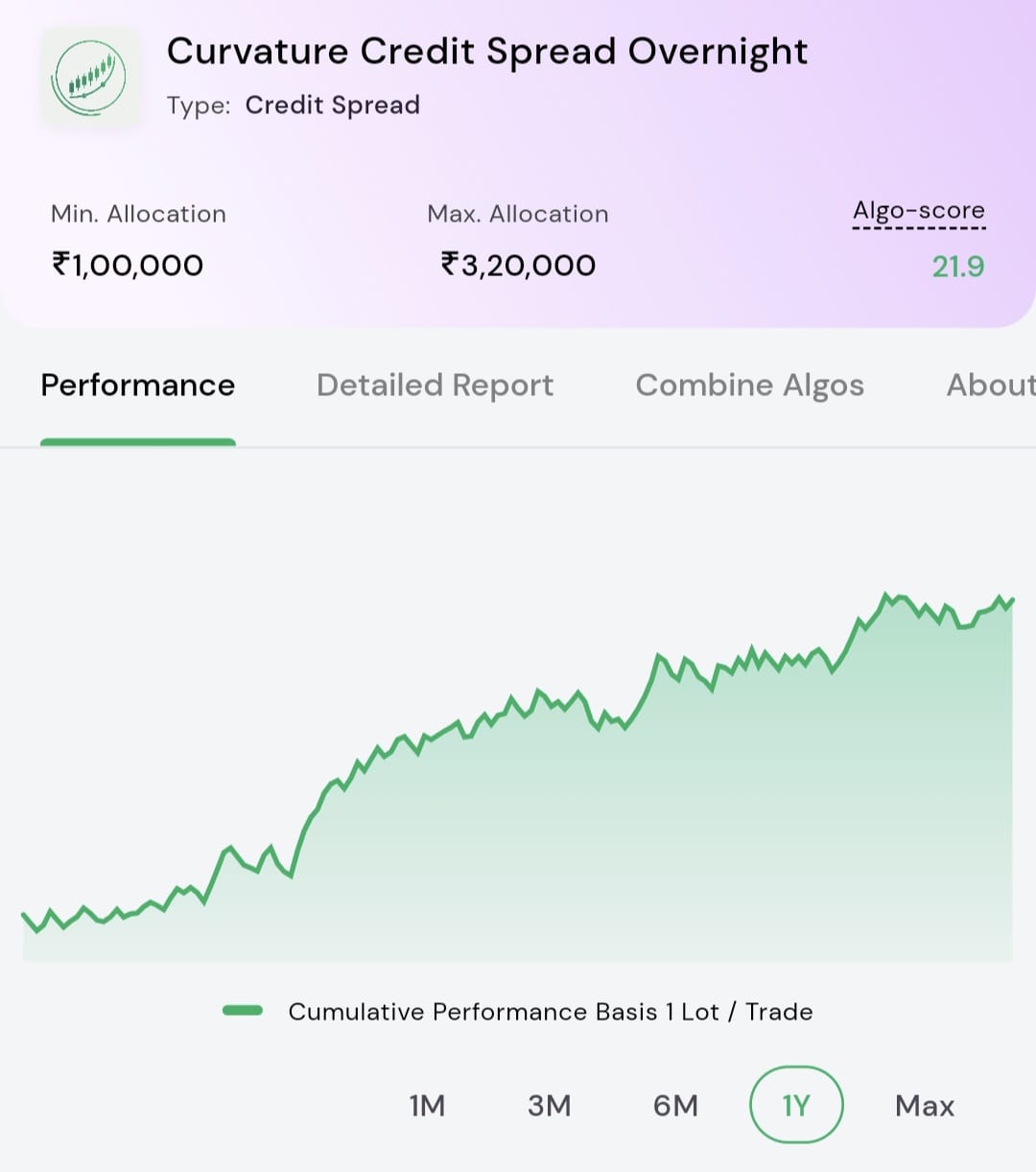
Historical performance is an outcome of consistently following the system’s rules—it is not the objective of the system itself.
Performance Snapshot
| Metric | Value |
|---|---|
| Since Inception Return | 171.12% |
| CAGR | 151.93% |
| 6 Month Return | 39.57% |
| 3 Month Return | 19.91% |
| 1 Month Return | -1.50% |
Risk-adjusted metrics also help evaluate how efficiently the system has delivered returns over time.
-
Sharpe Ratio: 2.11
-
Sortino Ratio: 3.63
-
Success Ratio: 53.33%
-
Average Profit: 5.58%
-
Average Loss: -4.33%
-
Average Recovery Time: 10 Days
These numbers provide historical context, but they should always be viewed alongside the strategy’s process, risk profile and suitability—not in isolation.
The August 2026 Drawdown: What Happened and Why
Lets check the performance of the most recent months of this algo.

Early August 2026 was a rough patch. A single overnight signal — a credit call spread on NIFTY — moved against the position when the sold call moved sharply in-the-money before the trade could be closed out. That one signal alone cost the algo -12.07% (-₹38,626.25) for the month so far, in a position that was opened at 10:43 PM on July 31 and closed the next morning at 9:16 AM.
In traffic-cop terms: this was a lane that stayed jammed well past the point the model expected the signal to clear it. The imbalance didn’t correct the way it usually does — it extended further instead — and by the time the position was closed, the loss was locked in.
This is a useful reminder of what “defined risk” actually means in practice: the loss was capped by the bought option in the spread, but capped doesn’t mean small. When the market imbalance the algo is reading doesn’t correct the way it’s expected to, a credit spread can still produce a meaningful one-trade drawdown. That’s a known characteristic of this style of strategy, not a flaw to gloss over — and it’s exactly why evaluating any algo over a full cycle, not one trade or one month, matters.
When Does Curvature Work Best — and When to Be Cautious?
✓ Temporary unevenness in how option prices move across strikes, that tends to correct
✓ Stable, orderly options activity
✓ Normal volatility environments
When to be cautious
✗ Sudden news events
✗ Strong, sustained one-sided trends
✗ Extreme volatility spikes
Why Diversification Matters: Combining Curvature With Other Algos
Imagine owning only an umbrella. It’s extremely useful when it rains. But on a cold, windy day, a jacket would serve you far better. Now imagine carrying both — no matter how the weather changes, you’re prepared for it.
Trading strategies behave the same way. No single algo, however well designed, is built to lead in every kind of market. Rather than expecting one strategy to outperform all the time, combining multiple, uncorrelated strategies can smooth out the overall investment journey.
Seeing It in the Data
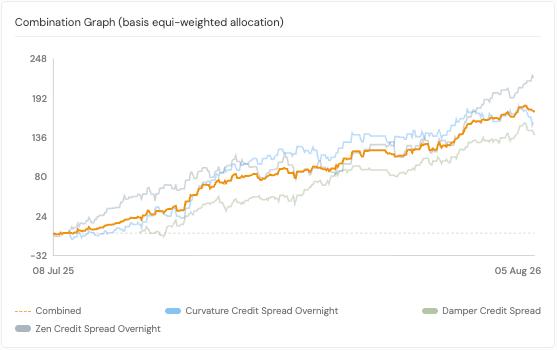
On Stratzy, the Combine Algo feature lets you check this for any algo — correlation with others, plus a combined equity curve based on equal-weighted allocation.
Curvature Credit Spread Overnight currently shows a correlation of just 0.10 with Damper Credit Spread and 0.11 with Zen Credit Spread Overnight — both close to zero. Interestingly, it also shows a correlation of just 0.11 with Convex Credit Spread Overnight, the algo we covered in Algo Spotlight #10 — worth knowing if you’re holding both, since it means they tend to have their good and bad days largely independently of each other.
Looking at a combined allocation across Curvature, Damper, and Zen over the past year:
| 1M | 3M | 6M | 1Yr | Max Drawdown | |
|---|---|---|---|---|---|
| Curvature Credit Spread Overnight (alone) | -1.50% | 19.91% | 39.57% | 158.38% | -27.97% |
| Combined (Curvature + Damper + Zen) | 8.70% | 49.14% | 80.99% | 166.98% | -14.26% |
The combined portfolio’s maximum drawdown was roughly half of Curvature’s on its own, while long-term returns held up well — in this case even ahead of Curvature alone. That’s diversification doing its job: not eliminating drawdowns, but softening them.
With Stratzy’s Combine Algo feature, you can build a portfolio of complementary strategies instead of leaning on any single algo — and check exactly how correlated (or uncorrelated) your current holdings really are before adding another one.
Frequently Asked Questions
What is Curvature Credit Spread Overnight? It’s a NIFTY-based options algo on Stratzy that trades overnight credit spreads, positioning for uneven option pricing across strikes to rebalance. It’s classified as a high-risk, directional strategy under the Credit Spread category.
Is Curvature Credit Spread Overnight safe? Every trade uses a defined-risk credit spread, meaning the maximum loss on any single trade is capped in advance. “Capped” doesn’t mean small, though — a single trade cost -12.07% in August 2026, so it should be sized and combined with other strategies accordingly.
What was Curvature’s biggest drawdown? Its maximum drawdown to date is -27.97%, with an average drawdown of -5.51% and an average recovery time of 10 days (worst case, 48 days).
How do I combine Curvature with other algos on Stratzy? Use the Combine Algo tab on the algo’s page to check correlation with other algos and preview a combined equity curve before allocating.
What is the minimum investment for Curvature Credit Spread Overnight? The allocation range is ₹1,00,000 to ₹3,20,000, based on current platform limits.
 The strategy doesn’t assume that pricing inefficiencies exist only at ATM CE strikes all the time. The strike selection is part of the overall system design and has been arrived at after extensive research and testing across different market conditions.