NIFTY | Credit Spread | Overnight | Mean-Reversion Strategy
Markets don’t move in straight lines—and neither do successful trading strategies.
One of the biggest mistakes traders make is judging a strategy based on a few recent trades or a single month’s performance. Markets constantly transition between trending, range-bound, and volatile phases. A strategy designed for one regime may temporarily underperform in another before regaining its edge.
IV-Imbalance Credit Spread Overnight is built around this very principle. Instead of chasing momentum, it looks for situations where price and volatility have moved away from equilibrium and attempts to capitalize on the probability of mean reversion using defined-risk credit spreads.
How does the strategy work?
Imagine you’re driving on a highway.
You wouldn’t decide to overtake another vehicle just because it looks slow. Before making the move, you’d quickly check your mirrors, the speed of nearby vehicles, and whether the road ahead is clear. Only when all these signals suggest it’s safe would you overtake.
This strategy follows a similar approach.
Instead of placing trades based on just the market’s direction, it first checks whether multiple market signals agree with each other. It looks at three key factors:
-
Price Movement – Is the market making a meaningful move, or is it just random noise?
-
Trading Activity (Volume) – Are enough traders participating to support that move?
-
Market Volatility – Is the market calm enough for the strategy to have a higher probability of success?
A trade is placed only when all these signals point in the same direction. This helps the strategy avoid many low-confidence setups where the market is uncertain.
Once a high-conviction opportunity is identified:
-
If the market is expected to remain stable or move slightly upward, the strategy creates a Credit Put Spread.
-
If the market is expected to remain stable or move slightly downward, it creates a Credit Call Spread.
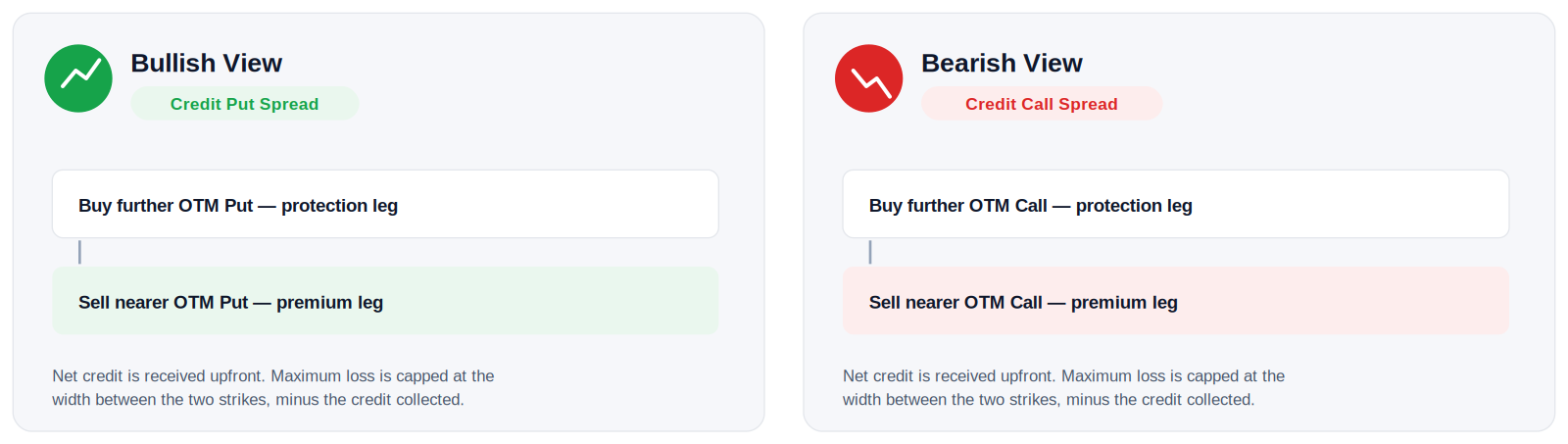
Think of a credit spread like running a small insurance business.
You collect a premium from others, but you also purchase your own insurance to limit how much you can lose if something unexpected happens. While this slightly reduces the maximum profit, it also keeps the risk predefined and controlled.
Since trades are carried overnight, the strategy is also designed to benefit from opportunities that may unfold over the next trading session rather than trying to capture every intraday move.
When does it perform best?
This strategy generally performs well when:
-
Markets experience temporary overextensions before reverting
-
Option premiums remain elevated
-
Volatility and volume provide reliable confirmation
-
The market avoids prolonged one-sided directional trends
When should investors expect pressure?
Like every quantitative strategy, this algorithm also experiences periods where its edge temporarily weakens.
It can face headwinds during:
-
Strong trending markets with limited pullbacks
-
Sudden news-driven directional moves
-
Extended periods where mean reversion fails to materialise
Such environments can lead to temporary drawdowns before the strategy adapts to changing market conditions.
Understanding Recent Performance
One of the most common behavioural mistakes investors make is evaluating a strategy based only on its latest monthly return.
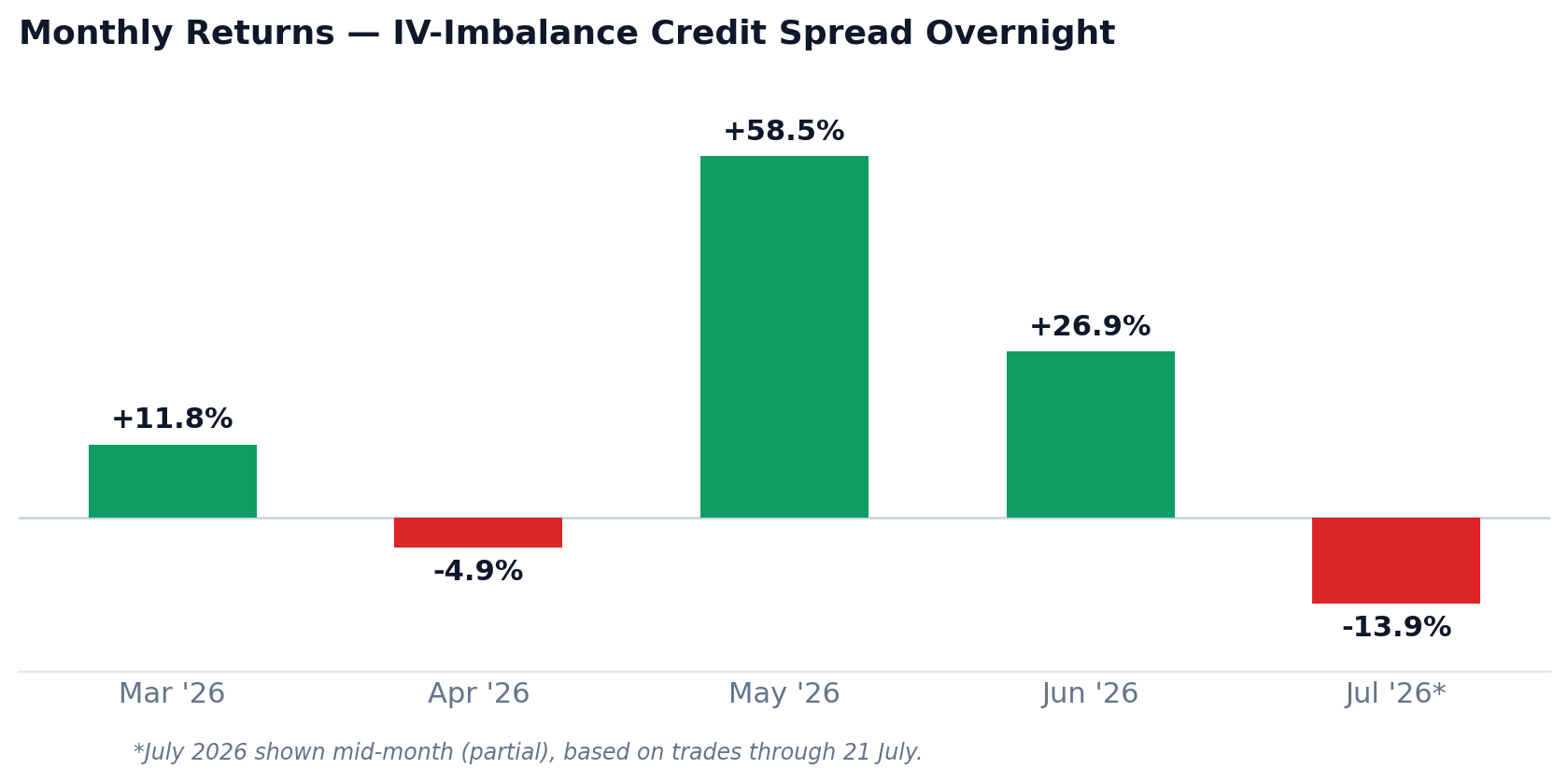
A single negative month does not define the long-term quality of a strategy.
Markets move in cycles, and systematic strategies naturally go through periods of outperformance as well as temporary underperformance.
Think of it like a roller coaster—there will always be climbs, dips, and sharp turns. Exiting the ride during every dip often means missing the recovery that follows.
The focus should always remain on the long-term consistency of the strategy, its risk-adjusted returns, and whether it continues to behave as designed rather than reacting emotionally to short-term fluctuations.
Who is this strategy suitable for?
IV-Imbalance Credit Spread Overnight is best suited for investors who:
-
Understand that systematic investing requires patience.
-
Are comfortable with temporary drawdowns in pursuit of long-term performance.
-
Prefer defined-risk option-selling strategies over naked option selling.
-
Want exposure to an overnight quantitative strategy driven by market data rather than discretionary decisions.
Final Thoughts
No algorithm wins every week, every month, or every market regime.
The true strength of a systematic strategy lies not in avoiding drawdowns altogether, but in maintaining a disciplined process, managing risk effectively, and delivering favourable risk-adjusted performance over complete market cycles.
IV-Imbalance Credit Spread Overnight is designed with this philosophy at its core—using quantitative signals, defined-risk spreads, and disciplined execution to navigate changing market conditions while staying focused on long-term consistency rather than short-term noise.