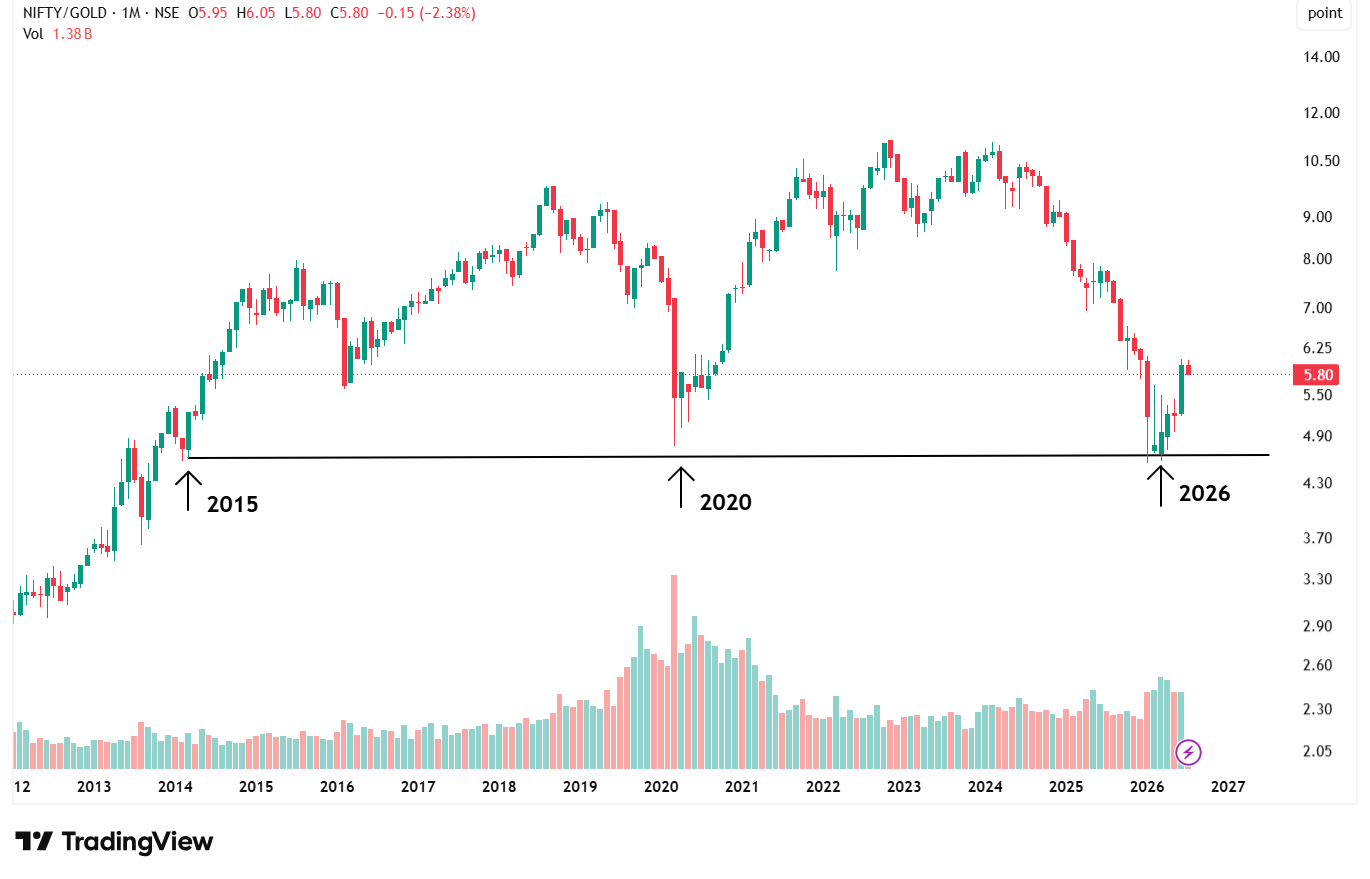
2014–15: The Beginning of Equity Leadership
The year 2014 marked a major shift in the Indian investment cycle. After nearly a decade of strong gains in gold, global conditions began to change as the U.S. economy recovered, the Federal Reserve started reducing monetary stimulus, and the U.S. dollar strengthened. At the same time, India witnessed a stable government with strong reform expectations, renewed investor confidence, and increasing foreign institutional inflows. As economic growth prospects improved, investors gradually shifted from safe-haven assets like gold to risk assets such as equities. This transition marked the beginning of a multi-year phase where the Nifty significantly outperformed gold.
2020: Liquidity Fueled a New Bull Market
The COVID-19 pandemic initially caused panic across global markets, leading investors to rush toward gold as a safe-haven asset. This pushed the Nifty/Gold ratio back to its long-term support. However, the recovery was driven by unprecedented global monetary and fiscal stimulus. Central banks slashed interest rates, governments announced massive stimulus packages, and liquidity flooded financial markets. Corporate earnings recovered much faster than expected, retail participation surged, and India’s economic outlook strengthened. As risk appetite returned, equities rallied far more aggressively than gold, resulting in another period where the Nifty decisively outperformed.
2026: Is History Repeating Itself?
Once again, the Nifty/Gold ratio has reached the same long-term support zone that acted as a turning point in both 2014 and 2020. Historically, this level has marked the beginning of phases where equities outperformed gold. However, this time, the outcome will depend less on the chart itself and more on the macroeconomic environment.
For the Nifty to sustainably outperform gold, several important triggers need to align. Easing interest rates would improve liquidity and encourage investments in equities. A recovery in corporate earnings would strengthen investor confidence, while renewed domestic and foreign equity inflows would provide the necessary buying momentum. In addition, a reduction in geopolitical tensions and global uncertainty would shift capital away from defensive assets like gold and back toward growth-oriented investments.
On the other hand, the opposite scenario cannot be ignored. If geopolitical conflicts intensify, inflation remains persistent, or the global economy weakens further, investors are likely to continue preferring gold as a safe-haven asset. In such a scenario, gold could establish a fresh base and continue outperforming equities.
At present, early signs suggest that selling pressure in equities has started to ease and gradual buying interest is emerging. The Nifty/Gold ratio has stabilized near its historical support, indicating that the aggressive phase of gold outperformance may be slowing. However, it would be premature to call this a confirmed trend reversal. The global economy continues to face several uncertainties, and therefore a prolonged sideways phase in equities appears more likely than the start of a powerful bull market. The coming quarters will be crucial in determining whether this support once again marks the beginning of a sustained period of Nifty outperformance or whether gold retains its leadership amid continued global uncertainty.