If you’ve ever heard the phrase “Don’t put all your eggs in one basket,” you’ve already understood one of the most important principles in investing: diversification.
Most investors spread their money across stocks, gold, fixed deposits, mutual funds, or real estate. The reason is simple - not all assets perform well at the same time.
The exact same principle applies to algorithmic trading.
Running multiple algos doesn’t automatically mean you’re diversified.
What really matters is correlation.
What is Correlation in Trading?
Correlation is a measure of how two investments or trading strategies move in relation to each other.
Simply put:
-
Highly correlated strategies tend to win and lose together.
-
Negatively correlated strategies often move in opposite directions.
-
Uncorrelated strategies behave independently, responding to different market conditions.
The lower the correlation between your strategies, the better diversified your portfolio is likely to be.
Diversification isn’t about quantity, it’s about behaviour
Let’s say you invest in:
-
Equities
-
Gold
-
Fixed Deposits
-
Real Estate
Why not put everything into stocks?
Because each asset reacts differently to changing economic conditions.
When equities struggle, gold may outperform.
When interest rates rise, fixed deposits become more attractive.
Diversification works because your investments don’t all move together.
The same rule applies to algo trading
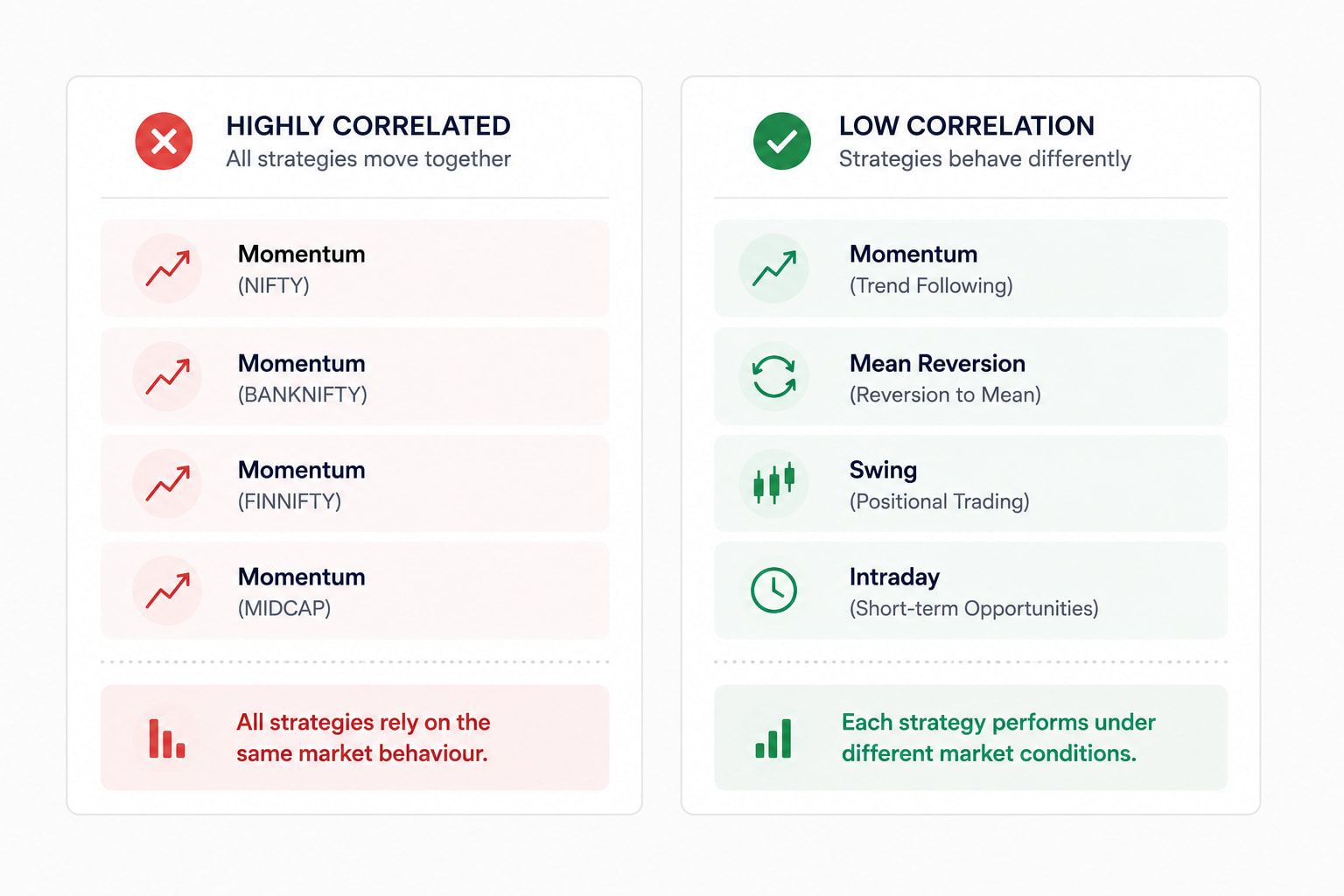
Now imagine you’re deploying three different algorithms:
-
Momentum Strategy on NIFTY
-
Momentum Strategy on BANKNIFTY
-
Momentum Strategy on FINNIFTY
At first glance, you have three different algos.
But in reality, they’re all dependent on the same market behaviour.
If momentum stops working, all three strategies could underperform at the same time.
Your portfolio isn’t truly diversified, it’s simply repeating the same idea.
Now compare that with a portfolio consisting of:
-
A Momentum Strategy
-
A Mean Reversion Strategy
-
A Swing Trading Strategy
-
A Market-Neutral Strategy
Each strategy looks for opportunities in different market conditions.
When one struggles, another may continue to perform well.
That’s the benefit of combining uncorrelated trading strategies.
Why Low Correlation Matters
A portfolio of uncorrelated strategies can help:
-
Reduce portfolio risk
-
Improve consistency over time
-
Lower overall drawdowns
-
Perform better across different market conditions
-
Avoid relying on a single trading style
Think of it as diversification, not across asset classes, but across sources of returns.
How We Think About Correlation at Stratzy
At Stratzy, we encourage traders to think beyond simply adding more algos.
Adding five similar strategies doesn’t necessarily reduce risk.
Instead, the objective is to build a portfolio where each strategy brings something different to the table.
For example, combining strategies that:
-
Follow trends
-
Capture market reversals
-
Trade different instruments
-
Operate across different timeframes
-
Perform well in different market regimes
helps create a portfolio that’s more resilient than one made up of highly correlated strategies.
The goal isn’t to find one “perfect” strategy.
It’s to combine strategies that don’t all succeed or fail - for the same reasons.
Final Thoughts
One of the biggest misconceptions in algorithmic trading is that more algos equal more diversification.
That’s not always true.
A portfolio of five highly correlated strategies can behave almost like a single strategy.
On the other hand, a thoughtfully constructed portfolio of uncorrelated trading strategies can deliver smoother performance, lower risk, and greater resilience over time.
Because in investing and in algo trading - true diversification isn’t about owning more. It’s about owning differently.
What are your thoughts on this?