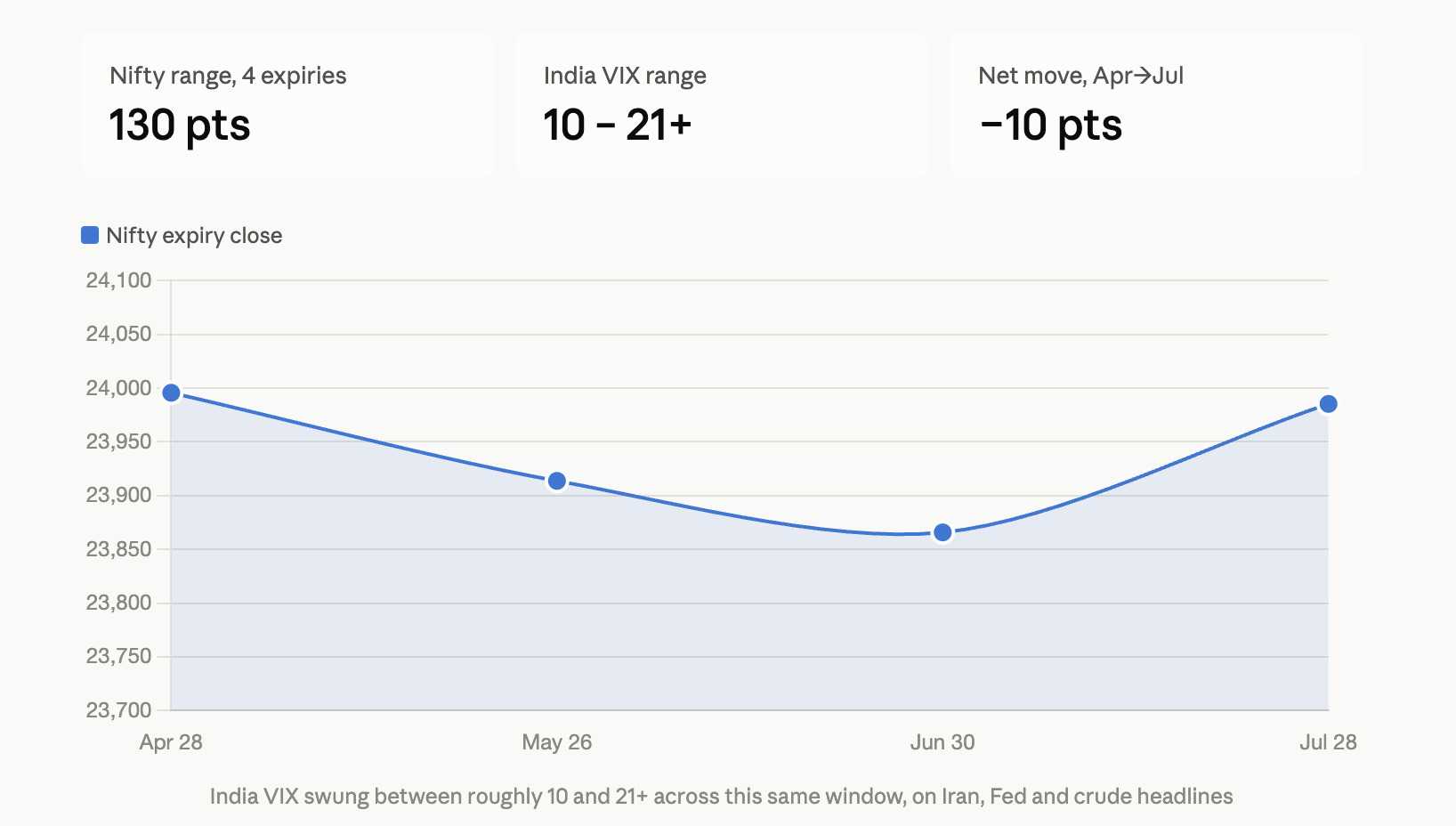
Range: 130 points. Across four monthly expiries. That’s practically a flat line on the index.
But India VIX tells a completely different story.
Over this same window, VIX ran from the low-10s all the way past 21 — spiking on the US-Iran escalation, collapsing back down on de-escalation, and repeating that cycle more than once. This is the regime shift most people miss when they only look at spot: the index can sit still while implied volatility whipsaws hard underneath it.
Why this matters for your algo, not just your view
We’ve talked before about the India VIX regime framework — below 13, 13 to 20, above 20 — and how each band calls for a different posture. This quarter, we lived through all three bands inside a single expiry cycle, while spot barely moved. That’s a genuinely tricky regime to navigate, and it split outcomes by strategy type:
Short vega / short gamma — this window was a gift. Range-bound spot plus elevated, oscillating premium meant theta did the heavy lifting. Credit spread books (the “33” side of our 33/66 framework) got paid to sit still.
Long gamma / long vol — a grind. You needed a real directional move to justify the cost of carry, and the index kept refusing to deliver one at the expiry level, even as VIX itself was anything but calm.
The takeaway
Flat spot doesn’t mean flat risk. If your algo is priced off realized volatility alone, this is exactly the kind of quarter that quietly reshapes your risk profile without your P&L curve looking dramatic either way.
If you’re running short-vega strategies right now, this has likely been a strong window for you. If you’re long options waiting for a breakout, worth reassessing whether the current VIX regime still supports that thesis, or whether a rotation makes sense.
Questions, comments, or any algo deep dive — drop it below, happy to dig in.