Elon Musk reposted this yesterday: a doctor sharing that frequent gamers performed on cognitive tests like non-gamers who were roughly 13.7 years younger. Musk’s reaction was two words. “Gaming ftw.”
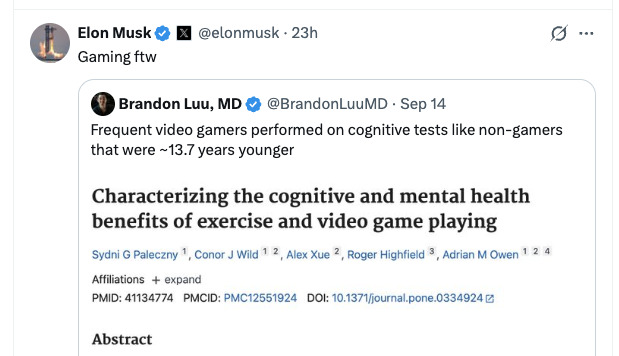
That stopped me for a second. We’ve spent years being told gaming is a waste of time, and here’s one of the most followed people on the planet amplifying the opposite, that an actively engaging hobby like gaming might be doing more for your brain than the passive scrolling most of us default to instead.
Naturally this sent me down the same path it always does. If gaming is genuinely this relevant as a behavioral and cognitive trend, what does that mean for how we should be looking at it as investors, especially in India.
Zoom out and the bigger picture makes this even harder to ignore. Gaming has quietly become one of the most used forms of entertainment globally, ahead of a lot of categories people still default to when they think about media and leisure spend. It’s not a niche hobby anymore, it’s daily behavior for a massive and growing base of people, and that kind of shift in how people spend their time is exactly the sort of thing that eventually shows up in where money flows too.
Gaming revenue globally is now bigger than the movie and music industries combined.
And that’s where it gets interesting fast. In the US, this theme is easy to access. There’s a Roundhill Video Games ETF, an Amplify Video Game Leaders ETF, a Global X Video Games and Esports ETF, a VanEck Video Gaming and eSports ETF, entire baskets built specifically around this one trend, ready to buy in a few taps.

India doesn’t have that. Nazara Technologies is really the only diversified listed name, spanning esports through Nodwin, casual gaming, and real money gaming exposure. Delta Corp is the other name people bring up, but that’s casino and card gaming, a different business entirely, and one that’s been under real regulatory pressure after the online gaming bill and the GST rulings this year. Two names, two very different businesses, and no clean single stock or ETF that lets an Indian investor actually own this theme the way a US investor can.
So the real question isn’t whether the trend is real, it clearly is. It’s how you actually play a theme like this in a market that doesn’t hand you a ready made ETF for it. That’s exactly the kind of gap a systematic, theme based approach through investing algos is built to close, structuring exposure to a real trend even when the market itself hasn’t built the shortcut for you yet.
We’ve been building something around exactly this kind of problem. Not ready to talk specifics yet, but if you’ve ever looked at a trend like this and felt like there was no clean way to actually invest in it, that’s the gap we’re working on closing.
New algos coming soon on Stratzy. More on this shortly.