Algorithmic trading in India still somewhere gets dismissed as something only hedge funds and HFTs do.
But honestly, I think we’re at an inflection point and most people are going to realize it only after it’s already happened.
Look at what’s changed.
Retail participation has exploded. Crores of new investors have entered the market - younger, more tech-comfortable, far more aware than the previous generation.
But the way most people still trade?
It hasn’t really evolved at the same pace.
It’s still largely manual.
Still emotional.
Still reactive.
And that creates a pretty big gap.
Because markets don’t reward effort. They reward correctness and speed. And humans, no matter how disciplined, are wired in ways that don’t always work well in volatile environments.
Algorithms don’t have that problem.
And yes, before someone brings up things like the 2010 Flash Crash - poorly designed systems can absolutely cause damage. That’s exactly why serious algo trading is built on research, testing, and iteration, not shortcuts.
What’s more interesting to me is this: India has quietly been building the foundation for all of this.
Better APIs.
Co-location.
Faster settlement cycles.
More progressive regulation.
And the market itself has evolved.
Volumes are significantly higher.
Options markets are deep and active.
There’s enough participation now that execution at scale is actually possible.
A few years ago, outside of something like Nifty or a few large caps, even a decent-sized order could move the price against you before it got filled. That’s not the case anymore.
So the limitation was never talent.
It was never technology.
It was just that the market wasn’t ready.
I think it is now and it’s only going to grow from here.
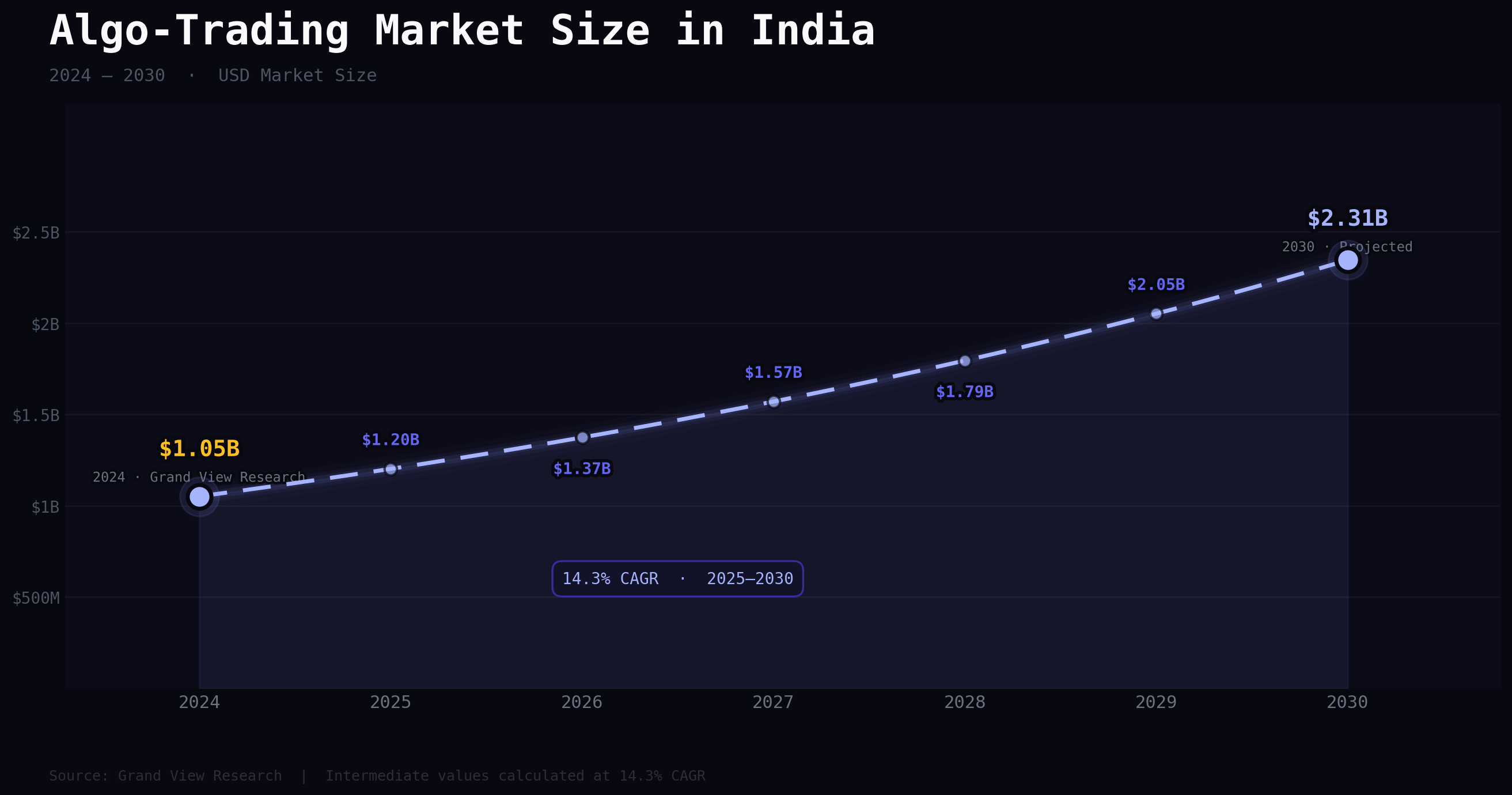
Manual trading isn’t going away. But over the next decade, I do think we’ll start seeing a clear separation between people who build systems, and people who continue reacting to the market.
Like we always say,
Happy Algo-trading!
~Nisshant Vernekar