The SIP Boom Is Real. But Is It the Best Way to Invest?
In August 2026, Indians put a record ₹32,297 crore into SIPs, taking total mutual fund AUM past ₹87 lakh crore. Equity mutual funds alone attracted ₹29,329 crore. These aren’t just numbers, they tell us something about Indian Investors. Despite volatility, the appetite to invest remains stronger than ever.
Money is flowing in. Confidence is holding up. But here’s where it gets interesting: Are investors simply investing, or are they investing in the right opportunities?
Indian investors are not sitting on the sidelines. They are putting money to work.
- SIP inflows hit a record ₹32,297 Cr in August
- Total mutual fund AUM crossed ₹87 lakh Cr; an all-time high
- Equity mutual fund inflows jumped 18.8% MoM to ₹29,329 Cr
- Small-cap funds attracted ₹7,973 Cr
- Mid-cap funds attracted ₹6,989 Cr
And this is happening despite a volatile market! Equity mutual funds have now recorded 66 consecutive months of net inflows.
What does this tell us? It tells us something bigger than just “Mutual funds are popular.”
People want to invest. They believe markets are correcting, valuations have become attractive and want to participate in the next phase of market growth. But there is one problem, Most investors know they should invest. But they don’t necessarily know how to invest.
There are thousands of different people, different sources and different stories around what and where to invest and it gets people confused on what should they choose.
Large-cap? Mid-cap? Small-cap?
Mutual funds? ETFs? Direct stocks?
SIP? Lump sum?
Buy and hold? Tactical allocation?
And most importantly: What kind of return are they actually getting for the risk they are taking?
Let’s look at the other side of the story. The enthusiasm around mutual funds is extremely high. But recent 1-year performance across major equity-fund categories has been far less spectacular.
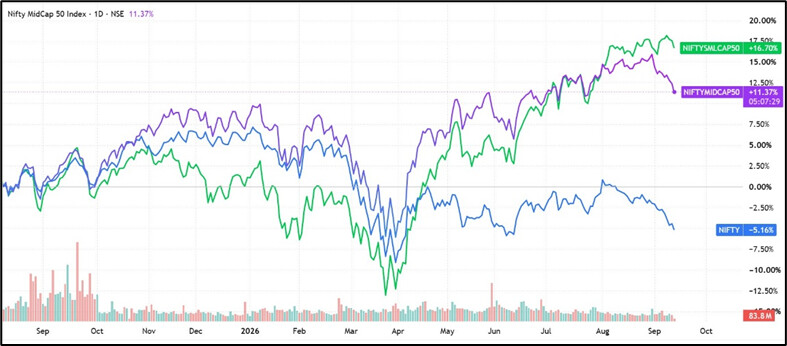
If you see Index level returns and compare Nifty 50, Nifty Midcap 50 and Nifty Smallcap 50, you can see how returns have varied significantly across segments, with some large-cap/index-oriented funds even showing negative 1-year returns, while several mid/small-cap and actively managed funds have done better.
So, the real question isn’t: Are mutual funds good or bad?.
The better question is: Is simply putting money into an investment enough or does the investment process matter?"
Because two investors can invest in the same market, at the same time, and still end up with very different outcomes. And this is where the investment landscape gets interesting. Mutual funds are one way to participate in markets. But they aren’t the only way.
Depending on your objective, risk appetite and time horizon, you can consider:
- Direct Equity: For investors willing to research and actively manage portfolios.
- ETFs & Index Funds: For low-cost, rules-based exposure to a market or theme.
- Debt & Bonds: For stability, income and portfolio diversification.
- Gold / Gold ETFs: For diversification beyond equities, gold ETFs also saw a sharp rise in August inflows.
- REITs / InvITs: For exposure to income-generating real assets.
- Algo / Systematic Investing: For investors who want investment decisions to be driven by predefined rules, data and systematic signals based on research and backtest, rather than emotions and market noise.
Maybe the next evolution isn’t just investing more. It’s investing smarter. The rise in SIPs tells us that Indians are increasingly comfortable with systematic investing. The next question is: Can we make the investment decision itself systematic?
Instead of asking: “Should I buy this stock?”, “Is the market going to go up?”, “Should I exit now?”
A systematic/algo-based approach can define rules beforehand: When to invest, What to invest in, How much to allocate, When to reduce exposure, When to exit.
No prediction. No emotion. Just a defined process executed consistently.
₹32,297 Cr of SIP money tells us Indians are ready to invest. The next question is whether they are using the right strategy to invest it. And that’s the question worth thinking about: If you’re already willing to invest every month, shouldn’t you also know where, when and how that money should be deployed?
Mutual funds and market-linked investments are subject to market risks. Past performance does not guarantee future returns. Algo/systematic strategies also carry market and model risks and are not guaranteed to outperform.