Last expiry-week
Period: 14th Jan – 20th Jan 2026
As a wealth manager at Stratzy, my job during volatile weeks isn’t to chase returns — it’s to protect capital first and let probability do its job.
This expiry week was a classic example of why risk structure matters more than strategy names.
 Market Snapshot
Nifty 50: 25,648 → 25,232 (Downward pressure)
Bank Nifty: 59,330 → 59,404 (Compressed & choppy)
India VIX: 11.20 → 12.75 (Rising fear, unstable premiums)
 Market Read
-
Direction kept changing
-
Premiums expanded unpredictably
-
Tough environment for non-hedged selling
-
Stock-specific & RR-based systems became noisy
 Credit Spread Performance (Defined Risk Zone)
Credit spreads continue to be the core building block for many Stratzy users — not because they win every week, but because losses stay controlled.
| Strategy | Net P&L |
|---|---|
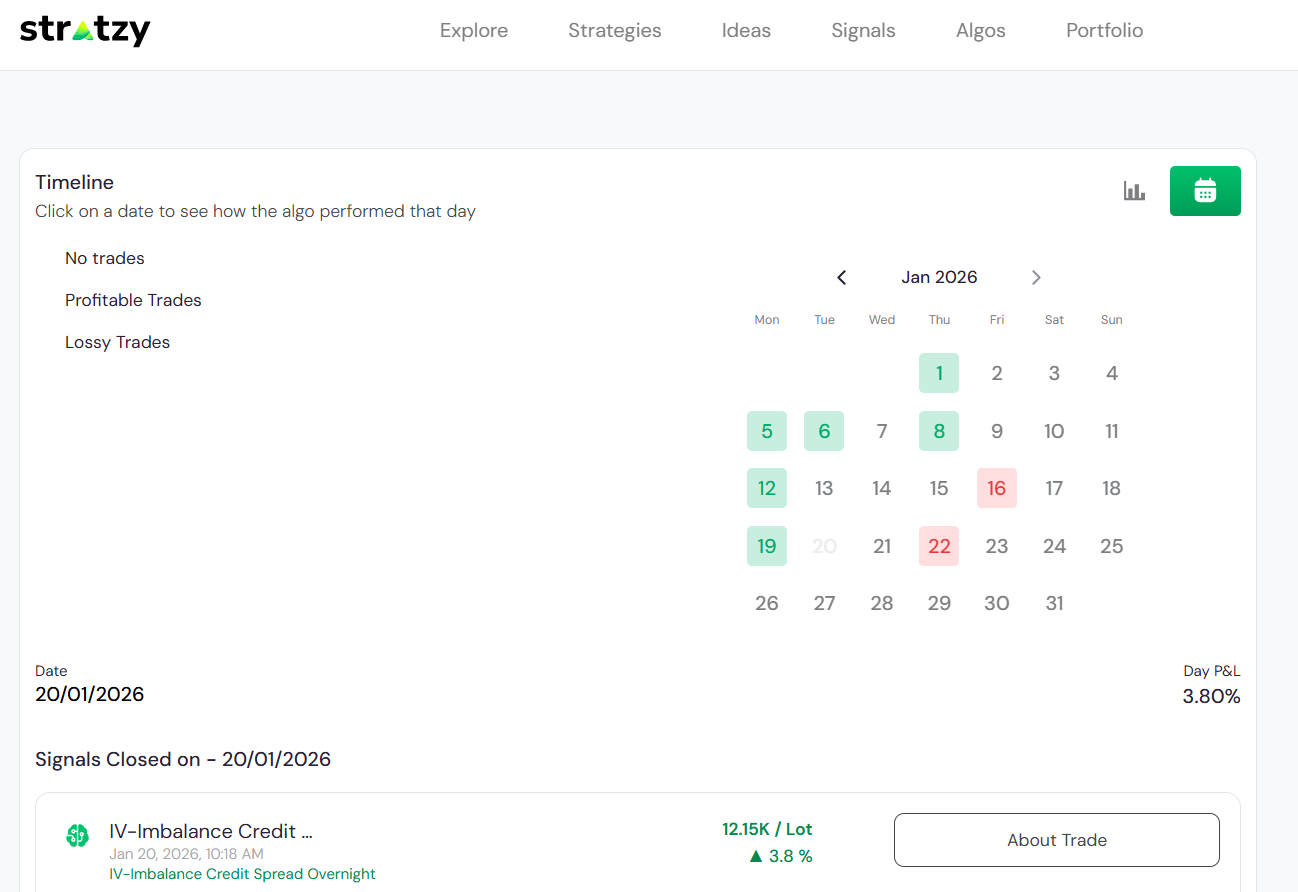
| IV-Imbalance Credit Spread Overnight | +10.57% |
| Theta-Flux Credit Spread Overnight | +12.34% |
| Delta-Leverage Credit Spread Overnight | +6.15% |
| Mathematician’s Credit Spread Overnight | +4.09% |
| Damper Credit Spread | +1.78% |
| Vega-Shift Credit Spread (Expiry) | +1.51% |
| Curvature Credit Spread Overnight | -1.18% |
| Convex Credit Spread Overnight | -4.13% |
| Chain-Sync Credit Spread Overnight | -4.08% |
| Hamilton’s Credit Spread | -4.69% |
| Super Entropy Credits | -4.05% |
| Theta-Harvest Credit Spread (Expiry) | -9.14% |
| Drifting Credit Spread Overnight | -11.55% |
| V-Score Credit Spread Overnight | -14.42% |
| Zen Credit Spread Overnight | -20.13% |
| Gamma-Fluxer Credit Spread Overnight | -18.88% |
Even with mixed results, drawdowns were capped.
This is exactly why credit spreads are treated as portfolio tools, not lottery tickets.
 Short Strangle Performance (Range Needed, Range Missing)
| Strategy | Net P&L |
|---|---|
| Holonomy’s Short Strangle | +0.41% |
| Intraday Short Strangle | +0.49% |
| Expiry Short Strangle | -2.70% |
| Premium-Zone Strangle | -3.03% |
| Flux Strangle | -1.30% |
| Compressed Strangle | -0.61% |
| Carry Forward Strangle | -1.09% |
| Theta-Zone Strangle | -1.86% |
Without a stable range, theta collection struggled.
Neutral strategies need calm markets — not confused ones.
 Short Straddles & Index Strategies
| Strategy | Net P&L |
|---|---|
| Single Lattice Straddle | +1.78% |
| Single Rangetrap Straddle | +0.71% |
| Lattice Short Straddles | -0.06% |
| Quiet Short Straddle | -3.58% |
| Single Tightgrip Straddle | -5.57% |
| Stratzy’s Index Strategies | -1.48% |
Selective setups worked — over-exposure didn’t.
 Aggressive & RR-Based Option Systems
| Strategy | Net P&L |
|---|---|
| Fixed RR 1:3 (30% SL) | +52.51% |
| Burst GRID (30% SL) | +20.97% |
| Index Scalper | +4.51% |
| SkewHunter | -8.63% |
| Index Sniper | -1.96% |
| SkewHunter TSL | -0.37% |
| Vacuum GRID (35% SL) | -41.90% |
| Burst RR 1:2 (25% SL) | -1.28% |
High returns exist, but so do deep drawdowns.
These systems demand strict allocation discipline.
 Expiry Week Highlights
-
Rising VIX punished open-risk selling
-
Credit spreads absorbed volatility better
-
RR & GRID strategies showed extreme swings
-
Diversified portfolios handled stress better
-
Risk control > return chasing
 Where Alpha Portfolio Fits
This is exactly why Stratzy Alpha Portfolio exists.
Instead of betting on one strategy:
-
Capital is spread across investing + trading
-
ETF investments are pledged
-
Trading happens using cash + collateral
-
Exposure is balanced between credit spreads, index systems, and selective options
 Goal: Systematic Alpha with controlled risk, not emotional trading.
If you were managing client capital, which bucket would you lean on during volatile expiry weeks?
 Credit Spreads
Neutral Theta Strategies
Aggressive RR / GRID Systems