NSE Indices announced 11 new sectoral indices yesterday, taking the total sectoral index count under the Nifty umbrella to 34. On the surface this looks like a routine market infrastructure update. For systematic traders, it’s more than that.
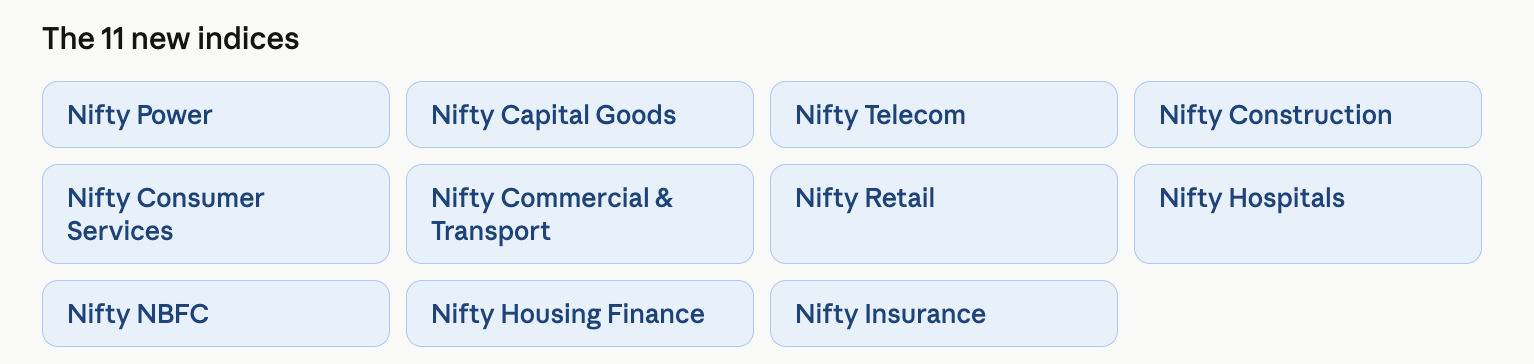
NSE Indices said the expanded suite is designed to offer deeper representation across both established and emerging sectors of the economy.
What this means — short term
1. ETFs will follow
Every new index is a potential benchmark for a new ETF. History shows that AMCs typically launch ETFs within 6–18 months of a new index being established. Nifty Bank ETF, Nifty IT ETF, Nifty Pharma ETF — all followed their respective indices. Expect ETFs on Nifty Power, Nifty Hospitals, Nifty Insurance, and Nifty NBFC to be announced in the coming months.
2. More granular sector rotation becomes possible
Until now, “financials” was one broad bucket — Banking, NBFC, Insurance, and Housing Finance all lumped together. With separate indices for each, systematic strategies can now rotate between these sub-sectors individually. The RRG we discussed in the Alpha Industries post can now be applied at a much more granular level — NBFC vs Banking vs Insurance vs Housing Finance, not just “financials.”
3. New benchmarks for existing strategies
Algo strategies that use sector indices as signals — for regime identification, mean reversion, or momentum — now have 11 more data series to work with. More indices mean richer signal sets, less correlated sources of alpha, and better diversification at the strategy level.
What this means — for Stratzy specifically
For those running Alpha Industries Automated — our sector rotation algo — this is directly relevant. As ETFs get launched on the new indices, the investable universe for sector rotation expands. Nifty Hospitals, Nifty Power, and Nifty Insurance in particular represent sectors with strong structural tailwinds in India’s current economic phase — healthcare capex, energy transition, and financial inclusion respectively.
More sectors with their own dedicated indices means more potential entries on the RRG — more sectors to rotate into when the signals align, and more diversification within the strategy itself. This is a positive development for sector rotation algos and we’ll be watching closely as ETFs get launched.
The bigger picture — India’s market infrastructure is maturing
Going from 23 to 34 sectoral indices in one announcement is a significant step. It signals that NSE sees enough depth and liquidity in these emerging sectors to warrant dedicated tracking — which in turn attracts more institutional flow, more passive money, and more derivatives products over time.
As we’ve said before — India’s algo and systematic trading ecosystem is still in its first chapter. This kind of market infrastructure development is what the second chapter looks like. More indices, more ETFs, more data, more instruments to build strategies on. Each of these is a building block.
The near-term watch list: Nifty Power, Nifty Hospitals, and Nifty Insurance ETFs. When AMCs announce these, they’ll be worth tracking for potential addition to sector rotation strategies. We’ll update the community when they go live.
Which of the 11 new indices are you most interested in from a rotation or investing perspective? Drop it below 
