Imagine you’re about to buy a new car. Would you purchase it without taking it for a test drive?
Probably not.
You’d want to know how it handles, how it performs in different conditions, and whether it actually lives up to its promises.
The same principle applies to trading strategies.
Before risking real money, you should first answer one important question:
“If this strategy had been used in the past, how would it have performed?”
That’s exactly what backtesting helps you do.
So, What is Backtesting?
Backtesting is the process of testing a trading strategy on historical market data to see how it would have performed if it had been followed in the past.
Think of it as replaying history.
Instead of guessing whether a strategy works, you let historical data answer the question.
For example, imagine you have a simple trading rule:
-
Buy when the 20-day moving average crosses above the 50-day moving average.
-
Sell when the opposite happens.
Rather than waiting months or years to see if this strategy works, you can apply these exact rules to the last 5 or 10 years of market data.
The results might tell you things like:
-
How many trades the strategy took
-
How often it was profitable
-
The average return per trade
-
The largest drawdown (the biggest decline from a peak)
-
How the strategy performed during bull, bear, and sideways markets
In a few minutes, you can learn what would otherwise take years of live trading to discover.
A Real-Life Example
Let’s say you believe that every time NIFTY falls more than 2% in a day, it tends to bounce back the next day.
That’s an interesting hypothesis.
But is it actually true?
Instead of relying on memory or a few examples, you can backtest it.
You check every instance over the last 10 years where NIFTY fell more than 2% in a single session.
Now you can answer questions like:
-
How often did the market recover the next day?
-
What was the average return?
-
Were there periods when this pattern stopped working?
-
Was the potential reward worth the risk?
Rather than making decisions based on assumptions, you’re making them based on data.
Why is Backtesting Important?
Backtesting helps you understand how a strategy has behaved under different market conditions.
It can help you:
-
Build confidence in your strategy before deploying capital.
-
Understand the risks - not just the returns.
-
Compare multiple strategies objectively.
-
Remove emotional bias from decision-making.
-
Identify weaknesses and improve your strategy before going live.
Most importantly, it replaces “I think this works” with “The data suggests this has worked under these conditions.”
But There’s a Catch…
One of the biggest mistakes traders make is assuming that a strategy with great historical performance is guaranteed to work in the future.
It isn’t.
Markets evolve.
Economic conditions change.
Volatility changes.
Regulations change.
A strategy that performed exceptionally well over the last five years may struggle in the next five.
That’s why traders often say:
Past performance is not a guarantee of future results.
What we do at Stratzy
At Stratzy, we don’t believe a strategy deserves to be deployed simply because it looks good on a chart.
Before any strategy reaches our users, it goes through an extensive research and validation process.
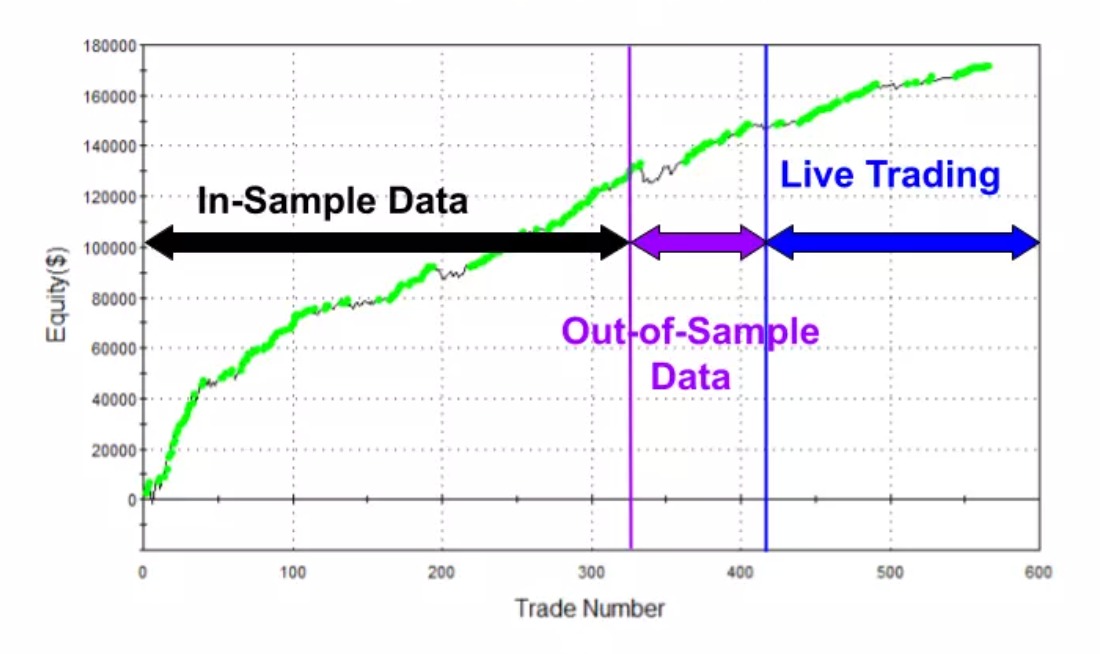
Our research team runs millions of simulations across years of historical market data, testing strategies through a wide range of market environments, not just the periods where they perform well.
This includes all types of market conditions.
The objective isn’t to build a strategy with the highest historical return.
It’s to build one that demonstrates consistency, robustness, and resilience across varying market conditions.
