If you have ever been to Goa, you must have seen the casinos on the Mandovi river. You might have even walked in, enjoyed the experience in those luxury interiors, poker tables and packed gaming floors. It looks like a business built to print money. But behind all of that, one of India’s biggest casino operators was fighting a battle that could have a massive impact on its entire business.

Much like the regulatory challenges faced by companies such as Vodafone Idea, this wasn’t just another business problem, it became a question of how the government would treat the economics of an entire industry.
The company at the center of this battle was Delta Corp, one of India’s largest gaming and hospitality players.
This is where O=Outlook in our MOST Framework becomes important. Outlook looks beyond a company’s current performance and asks: What could change over the next 3–5 years? Delta Corp is a good example. Its outlook was clouded by regulatory uncertainty and the GST demands. But as the legal situation evolved and the potential liability changed significantly, the future opportunity for the business started looking different. Sometimes, the biggest change in a company isn’t in its current numbers, but in what its future could look like.
If you don’t know about our MOST Framework, read here: MOST Framework breakdown
For nearly two decades, Delta Corp has built its business around gaming and hospitality, becoming one of the most prominent players in India’s organised casino industry. Its flagship “Deltin” brand operates offshore and land-based casinos in Goa, while the company also has hospitality assets and interests in online gaming and real estate. Today, Delta Corp is the only publicly listed company in India’s regulated casino gaming sector and holds three of the six offshore gaming licences in Goa.
But the real story begins in 2017, when India introduced GST. Casinos were brought under the new tax system, but over the years, a bigger question emerged: What exactly should the casino be paying GST on? This sounds simple, but it became a huge issue for the entire gaming industry. In 2023, the government decided to impose a 28% GST on casinos, online gaming and horse racing, with the tax linked to the amount involved in the gaming transaction.
To understand why this became such a big issue, imagine this- A player walks into a casino with ₹100 and buys chips. They place ₹100 on the table, win ₹80, and then use that ₹180 to play again. They win another ₹50 and continue playing. By the end of the night, the player may have made bets worth several hundred rupees, even though they originally brought only ₹100 into the casino. The casino, however, doesn’t earn all those as revenue. Its actual earnings come from the amount it ultimately retains after paying out the customers after their win. This is broadly what the industry refers to as Gross Gaming Revenue (GGR).

The industry therefore believed GST should be calculated on the casino’s actual gaming revenue rather than counting every bet made during the game. The government’s interpretation was different, and that difference turned into a massive tax dispute. Imagine getting taxed on those 100’s of rupees that were used for making bets, when your actual revenue was just fraction of it.
Then came the shock.
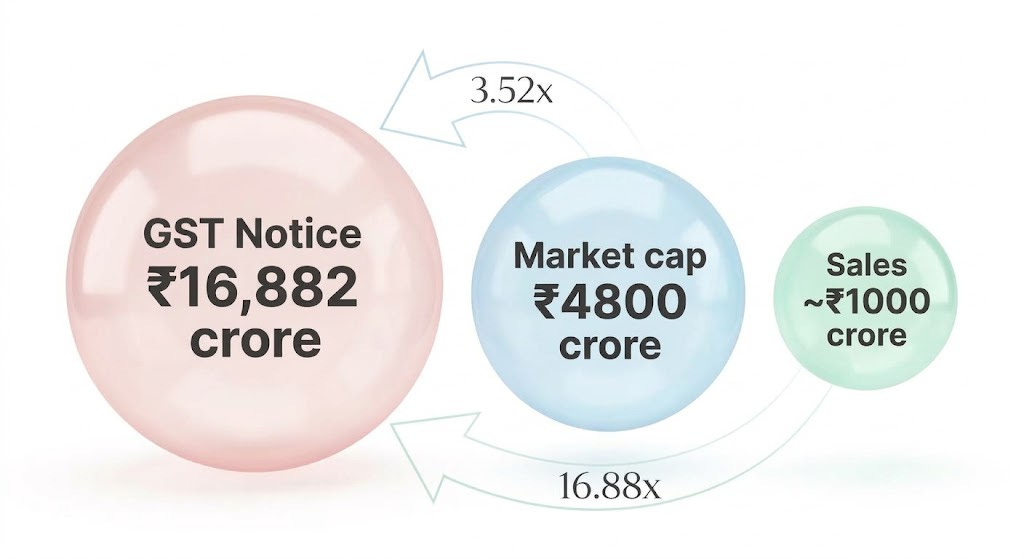
In September 2023, Delta Corp disclosed that it had received GST notices for the period from July 2017 to March 2022. The demand against Delta Corp itself was around ₹11,140 crore, while three of its subsidiaries faced another ₹5,682 crore. Together, that added up to a staggering ₹16,822 crore, apart from interest and penalties.
Now, let’s pause for a moment and understand just how big that number actually was. When the ₹16,822 crore notice arrived in September 2023, Delta Corp’s market capitalisation was only around ₹4,800 crore, meaning the tax demand was more than three times the entire value of the company. For context, Delta Corp’s consolidated revenue for 2022-23 was around ₹1,000 crores. In other words, the tax department was demanding an amount that was several times the company’s annual revenue and far larger than what investors believed the entire business was worth.
The market reacted almost immediately. When the news broke, Delta Corp’s stock fell around 20% in intraday trading, hitting a 52-week low of about ₹140, with roughly ₹700 crore wiped off its market value within just 30 minutes of trading.
But Delta Corp did not accept the demand. It challenged the GST notices in the Bombay High Court in 2023, arguing that the government was wrongly treating the gross value of bets as taxable revenue.
Delta Corp CFO Anil Malani argued that “Globally, what is the method of calculation for casinos is the gross gaming revenue.”
In October 2023, the Bombay High Court restrained the GST department from passing final orders on the notices while the case was being heard. The issue, however, was much bigger than Delta Corp. Similar cases involving online gaming, casinos and betting were being heard in different courts, creating the possibility of different courts reaching different conclusions. To bring uniformity, the Supreme Court began consolidating these cases, with several gaming-related matters transferred to it in 2024. The long-running dispute finally reached its biggest turning point on 27 May 2026, when the Supreme Court delivered its judgment on the broader GST framework covering online gaming, betting, gambling and casino transactions and the pending cases, including Delta Corp’s were then required to be dealt with according to the principles laid down by the Supreme Court.
This left Delta Corp with two very different possibilities.
In the Worst-case scenario: The government’s interpretation holds, making the massive GST demand payable and putting severe financial pressure on the company.
In the Best-case scenario: Delta’s interpretation wins, the tax base is revised, and the actual GST liability falls substantially. Everything now depended on one question: “How would the court decide the tax should be calculated?”
Now comes the latest twist which makes the story much more interesting. In late September 2026, GST authorities issued a ₹116.43 crore demand against Delta Corp and its subsidiaries for the 2017-22 period, plus a ₹37.11 crore penalty. Importantly, the latest calculation uses the value of chips sold rather than the gross value of every bet, in line with the Supreme Court’s directions, far below the original ₹16,822 crore headline.
Interestingly, the stock had already surged nearly 48% in ten sessions, from ₹53.79 on September 16th to ₹80.5 on September 30th, showing how quickly market expectations around the case had changed.
Takeaway
We often look at a stock chart and see a sharp move like this, but the bigger story behind that move is easy to miss. In Delta Corp’s case, what looks like a sudden stock-price surge is actually the result of years of regulatory changes, tax disputes and court proceedings playing out behind the scenes.
And that’s the bigger lesson: companies don’t operate in isolation. Regulation, taxation and policy can change the economics of an entire industry and ultimately change how investors value a business. A headline number can trigger panic, but the real story often lies underneath it: What changed? Why did it change? Who does it affect? And what does it mean for the business going forward? Understanding those questions is what separates reacting to a headline from actually understanding a company.
Join our Investing Algos Waitlist, for early access: WhatsApp Group Invite