Many traders focus only on returns. But professional investors know that returns alone don’t tell the full story.
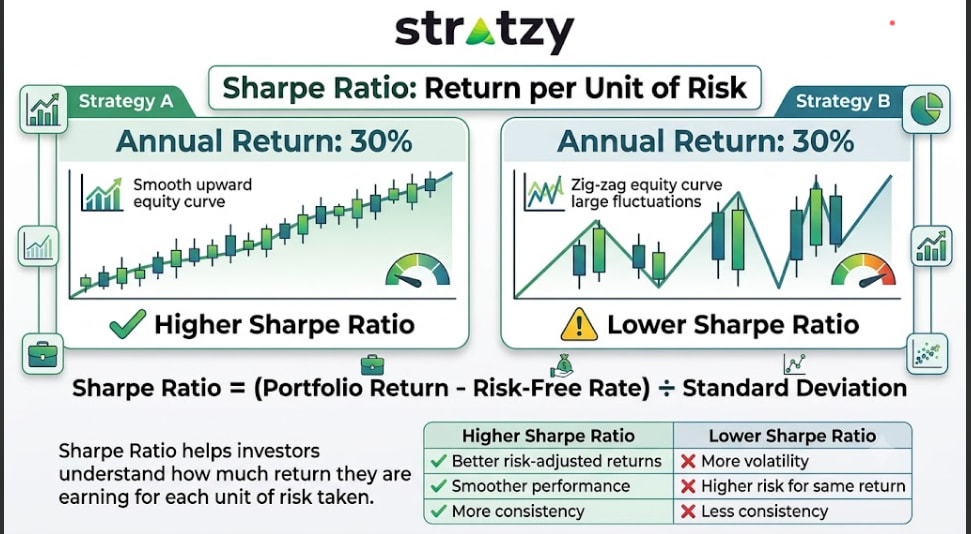
Imagine two strategies:
 Strategy A generates 30% annual returns with smooth performance.
 Strategy B also generates 30% annual returns but experiences large drawdowns and wild fluctuations.
Which one would you prefer?
This is where the Sharpe Ratio becomes important.
What is Sharpe Ratio?
Sharpe Ratio measures how much return a strategy generates for every unit of risk taken.
Higher Sharpe Ratio = Better Risk-Adjusted Performance
A strategy with a high Sharpe Ratio is delivering returns more efficiently and consistently, without taking excessive risk.
General Interpretation
- Below 1.0 → Risk-adjusted performance needs improvement
- 1.0 – 2.0 → Good
- 2.0 – 3.0 → Very Good
- Above 3.0 → Excellent
Why Should Algo Investors Care?
When comparing two strategies with similar returns, the one with the higher Sharpe Ratio often provides a smoother investment experience and better risk management.
This is why at Stratzy, we encourage users to look beyond absolute returns and evaluate metrics such as:
 Sharpe Ratio
 Maximum Drawdown
 CAGR
CAGR
 Risk-Reward Profile
A successful strategy isn’t just about making money—it’s about making money consistently while managing risk effectively.
What Sharpe Ratio do you generally consider acceptable before allocating capital to a strategy? Share your thoughts below.
