Think about two investors.
Both have ₹10 lakh to invest.
Both research the same companies.
Both understand the market.
Both make good investment decisions.
But there’s one difference.
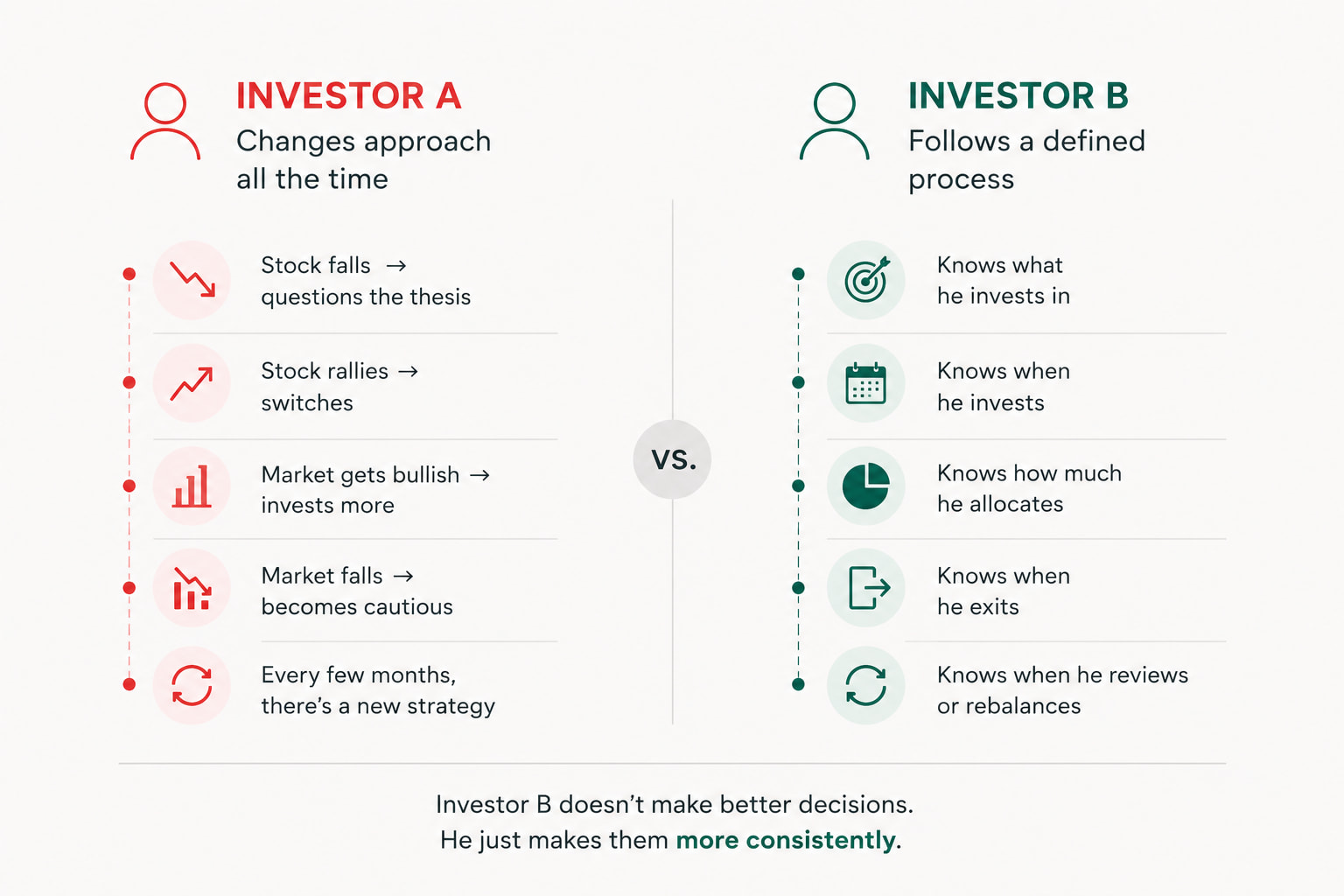
Investor A keeps changing his approach.
A stock falls → he questions the thesis.
Another stock rallies → he switches.
The market gets bullish → he invests more.
The market falls → he becomes cautious.
Every few months, there’s a new strategy.
Investor B follows a defined process.
He knows:
-
What he invests in
-
When he invests
-
How much he allocates
-
When he exits
-
When he reviews or rebalances
He doesn’t necessarily make better decisions.
He just makes them more consistently.
And that distinction matters.
Because investing isn’t about making one brilliant decision.
It’s about making hundreds of decisions over years without letting fear, excitement, market noise or hindsight constantly change the process.
That’s why perhaps the real advantage in investing isn’t:
“How good is your next decision?”
It’s:
“Can you consistently make good decisions when the market gives you every reason not to?”
Technology can help here.
Not by predicting what the market will do next.
But by turning an investment approach into a repeatable system: one that can follow predefined rules even when you don’t feel like following them yourself.
Be honest, are you a systematic investor too?