The single biggest reason algos underperform isn’t the algo. It’s deploying the right algo in the wrong regime.
What is a market regime?
A market regime is the personality of the market at a given point in time. Just like weather has seasons — summer, monsoon, winter — markets have regimes. You wouldn’t wear a raincoat in summer. Similarly, you wouldn’t run a strangle strategy in a high-volatility, trending market.
Every algo is designed to perform in specific conditions. Knowing the regime tells you which algos to turn on, which to pause, and how to size your portfolio.
The 3 market regimes
Regime 1 — Sideways / Calm
The market oscillates in a range without a clear directional move. Volatility is low, premiums are thin, and theta decay is your best friend. This is the sweet spot for non-directional strategies — straddles, strangles, iron condors — where you simply collect premium as time passes and the market goes nowhere.
Nifty was largely in this regime through most of 2023–24, bouncing in a broad range without conviction. If you were running strangles through that period, you know how well it worked.
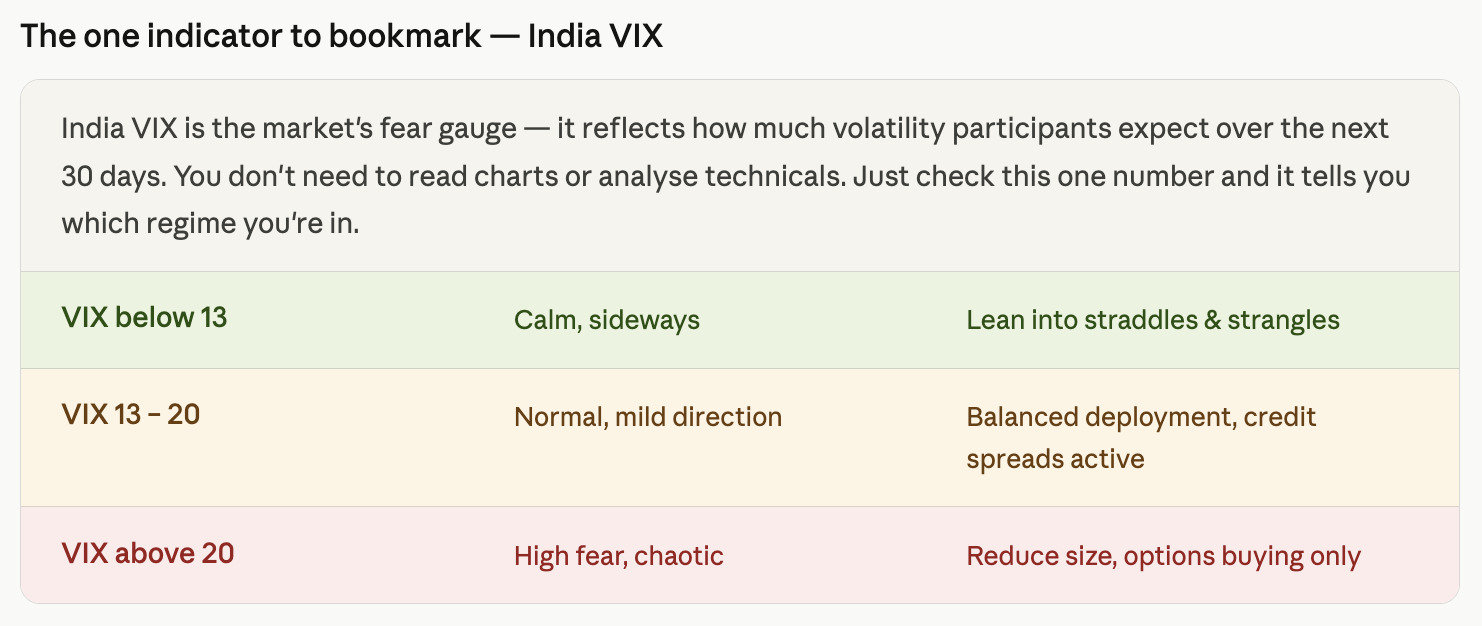
India VIX signal: Below 13 — market is calm, fear is low, premiums are soft
Regime 2 — Directional / Normal Volatility
The market has a lean — either gradually trending up or grinding down — but without extreme fear or panic. Volatility is in the normal range. This is where a balanced deployment works best: a core of non-directional strategies, complemented by directional algos like credit spreads that let the market’s lean work in your favour automatically.
India VIX signal: 13–20 — normal range, balanced deployment, most algos can run
Regime 3 — High Volatility / Chaotic
Sharp, sudden moves driven by macro events — RBI decisions, budget day, global shocks, geopolitical events. Options premiums spike, spreads widen, and most selling strategies get hurt. This is a regime to significantly reduce exposure on options selling algos and let options buying strategies — which benefit from the move itself — do the work.
Think March 2020, the 2024 election results day, or any surprise RBI rate move. These moments are rare but they can wipe out months of premium collection in a single session if you’re unprotected.
India VIX signal: Above 20 — caution, reduce options selling, protect the portfolio
The 2-minute Sunday regime check
Before every week begins, do just this:
1. Go to NSE website → check India VIX closing value from Friday
2. Map it to one of the three buckets above — below 13, 13–20, or above 20
3. Adjust your deployed algos accordingly — pause what doesn’t fit, keep what does
Regimes don’t flip overnight — they typically persist for weeks to months. A weekly check is more than enough.
The goal isn’t to predict what the market will do next. It’s to make sure your algos are suited to the environment they’re running in. One number — India VIX — is all you need to make that call.
What’s your read on the current regime? Drop the VIX level you’re seeing and which algos you have running — would love to see how the community is positioned. 